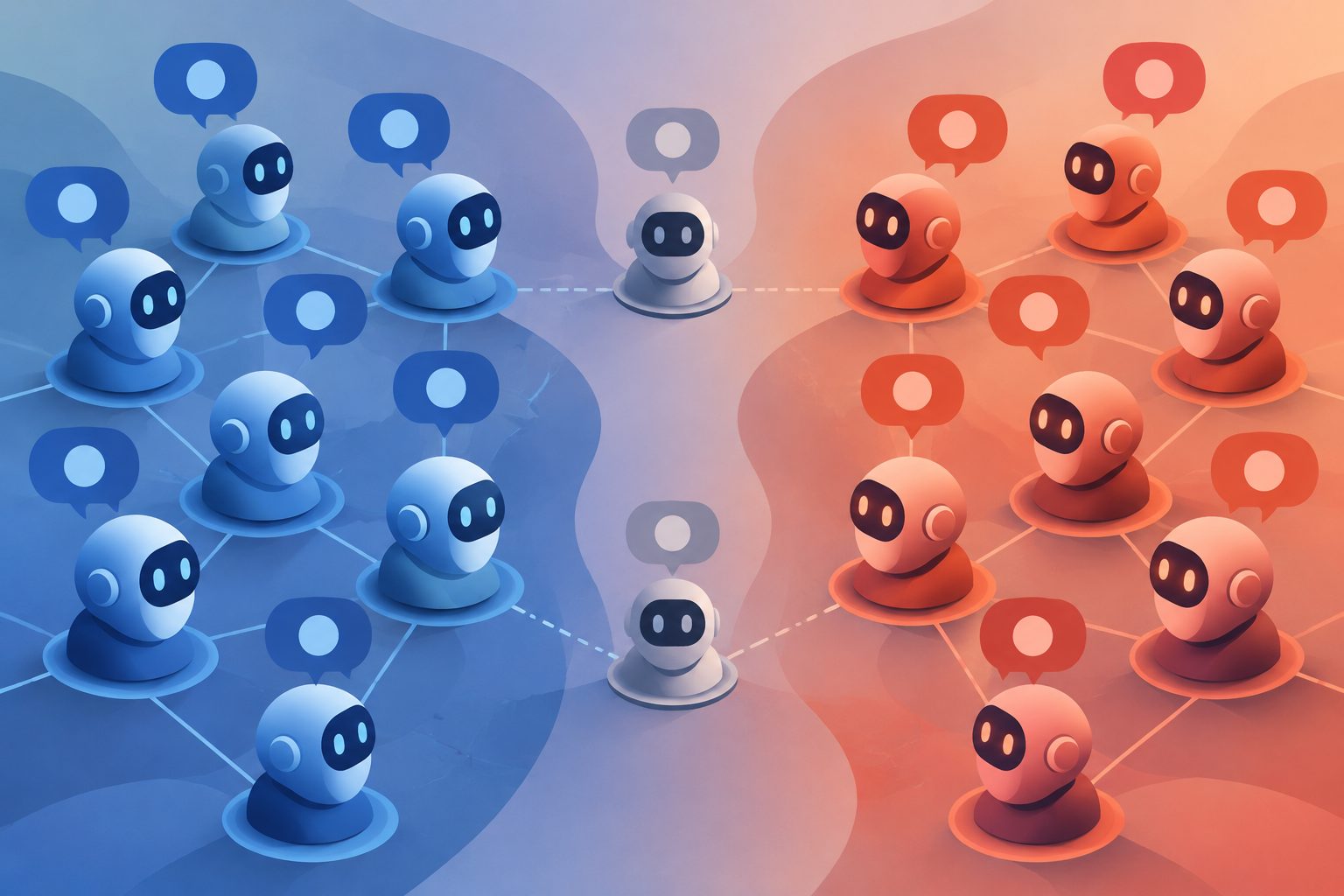
Across thousands of language-model agents, patterns of friendship and disagreement emerged as they discussed political issues.
Researchers simulated networks of thousands of language-model agents using several different underlying systems. The agents held conversations, updated their opinions and formed social connections, with collective views becoming polarized over time. Their networks showed homophily, meaning agents tended to cluster with others more like themselves.
The researchers then used these simulated networks to examine possible ways to influence opinion dynamics. They tested interventions including encouraging more diverse interactions and reducing confirmation bias, a tendency to favor information that supports existing views.
How the opinions divided
The agents developed polarized opinions through repeated, language-model-guided interactions. They also spontaneously formed social networks with features associated with human networks, including homophilic clustering, in which similar agents tend to group together. Across the language-model systems examined—including GPT-3.5, GPT-4o, ChatGLM, Llama-3 and DeepSeek-V3—the agents' collective opinion changes showed patterns consistent with mechanisms discussed in studies of human behavior and models of opinion dynamics. The simulated networks were also used to examine network- and individual-level interventions, such as promoting more varied interactions and reducing confirmation bias.
// Source
Nature Communications · 2026 · DOI: 10.1038/s41467-026-78228-y
Authors: Zhihong Lu, Gao Chen, Fengli Xu, Fernando Pereira dos Santos, Yongping Li, James A. Evans