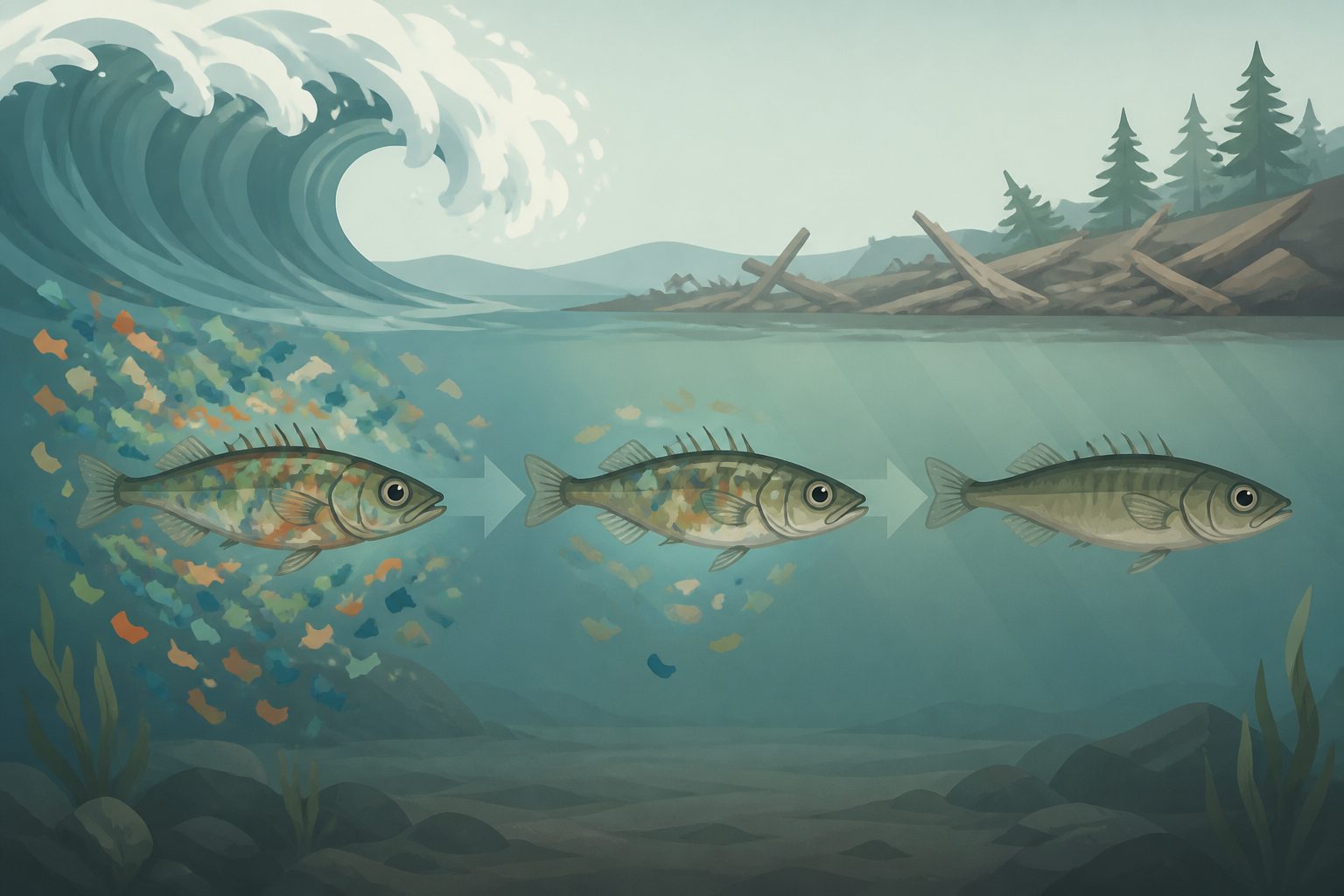
A nine-year study found that DNA from a marine stickleback was removed from most of a newly formed hybrid population within a few generations.
On 11 March 2011, a tsunami struck Japan’s Tohoku region, creating new stickleback habitats and bringing freshwater Gasterosteus aculeatus into hybridization with the marine Gasterosteus nipponicus. Researchers followed the resulting population genetically for nine years.
Within the first few generations, G. nipponicus alleles—alternative forms of genes—were removed from major regions involved in keeping the species apart. Marine alleles were later purged across most of the genome, although they remained at several locations.
// Source
Nature Ecology & Evolution · 2026 · DOI: 10.1038/s41559-026-03184-1
Authors: Takuya K. Hosoki, Seiichi Mori, Kotaro Kagawa, Shotaro Nishida, Manabu Kume, Atsushi J. Nagano, Hiyu Kanbe, Ryo Kakioka, Kenta Nakamoto, Yuki Iino, Masafumi Kodama, Satoki Oba, Taekyoung Seong, Naoki Kabeya, Asano Ishikawa, Kohta Yoshida, Yo Y. Yamasaki, Jun Kitano
Institutions: Kyoto University, The University of Tokyo, Nagoya University, Niigata University, The Graduate University for Advanced Studies, SOKENDAI, University of the Ryukyus, Kagoshima University, Keio University, Ishinomaki Senshu University, Kyoto University of Education, Tokyo University of Marine Science and Technology, National Institute of Technology, Tomakomai College, Gifu Kyoritsu University, National Institute of Genetics, National Fisheries University