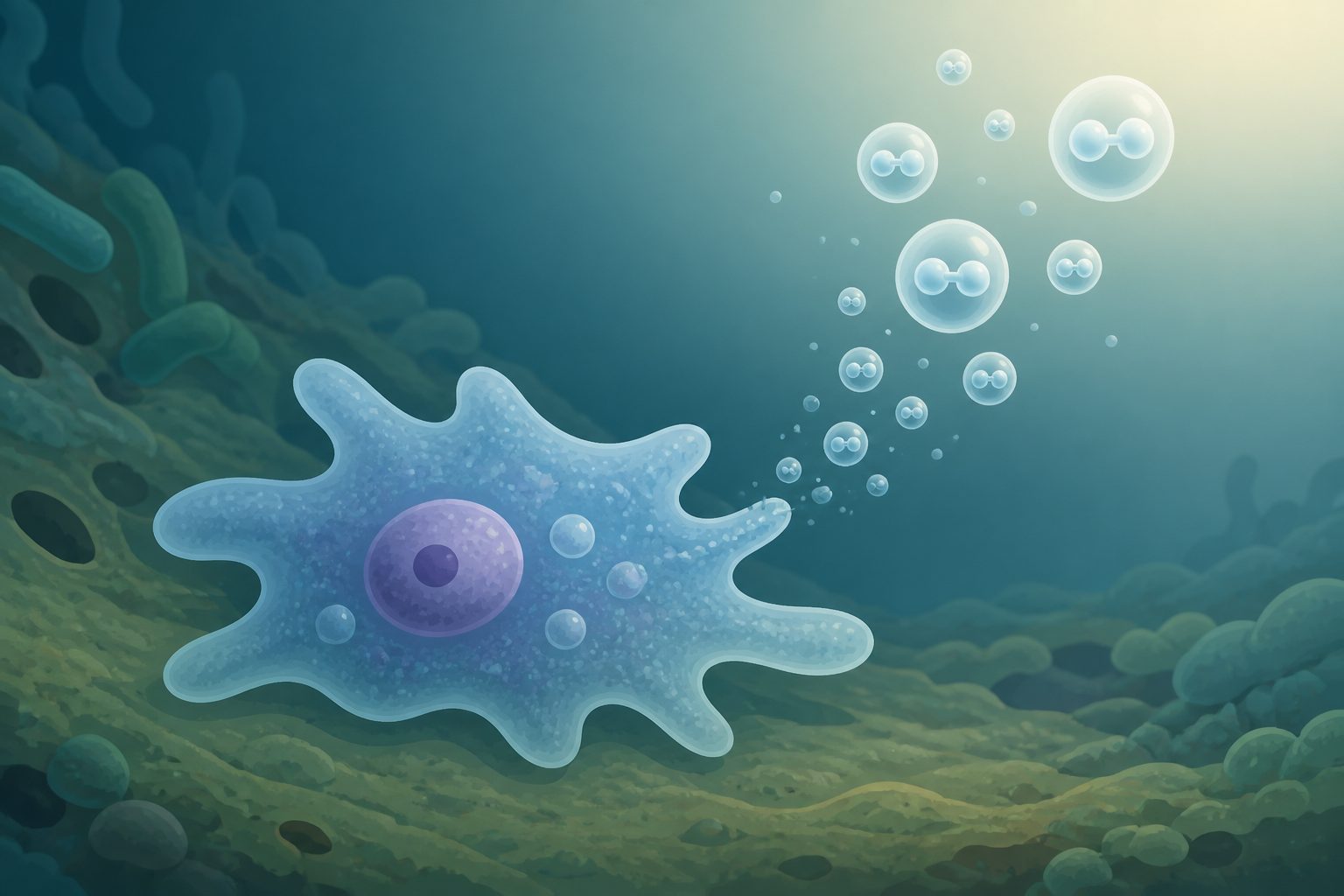
Acanthamoeba makes hydrogen gas when oxygen runs out
Researchers found that the organism uses a mitochondria-based enzyme to produce hydrogen in oxygen-free conditions.
Editorial illustration — not from the study.
Researchers created a detailed inventory of the proteins in Acanthamoeba castellanii mitochondria, identifying 1,122 proteins, including 381 without readily identifiable counterparts in human or yeast mitochondria. They also identified 20 large molecular assemblies within the organelle.
Proteomic and gene-activity measurements showed that oxygen changes the mitochondria’s energy-related machinery. When oxygen was absent, Acanthamoeba activated a pathway that converts pyruvate to hydrogen through an enzyme located in the mitochondria. Experiments confirmed that the organism produces hydrogen gas under these conditions.
How Acanthamoeba makes hydrogen
The researchers assembled a high-confidence inventory of the Acanthamoeba mitochondrial proteome, called AcMitoCarta, containing 1,122 proteins. Of these, 381 had no readily identifiable homologs—similar proteins—in human and yeast mitochondria. Analysis also highlighted 20 molecular assemblies.
Oxygen altered the organelle’s bioenergetic machinery, the systems used to manage energy production. Under anoxic conditions, Acanthamoeba induced an anaerobic pathway involving pyruvate:ferredoxin oxidoreductase and hydrogenase. Experiments showed that it produced hydrogen gas through a hydrogenase located in the mitochondria. The enzyme was oxygen-labile, meaning that oxygen interfered with its activity.
Why its mitochondria matter
Acanthamoeba has mitochondria that contain both oxygen-dependent and oxygen-free energy pathways, but the details of those systems had not been fully defined. This study provides a reference for investigating how the organelle switches between them and for comparing its unusual mitochondrial biology with that of humans and fungi.
Because Acanthamoeba can cause infectious blindness and has mitochondrial proteins that differ from those in humans and yeast, the inventory may also help researchers examine possible drug targets. The study does not itself identify a treatment or show that blocking the hydrogen-producing pathway would affect infection.
Evidence and open questions
The findings come from several complementary forms of laboratory evidence, including mitochondrial protein isolation, mass spectrometry, analysis of protein assemblies, measurements of gene activity and microscopy. The researchers also directly measured hydrogen production under oxygen-free conditions and linked it to a mitochondria-localized hydrogenase.
The abstract describes the protein inventory and oxygen-dependent metabolic changes, but it does not report how common these features are across Acanthamoeba species, how the pathway functions during human infection or whether any of the proteins can be safely targeted with drugs. It also does not provide the amount of hydrogen produced or the duration of the experiments.
A 20-year comparison in California’s Central Valley found that reduced tillage with cover crops produced more stable soil aggregates, greater water retention and different forms of carbon protection than standard tillage without cover crops. The conservation system also retained room for additional carbon storage, although the study measured potential rather than future gains.
Human forebrain organoids classified artificial tactile Braille signals after a sensor converted the touch data into electrical stimulation. Accuracy averaged 61% with one organoid and rose to 83% when responses from three organoids were combined.
A study in mice found that a peptide targeting the memory-related protein CPEB3 reduced the persistence of traumatic memories and anhedonia, a loss of pleasure. The findings are an early genetic preclinical test of a possible approach for PTSD, not evidence of a treatment in people.