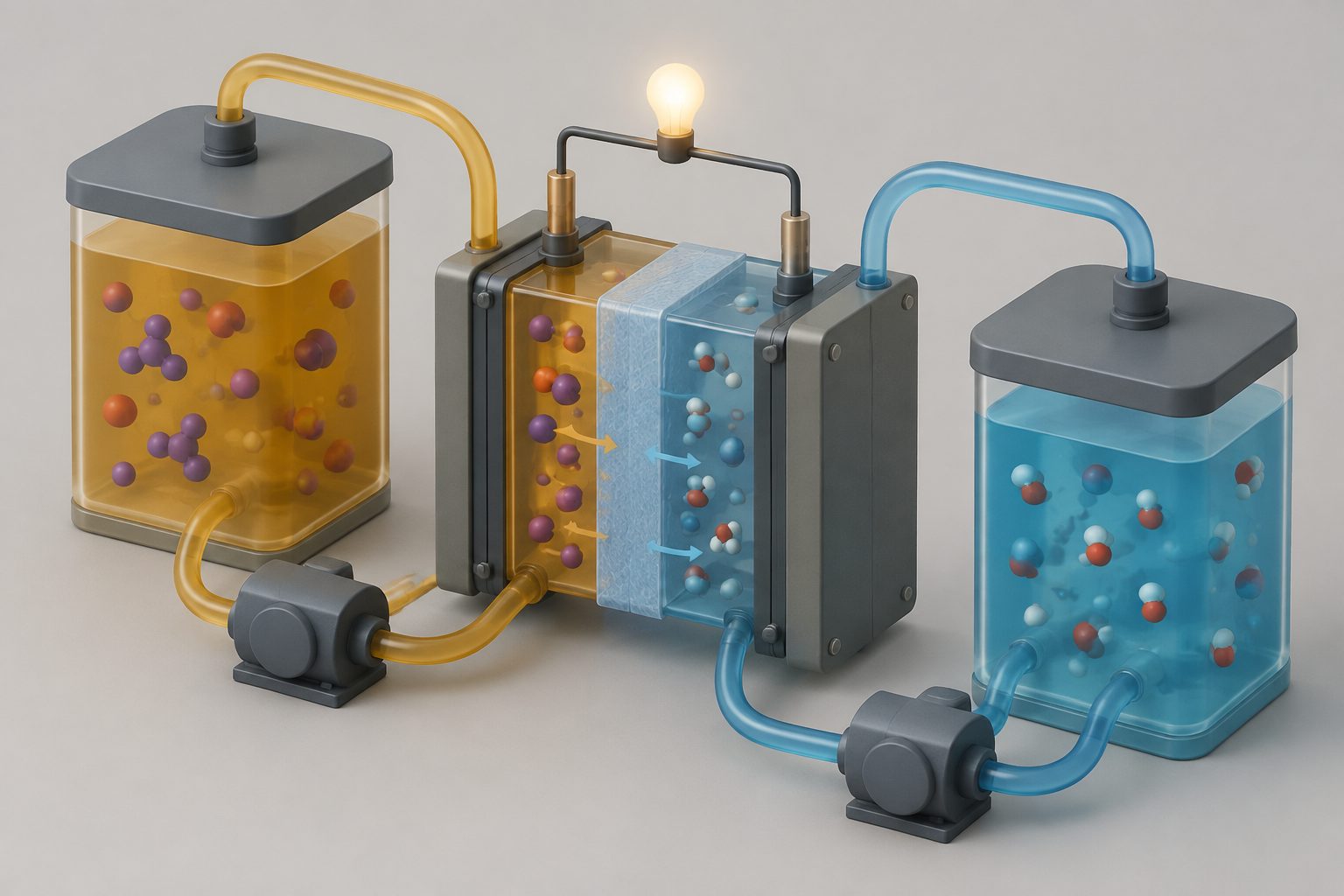
The electrolyte enabled reversible iodine chemistry in both zinc–iodine and aluminum–iodine batteries.
Four-electron iodine chemistry could increase the charge stored by aqueous metal–iodine batteries, but it has generally required highly concentrated, corrosive electrolytes containing halogens. The new electrolyte uses a combination of anions and nucleophilic molecules instead, creating an electrode interface with less water and more anions.
Experiments with four nucleophilic molecules, together with spectroscopy, simulations, theoretical calculations and electrochemical tests, linked this environment to the stabilization of reactive iodine ions. The framework enabled reversible iodine conversion in aqueous zinc–iodine and aluminum–iodine batteries.
How the electrolyte works
The researchers designed a halogen-free electrolyte framework combining kosmotropic anions, polar anions and nucleophilic molecules. Polar anions reduced the amount of water and increased anion concentration near the electrode, while kosmotropic anions altered interactions between water and the nucleophilic molecules. This made more of those molecules available to stabilize reactive iodine ions through halogen bonds.
In zinc–iodine batteries, the framework enabled reversible conversion across the iodide, neutral iodine and positively charged iodine states. The result was reproduced with four nucleophilic molecules: urea, acetamide, pyridine and nicotinamide. The electrolyte also worked in both aqueous zinc–iodine and aluminum–iodine batteries. Comparisons among anions showed that acetate produced a more water-deficient, anion-rich interface and supported more reversible iodine conversion than the other tested polar anions. Sulfate provided the strongest cycling stability among the tested kosmotropic anions, although nitrate behaved differently because of limited electrochemical stability in the tested voltage range.
Why the chemistry matters
The work offers an alternative to the highly concentrated, corrosive halogen-containing electrolytes previously used to stabilize reactive iodine ions in aqueous batteries. It also identifies an electrolyte-design strategy that controls both the electrode’s local water environment and the molecular interactions that stabilize iodine.
That strategy was demonstrated in two types of aqueous metal–iodine battery rather than only one chemistry. The findings may therefore help guide further development of aqueous batteries that use multi-electron iodine reactions, although the supplied results do not establish their practical performance at scale.
Evidence and open questions
The evidence combines electrochemical measurements with nuclear magnetic resonance and infrared spectroscopy, ultraviolet–visible measurements, micro-computed tomography, molecular-dynamics simulations and density-functional-theory calculations. Tests covered four nucleophilic molecules and both zinc–iodine and aluminum–iodine battery systems, while control experiments helped separate the roles of the two anion types.
The supplied abstract and excerpts do not report complete battery-performance metrics such as energy density, cycle counts, operating lifetimes or scale-up results. They establish reversible four-electron iodine conversion and its proposed chemical mechanism, but do not by themselves show how the electrolyte would perform in large or long-duration energy-storage systems.
// Source
Nature · 2026 · DOI: 10.1038/s41586-026-11282-0
Authors: Haobo Dong, Yuhang Dai, Jingyu Wang, Jie Chen, Jiyang Liu, Jianrui Feng, Yunpeng Zhong, Yunpeng Zhong, Wei Zhang, Hang Yang, Zhe Cui, Guanjie He
Institutions: University of Oxford, University College London