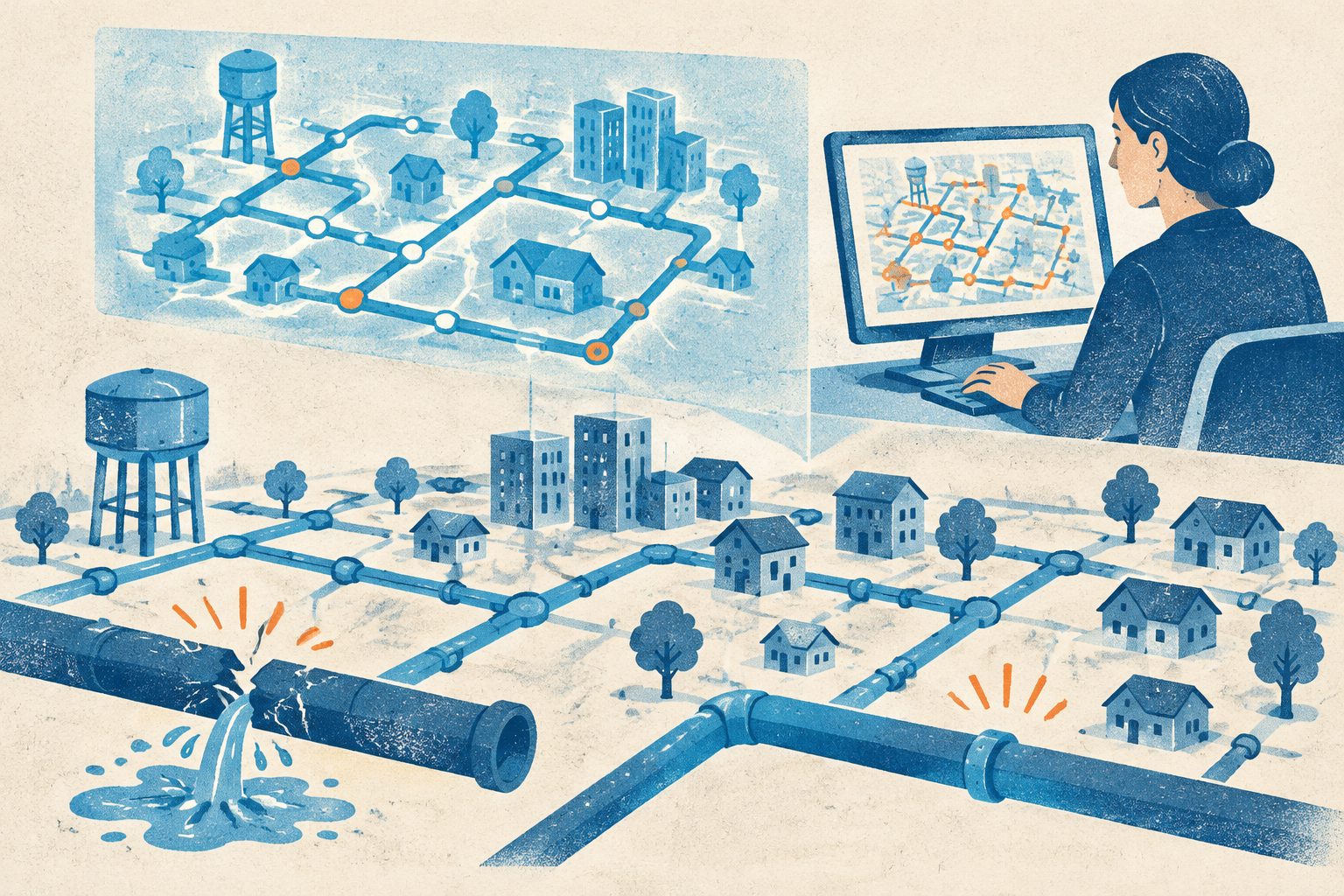
An integrated system used live network data to identify likely leaks and adjust valves and pumps around them.
The researchers built a digital twin that updates water pressure, flows, pipe roughness and demand estimates using data from multiple sensors. Its leak-detection component identified suspicious locations, while a control system adjusted valves and pump speeds to reduce pressure where leaks were more likely, subject to service and network-safety limits.
Across the tested networks, the system’s pooled leak-identification score was 0.916, compared with 0.836 for the strongest baseline. Average detection time fell to about four hours. On an independent set of BattLeDIM 2019 scenarios, the identification score was 0.818, while its ability to place a leak among the five most likely locations was lower than in the in-house tests.
What the system found
The integrated system identified leaks more accurately than the strongest comparison system in the study: its pooled F1 score was 0.916 versus 0.836, and its Top-5 hit rate was 0.816 versus 0.573. The F1 score ranged from 0.903 on C-Town to 0.932 on Net3, and mean detection time was about four hours.
When detection and pressure control were linked on C-Town, simulated leakage reduction increased from 24.6% with uniform pressure reduction to 37.5%. Service requirements were met 99.4% of the time. On the independently held-out BattLeDIM 2019 scenarios, the F1 score was 0.818, while the Top-5 hit rate was 0.604. Tests removing components of the system indicated that updating the model’s internal state from sensor data was especially important.
Why connected control matters
Leak detection and pressure control are often handled with separate models, so information about a suspected leak may not directly guide pressure adjustments. This system was designed to connect those tasks, reducing pressure most where leaks were more likely while keeping service within the stated limits.
The results suggest that pressure management could reduce water loss while a leak is being confirmed or repaired. The study does not present pressure control as a replacement for repairing damaged pipes, and its regulation results were demonstrated on one network and one confirmed leak scenario.
Evidence and limits
The findings come from experiments on public benchmark network models, using leak scenarios generated by the researchers, rather than from a deployment in a municipal water system. The independent BattLeDIM test produced a lower Top-5 hit rate, indicating limited transfer from the study’s training scenarios. The pressure-regulation comparison was conducted on C-Town only, and the authors note that the system’s performance beyond a few thousand network nodes, under rapidly changing water flows, and with the cost of dense sensor coverage remains unresolved.