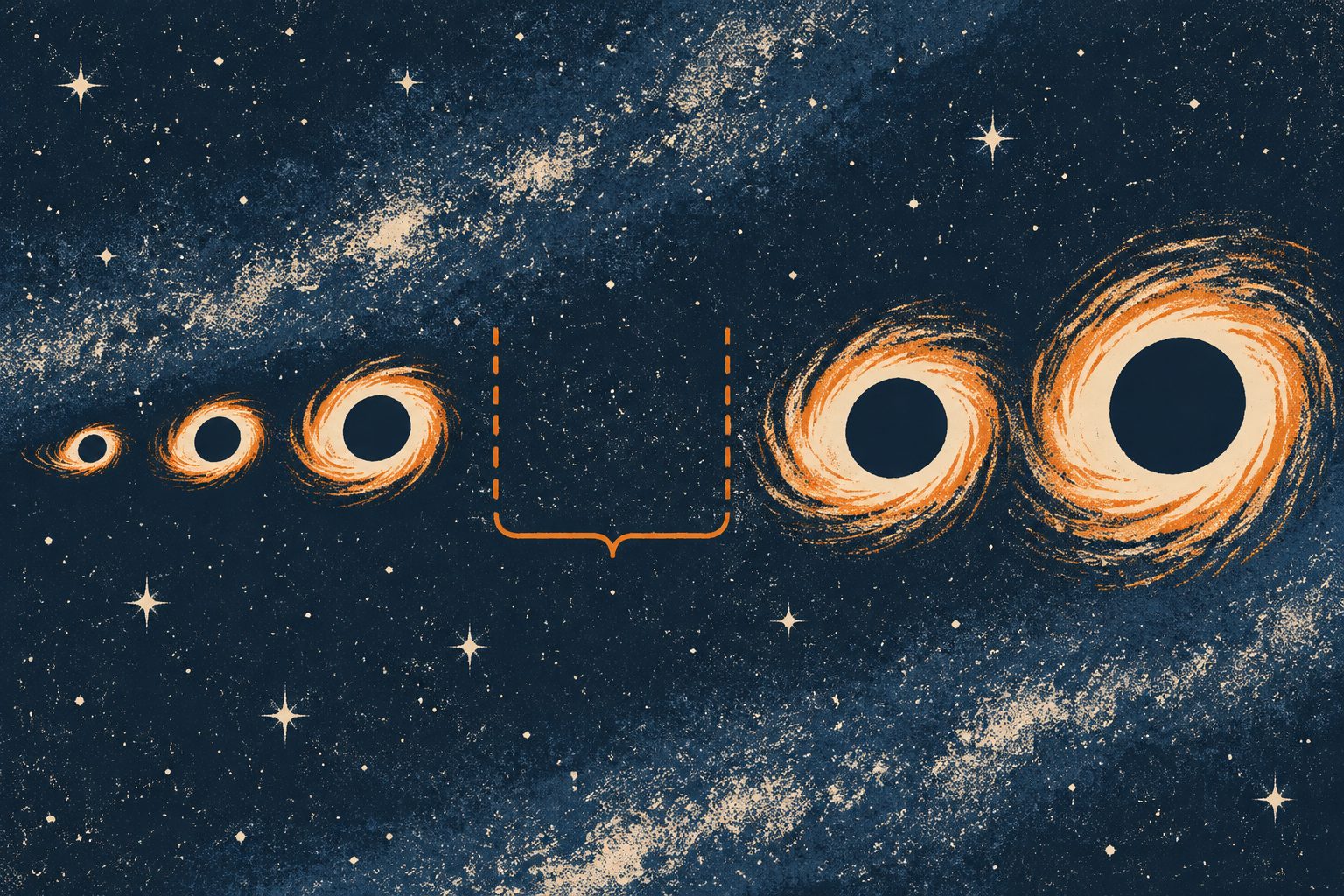
A new analysis finds that the lower-mass gap may contain a small number of black holes rather than none at all.
Researchers updated a Bayesian analysis of the mass distribution of black holes in the Milky Way. The study examined 28 low-mass X-ray binaries, six high-mass X-ray binaries, seven detached binaries and one isolated black hole, all included in the new CatNoir catalog.
The researchers compared five mathematical descriptions of the observed masses. A power-law model best described the combined sample, while a Gaussian model was preferred for the low-mass X-ray-binary sample. The predicted lower end of the distribution allowed for a sparsely populated lower-mass gap.
What the mass survey found
For the combined sample, the power-law model provided the best fit. For the low-mass X-ray-binary sample, the Gaussian model was preferred, followed closely by the two-Gaussian and lognormal models. Using the preferred models, the researchers estimated the lower end of the black-hole mass distribution: the 1% quantile was above 4.06 solar masses for the combined sample and above 2.56 solar masses for the low-mass X-ray-binary sample, with 90% credible intervals. The low-mass X-ray-binary result allows a sparsely populated lower-mass gap rather than requiring it to be completely empty.
// Source
The Astrophysical Journal Supplement Series · 2026 · DOI: 10.3847/1538-4365/aea6ab
Authors: L. S. Rocha, N. Pires, L. M. de, B.B. Martins, L. G. Barão, G. R. C. Sampaio, D. V. Rodrigues, R. M. G. Takahashi, M. G. B. de Avellar, J. E. Horvath, A. Bernardo
Institutions: Universidade de São Paulo, Heidelberg University, Instituto Nacional de Pesquisas Espaciais