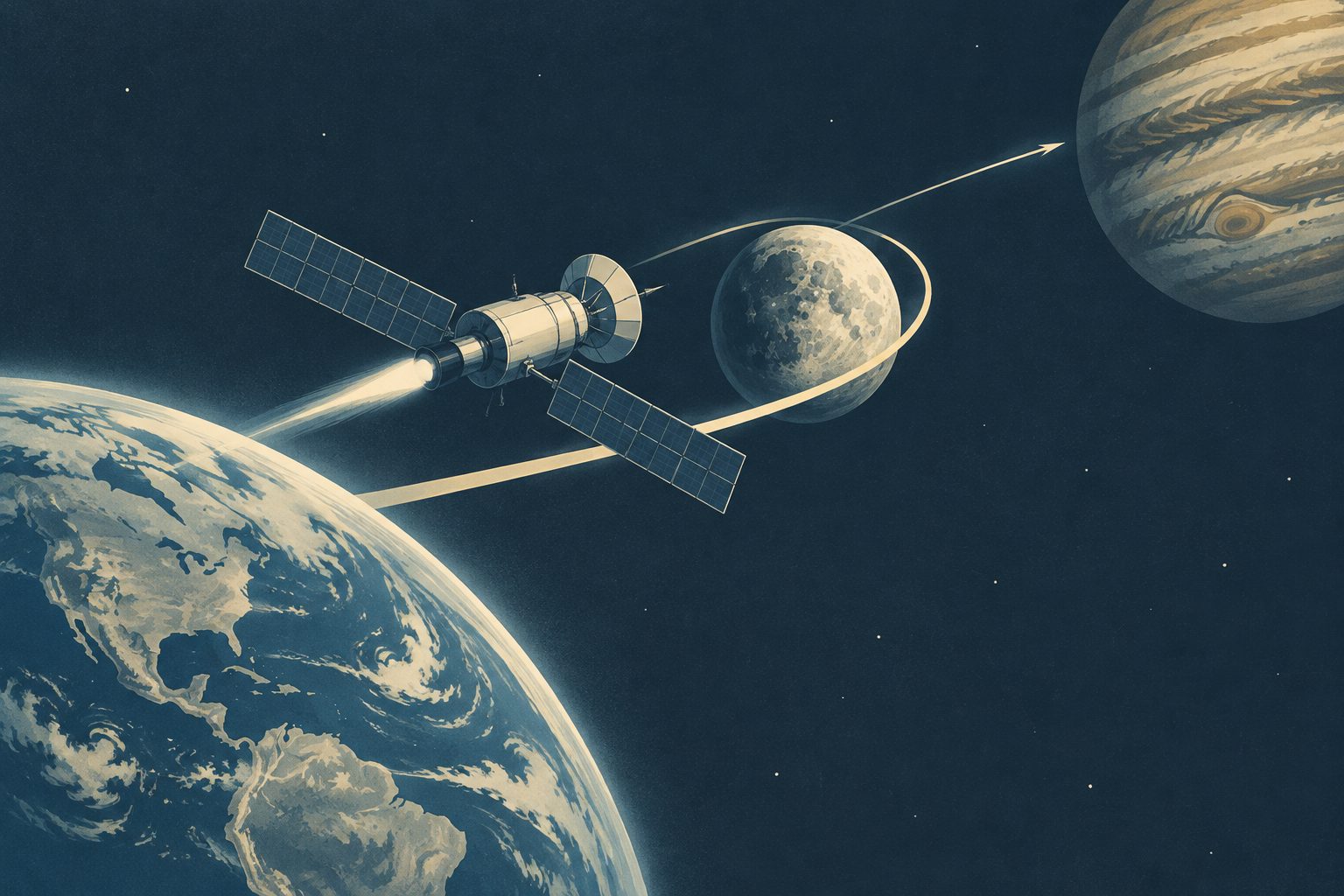
The two-flyby manoeuvre helped redirect ESA’s JUICE spacecraft while limiting the propellant it needed.
The paper reviews how teams designed, navigated and operated JUICE’s lunar–Earth gravity assist. In the manoeuvre, the spacecraft passed the Moon first and Earth second, using the bodies’ gravity to reshape its path rather than relying mainly on onboard propulsion.
The operation required precise navigation, coordinated planning and special procedures for communication and onboard commands. JUICE’s manoeuvre performance was highly accurate, and only two of eight reserved manoeuvre opportunities were needed. The spacecraft remained stable despite temporary sensor blinding, a communication blackout lasting more than eight hours and a small trajectory disturbance attributed to outgassing.
What happened during the flyby
JUICE completed the first lunar–Earth gravity assist on 19–20 August 2024. The Moon-first, Earth-second flyby produced a large gain in trajectory energy while minimizing propellant use and redirected the spacecraft toward Venus in August 2025 and, ultimately, Jupiter in 2031.
The spacecraft delivered exceptionally accurate manoeuvre performance. Because the manoeuvres were so accurate and forces caused by unloading the reaction wheels had little effect on orbit calculations, flight controllers used only two of the eight manoeuvre slots that had been allocated.
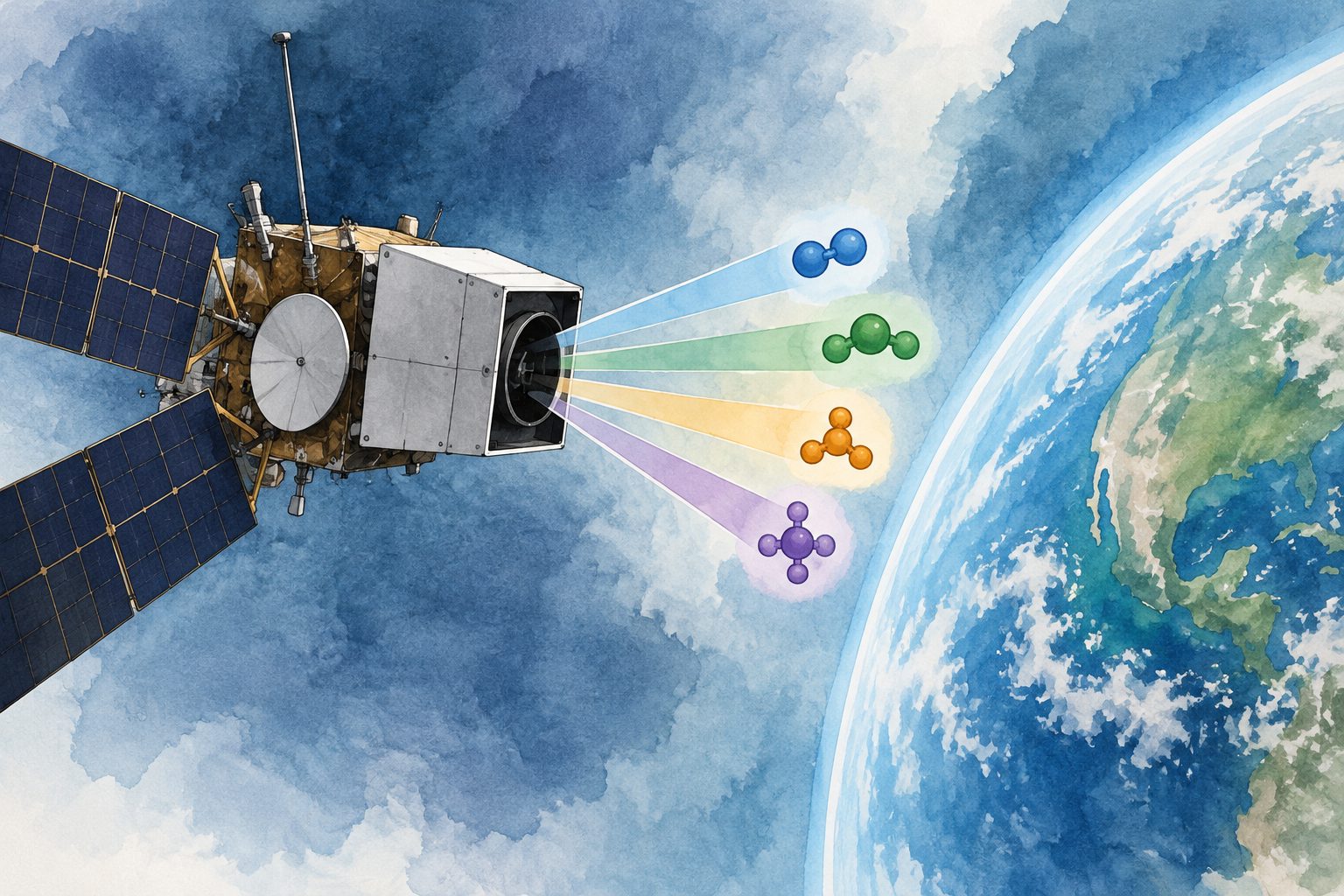
During the lunar flyby, teams detected a small torque and change in velocity beginning about five minutes after closest approach and lasting roughly 20 minutes. The paper attributes this to sunlight reflected from the Moon heating a normally shaded spacecraft surface, causing outgassing; instrument measurements supported that explanation. Earth temporarily blinded each star-tracker optical head for about two hours, but never all three at once, and the attitude-control system continued operating normally. JUICE also experienced a communication blackout of more than eight hours around the Earth flyby.
Evidence and caveats
This is an engineering account of one spacecraft operation, based on the mission’s trajectory design, navigation and flight-operations results. It is an executive summary of more detailed papers on those areas, rather than a controlled experiment or a statistical study. The evidence therefore demonstrates what happened during JUICE’s 2024 manoeuvre, but does not establish how often the same approach would work for other spacecraft or mission designs. The reported explanation for the small trajectory disturbance is supported by instrument measurements, while the paper describes the overall operation as validating the feasibility of this technique for complex interplanetary trajectories.
// Source
Annales Geophysicae · 2026 · DOI: 10.5194/angeo-44-1131-2026
Authors: Angela Dietz, Arnaud Boutonnet, Frank Budnik
Institutions: European Space Operations Centre