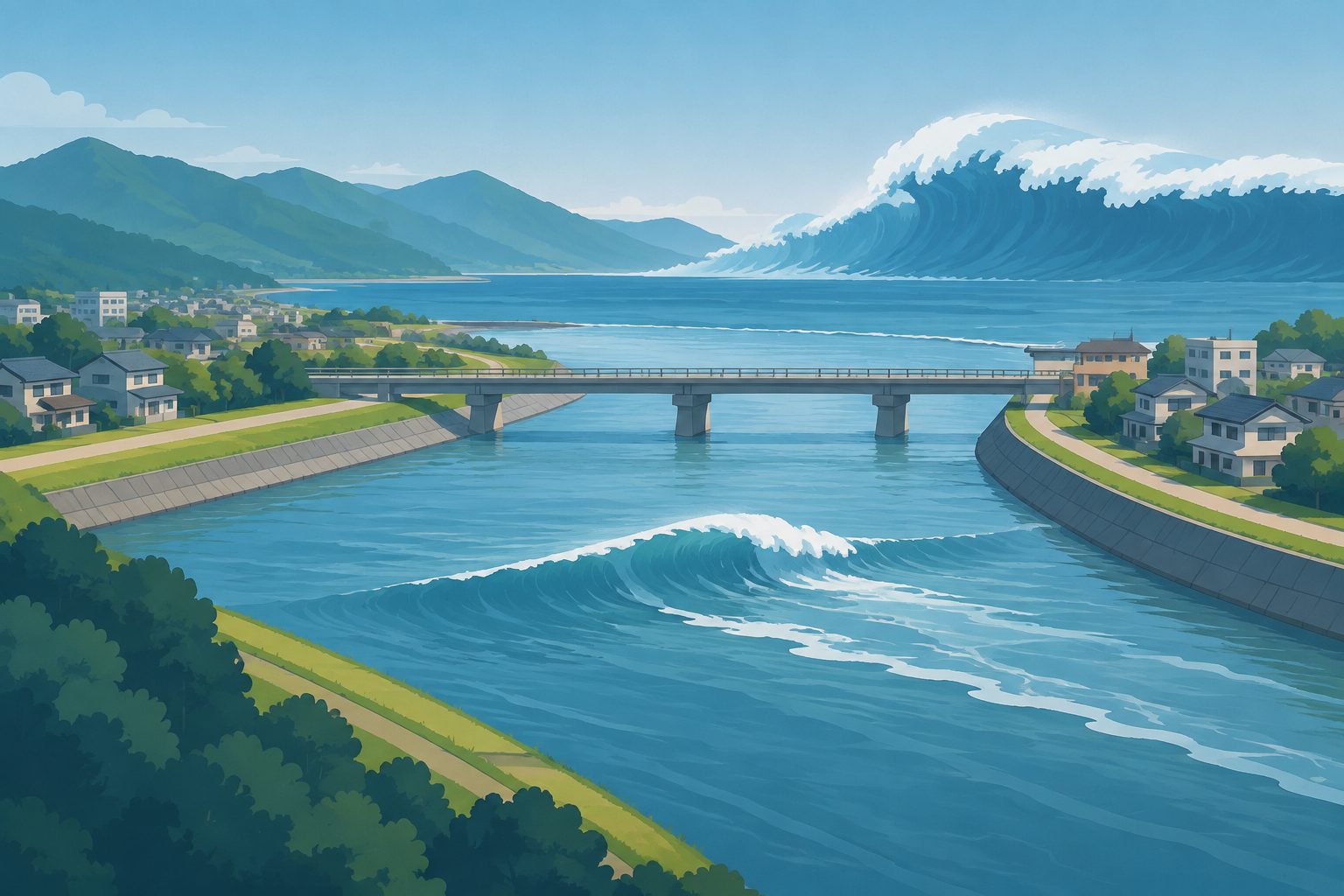
Simulations and local observations link the early, receding wave to earthquake-driven movement along a steep underwater slope.
Researchers modeled the tsunami using both the earthquake’s vertical movement and its horizontal movement across the seafloor. The model produced a short, receding wave near the southeastern Noto Peninsula that traveled toward Toyama Bay and reached the Kurobe River area before the main tsunami.
The predicted wave matched features recorded at the Tanaka and Ikuji stations and changes visible in footage from a camera at the river mouth. At Tanaka, the early wave was about 30 centimeters high and arrived roughly 10 minutes before the main tsunami.
The early wave
The study identified a small negative tsunami, meaning an initial fall or retreat of the water, near the mouth of the Kurobe River in Toyama Prefecture. Its observed and simulated amplitude was approximately 30 centimeters, and it reached the Tanaka station about 10 minutes before the main tsunami.
The simulations produced this early wave only when they included the earthquake’s horizontal movement across a steep underwater slope southeast of the Noto Peninsula. The researchers found that the wave affected a limited coastal area, including the Kurobe River mouth and the nearby Ikuji and Tanaka stations. Video from the river mouth showed changes in a sandbar that were consistent with the modeled wave, although the signal there was indistinct.
Why the timing matters
The findings show that one earthquake can produce tsunami waves with different sources and arrival times. In this case, horizontal movement along a steep underwater slope generated a small local wave that arrived before the larger tsunami produced mainly by the earthquake’s vertical movement.
Recognizing such local forerunners helps explain tsunami observations near complex coastlines. The researchers also concluded that this small wave was confined to the Kurobe River area and did not affect tsunami records used to estimate the earthquake’s source or a related landslide source.
Evidence and caveats
The researchers combined tsunami simulations with data from a tide gauge at Ikuji, a wave-direction instrument at Tanaka, and closed-circuit television footage from the Kurobe River mouth. The agreement was strongest for the early wave at Tanaka. At Ikuji, the modeled early pulse was similar to the observation but close to the noise level, and the one-minute sampling interval limited precise comparisons of its timing and size.
The model did not fully reproduce the arrival times and amplitudes of the main tsunami because it used an earthquake source model based on ground-movement measurements rather than one estimated from tsunami waveforms. At the river mouth, the height of the sandbar was unknown, so the modeled wave height was adjusted to match water-level fluctuations before the main wave. The study therefore provides evidence for the early wave and its proposed origin, while leaving some details of the observations and the main tsunami unresolved.