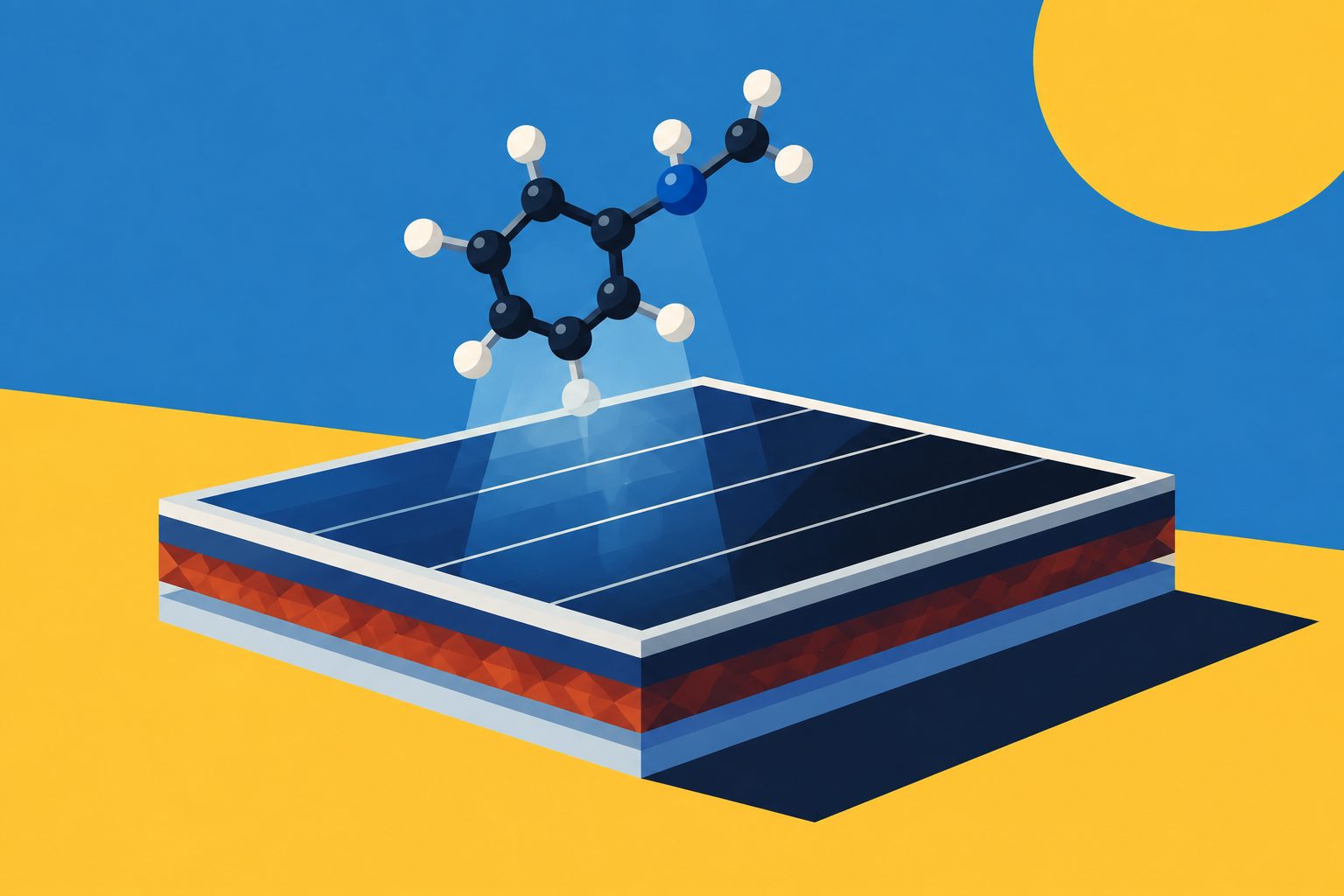
Adding O-phospho-D-serine to an early processing step produced a cell with 26.04% efficiency and improved resistance to operating losses.
The team added serine and phosphoserine molecules to the lead iodide precursor before the organic salt was introduced. Their measurements and calculations indicated that O-phospho-D-serine interacted strongly with lead iodide, changing film formation and helping the material convert into the light-absorbing alpha phase at temperatures as low as 110 °C.
The resulting films had larger grains, less leftover lead iodide, lower non-radiative recombination and greater quasi-Fermi level splitting, a measure related to the voltage a solar cell can produce. Devices using the D form of phosphoserine reached a champion efficiency of 26.04% and retained 90.2% of their starting efficiency after 1,000 hours under maximum-power tracking. The approach was also applied to inverted devices, although the excerpts do not give their performance figures.
What the additive changed
O-phospho-D-serine, added to the lead iodide precursor, bound more strongly to lead iodide than the corresponding serine and L-form compounds in the researchers’ calculations and measurements. The researchers report that this changed the crystallization pathway, reduced residual lead iodide and lowered the barrier for the transition to the photoactive alpha phase of FAPbI3, allowing almost complete conversion at temperatures as low as 110 °C.
Films made with the additive had larger grains and enhanced quasi-Fermi level splitting, while the researchers also report suppressed non-radiative recombination. Regular, or n-i-p, solar cells using the additive reached a champion power-conversion efficiency of 26.04% under simulated sunlight and retained 90.2% of their initial efficiency after 1,000 hours of maximum-power-point tracking. The same strategy was extended to inverted solar cells, but no efficiency or stability value for those devices is provided in the excerpts.
Why the processing step matters
Sequential processing of FAPbI3 solar cells can leave excess lead iodide and usually needs substantial heating to form the desired alpha phase. The reported additive addresses both processing problems in the material studied: it promotes the reaction between the lead iodide and organic salt and enables near-complete conversion at a lower temperature.
The efficiency and operating-stability results suggest that controlling the precursor before the film is formed can improve both device performance and durability. The successful extension to inverted cells indicates that the processing idea is not limited to one device design, although the excerpts do not establish how broadly it will work across manufacturing conditions.
Evidence and limits
The evidence combines density-functional-theory calculations with X-ray photoelectron spectroscopy, infrared and nuclear-magnetic-resonance measurements, microscopy and solar-cell testing. These results support stronger coordination between D-phosphoserine and lead iodide and connect that interaction with changes in film structure, phase conversion and device performance.
The reported 26.04% value is a champion result rather than an average across devices, and the excerpts do not provide device counts, large-area results, outdoor testing or stability beyond 1,000 hours. They also do not give performance figures for the inverted cells. The stability test was conducted under maximum-power-point tracking, so the reported result should not be treated as a measure of all environmental or operating conditions.