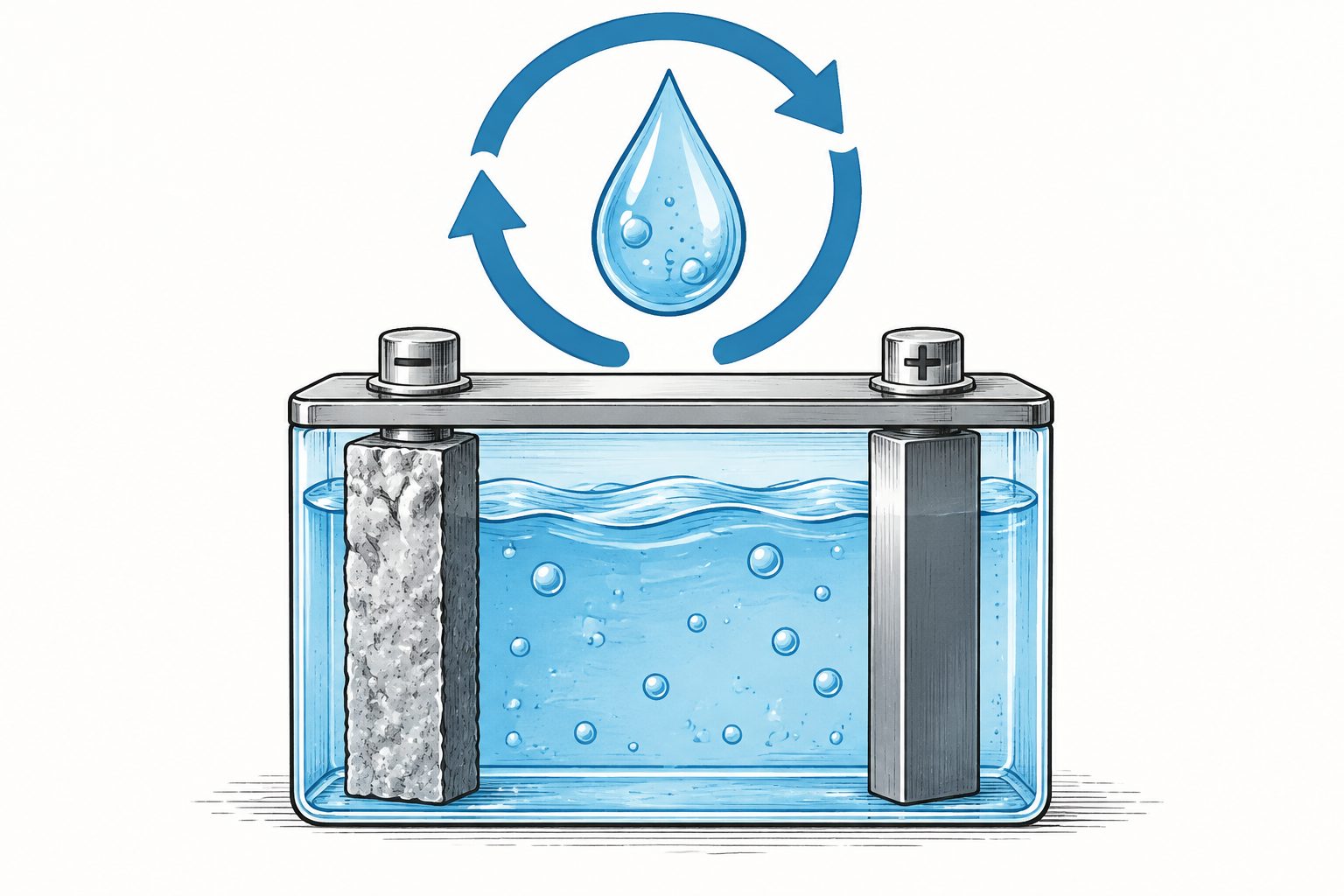
An additive that changes how water molecules interact supported efficient zinc cycling and a 1-Ah pouch cell.
The researchers used 4-hydroxy-2-butanone, or HBN, to alter the network of hydrogen bonds linking water molecules in the electrolyte. They say this broke the network into smaller, less cooperative water domains, reducing proton transfer and the hydrogen-producing side reaction at the zinc surface.
HBN also changed the environment around zinc ions without stopping their movement. In tests, the electrolyte supported compact zinc deposition and reversible zinc plating and stripping, reaching an average Coulombic efficiency of 99.12% over 800 cycles. A 1.0-Ah NVO||Zn pouch cell operated for 70 cycles with negligible capacity decay.
What the electrolyte changed
The study attributes aqueous zinc battery failure partly to a continuous hydrogen-bonded water network at the zinc–electrolyte interface. This network can promote hydrogen production, local increases in alkalinity, unwanted by-products and uneven zinc-ion transport.
Adding HBN disrupted that network and mildly changed the water surrounding zinc ions. The optimized electrolyte suppressed these water-related side reactions, reduced distortion of zinc-ion flow and enabled more compact zinc deposition. It delivered an average Coulombic efficiency of 99.12% over 800 cycles and supported a 1.0-Ah NVO||Zn pouch cell for 70 cycles with negligible capacity decay.
Why water control matters
Aqueous zinc batteries use water-based electrolytes, but reactions involving water can reduce the reversibility and operating life of the zinc electrode. The results indicate that controlling how water molecules interact can address several linked problems at the zinc surface rather than targeting only one side reaction.
The test of a 1.0-Ah pouch cell provides evidence beyond small laboratory electrode measurements, although the abstract does not establish whether the electrolyte is ready for commercial batteries or how it compares with all competing formulations.
Evidence and caveats
This is a journal article reporting electrolyte tests, zinc plating and stripping results, and operation of a 1.0-Ah NVO||Zn pouch cell. The abstract gives results for 800 cycles in the efficiency test and 70 cycles in the pouch-cell test, but it does not describe the full experimental conditions, the comparison electrolytes, the pouch-cell capacity retention in numerical terms, or performance at larger scale.
The proposed explanation relies on changes to water hydrogen bonding, zinc-ion solvation and interfacial reactions. The abstract does not provide enough methodological detail to assess the separate contribution of each effect or the electrolyte's safety, cost and long-term performance outside these tests.
// Source
Angewandte Chemie International Edition · 2026 · DOI: 10.1002/anie.7342949
Authors: Shaohua Han, Weijie Fan, Zekai Mei, Shen Gong, Yangyang Liu, Jiang Zhou
Institutions: Central South University, Xi'an Jiaotong University