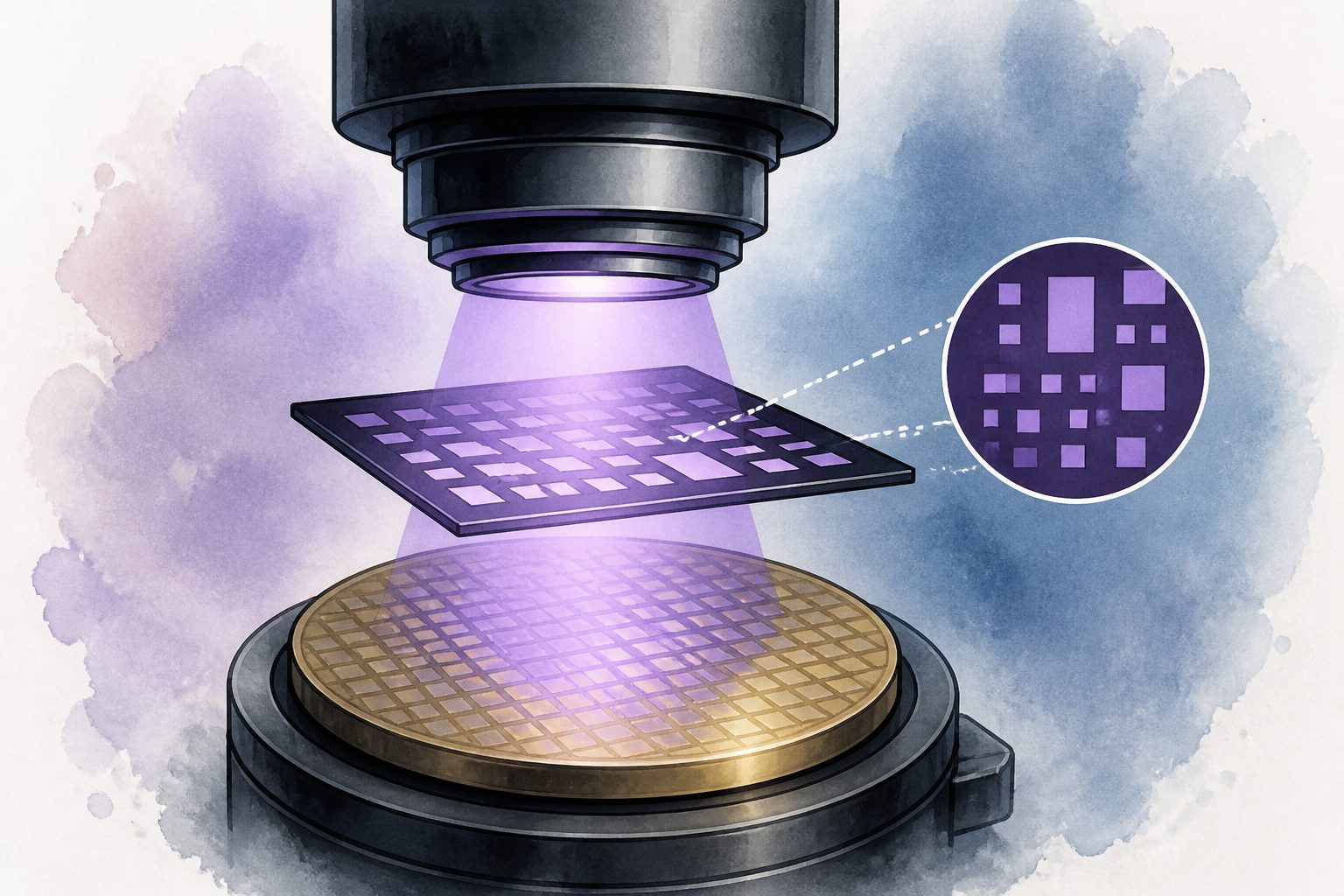
The device changed its pixel pattern between exposures and produced photoresist features as small as about 1.7 micrometres.
Researchers demonstrated a reprogrammable photomask that can change which of its microscopic pixels transmit light during repeated exposures in a conventional photolithography stepper. The mask uses electrically controlled suspended membranes and Fabry–Perot interference—an optical effect created by reflections inside a small air gap—to switch pixels on and off at 365 nanometres.
A reticle-format module with a 10 × 10 pixel array, wireless programming and exposure synchronization patterned a positive-tone photoresist. Using pixels with apertures of about 2.7 micrometres, the team produced resist features as small as about 1.7 micrometres.
What the mask printed
The researchers built a reticle-format module containing a 10 × 10 array of MEMS Fabry–Perot pixels. Each pixel used electrostatic tuning of a suspended membrane to switch between on and off states at the 365-nanometre wavelength used by an i-line photolithography stepper. The module also included a circuit board for control, wireless programming and photodiode-based synchronization with the stepper's exposure shots.
In photolithography tests, the researchers programmed pixel states and updated them between exposures while patterning a positive-tone photoresist. A systematic dose test identified the process range in which the pixel modulation produced clearly different resist-development states. With a pixel aperture of approximately 2.7 micrometres, the process produced resist features with lateral dimensions down to about 1.7 micrometres.