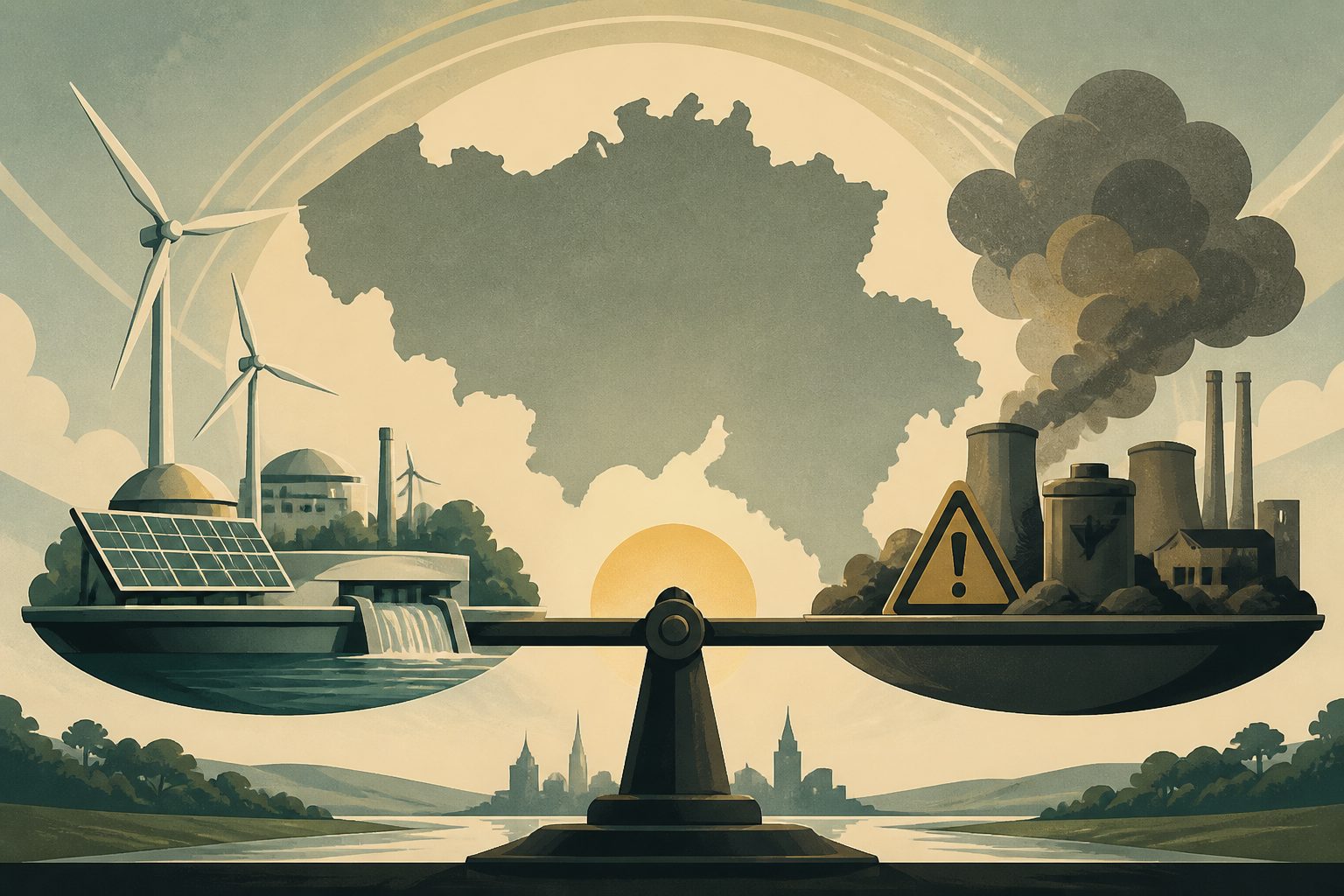
A 2045 study found that pathways meeting the climate target could still exceed limits linked to toxic pollution and fine particles.
The researchers developed a framework that combines energy-system planning with life-cycle assessment, which accounts for environmental effects across a technology’s supply chain, and measures linked to planetary boundaries. They used it to explore environmental trade-offs in a low-carbon energy scenario for Belgium in 2045.
The analysis identified four broad system configurations among the near-optimal options: electrification-dominated, hydrogen-dominated, renewable-capacity-dominated and mixed strategies. Each had similar costs, but their environmental effects differed. Under the most permissive way of translating global environmental limits to the national case, every near-optimal pathway met the climate target while exceeding boundaries for ecotoxicity and particulate matter.
What the energy pathways showed
The framework showed that reducing greenhouse-gas emissions did not ensure that the modeled energy pathways stayed within all assessed environmental limits. In the Belgium 2045 case, all near-optimal pathways met the climate target but exceeded boundaries for ecotoxicity and particulate matter under the most permissive downscaling principle.
The researchers used an optimization model to examine multiple objectives and a goal-programming approach to describe trade-offs among them. They then used interpretable machine learning to group the large set of options into four system configurations: electrification, hydrogen, renewable power capacity and mixed strategies. These configurations achieved similar costs but had different environmental trade-offs.
Evidence and limits
This is a modeling study and a methodological framework, applied as a case study to Belgium’s 2045 low-carbon energy system. It combines prospective life-cycle assessment with planetary-boundary measures and explores near-optimal options rather than observing outcomes from an operating energy system.
The abstract does not report how closely the modeled results match measured environmental impacts or provide the underlying effect sizes. The researchers say future versions should include changing energy demand and behavioral adaptations, which are not included in the current framework. The findings also depend on the selected downscaling principle used to translate broader environmental limits to the case study.