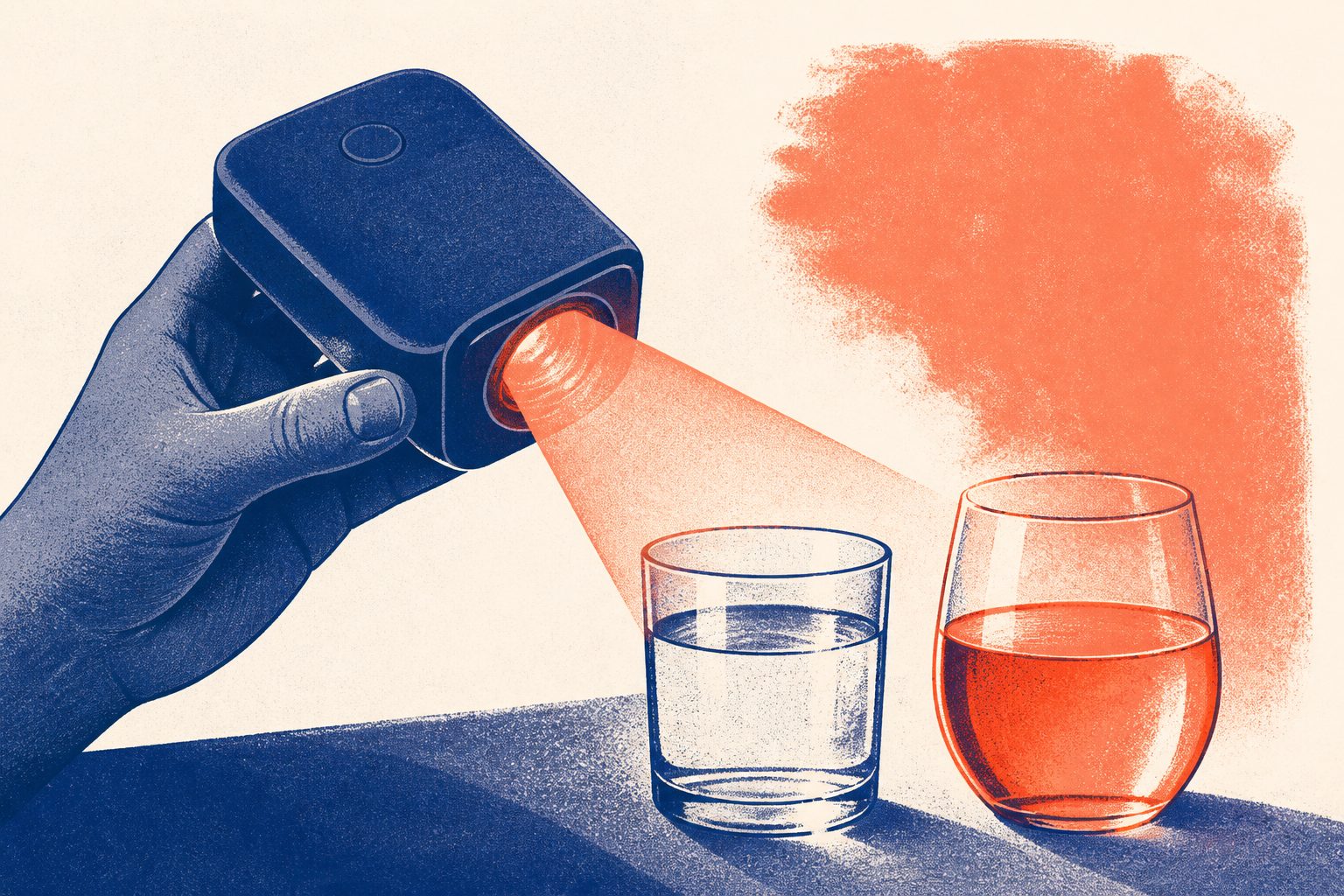
The compact detector turns near-infrared signals into five visual levels for screening commercial samples.
Researchers developed a compact device that uses near-infrared light to screen alcohol and water content. Instead of displaying a numerical measurement, it converts faint optical signals into one of five visual levels.
The device uses lead-free perovskite phosphors designed to emit light at wavelengths absorbed by alcohol or water. Tests on commercial samples showed screening across alcohol concentrations of 30–60% and water contents of 45–100%, although the abstract does not give details about the samples or the device’s accuracy.
What the device detects
The researchers first used a machine-learning-guided process to optimize lead-free neodymium- and ytterbium-doped cesium-sodium-yttrium-chloride double-perovskite phosphors. A neodymium-doped phosphor emits at 885 nanometres, matching a characteristic absorption band of alcohol. A neodymium/ytterbium version produces stable emission at 985 nanometres, matching a characteristic absorption band of water; the reported energy-transfer efficiency was 78.66%, and the emission retained 70% of its intensity at 500 kelvin.
The optimized phosphors were incorporated into light-emitting devices and a compact detector. A coaxial dual-disc stepper mechanism and a three-stage circuit amplify weak optical signals and produce a five-level visual indicator. The resulting device was used to rapidly screen alcohol content from 30% to 60% and water content from 45% to 100% in commercial samples.
// Source
Communications Materials · 2026 · DOI: 10.1038/s43246-026-01335-2
Authors: Qinghua Li, Tianfu Gao, Xinhao Rao, Zhelei Ren, Haodi Duan, Xiaomin Xie, Jiaxin Liao, Shuwen Xue, Bin Xu, Xiao Jin, Weifeng Zhao, Jinke Bai
Institutions: Soochow University, Lingnan Normal University, Xi'an Technological University