The team made a boron- and nitrogen-doped carbon nanozyme, a material that mimics some enzyme activity without using metals. A post-oxidation treatment increased its peroxidase-like activity by 155.48% to 310.15% compared with the controls described in the study, while limiting interference from oxidase-like activity.
Materials & Energy1 week ago
A portable gel distinguishes several types of long-lasting fluorinated chemicals
The color-changing sensor uses a carbon-based material to detect per- and polyfluoroalkyl substances, or PFAS, on site.
What the gel detected
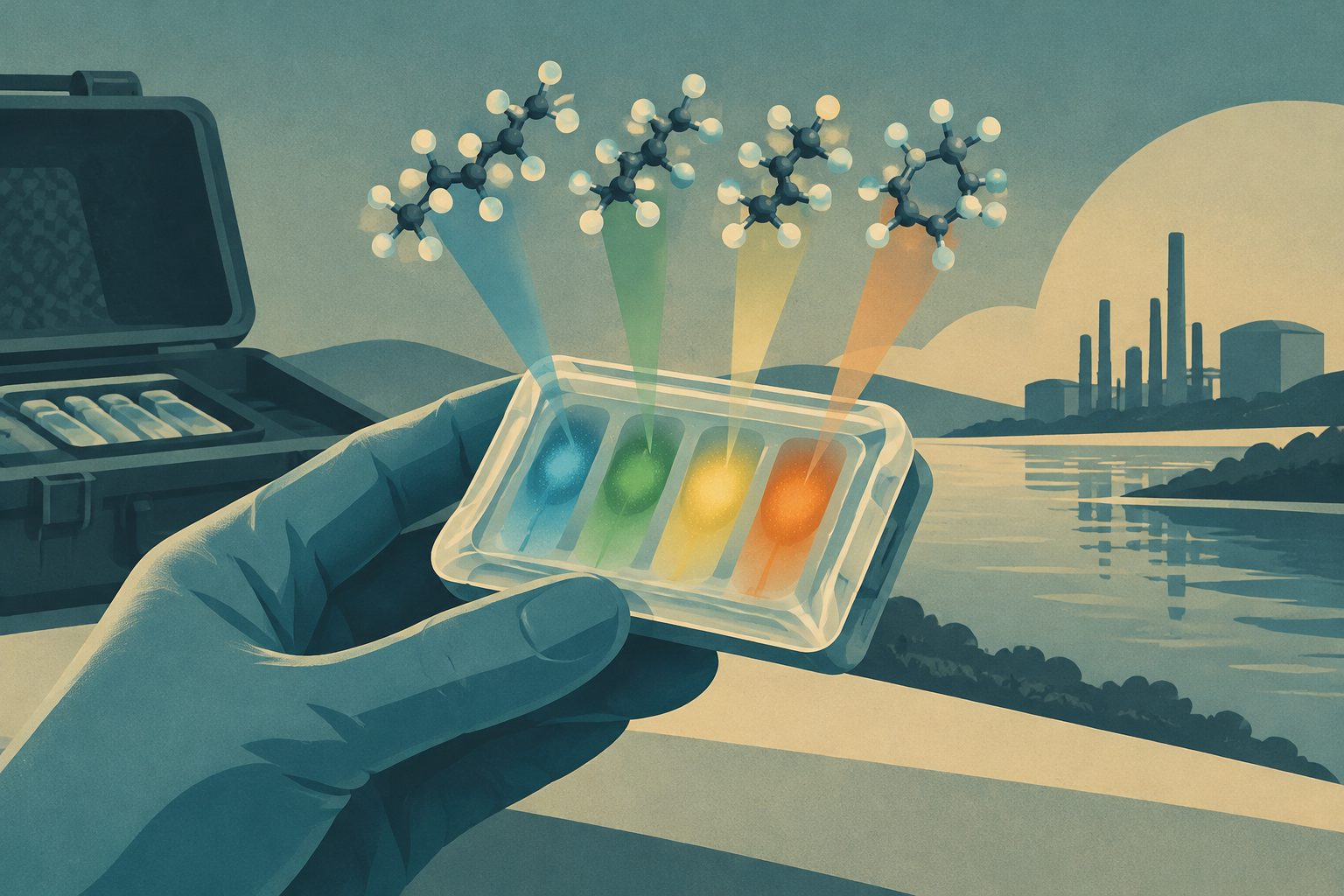
The researchers embedded the most active material, called 2D-BN@C-0.90, in a hydrogel made from polyvinyl alcohol and agarose. PFAS entering the gel inhibited the material's peroxidase-like activity, reducing the oxidation of a color-producing chemical. An image-processing algorithm converted the gel's color into red, green and blue values for quantification.
PFAS with a sulfonic acid group showed the strongest inhibition, followed by PFAS with a carboxylic acid group. PFAS with a hydroxyl group showed the weakest inhibition. The sensor quantified PFOA with a reported limit of detection of 0.12 micrograms per milliliter. The researchers also reported production of more than 1 gram of the carbon nanoflakes and improved dispersion in water.
Why portable testing matters
PFAS monitoring often relies on laboratory instruments and trained operators, according to the study. A low-cost, portable hydrogel that provides a visual signal could offer a simpler way to obtain on-site information about these chemicals in environmental and food-safety monitoring.
The different responses to PFAS chemical groups also suggest that the sensor can provide more than a single yes-or-no signal. However, the reported results support the sensor as a developed laboratory method; they do not by themselves establish how it will perform across all real-world samples.
Evidence and caveats
The evidence comes from material synthesis and characterization, chemical activity tests, PFAS inhibition experiments and a color-based hydrogel sensor analyzed with image processing. The article reports comparisons with control materials and gives a detection limit for PFOA.
The provided abstract and excerpts do not report testing in specific environmental or food samples, comparisons with standard laboratory methods, or field performance. They also provide a detection limit only for PFOA, so the sensitivity of the hydrogel to other PFAS compounds is not specified here. The excerpts describe recognition of most PFASs compared with non-PFASs, but do not establish that the sensor identifies every PFAS or fully distinguishes individual compounds.
// Source
Advanced Functional Materials · 2026 · DOI: 10.1002/adfm.78840
Authors: Haiyin Li, Xuan Wang, Yifan Gao, Xintong Ma, Ming Su, Zhenguo Chi, 沈益忠, Jianling Chen
Institutions: Hebei University, Hefei University of Technology, Wuyi University, Wuyi University