In simulations, a simple rule for changing local tension let model tissues adapt to repeated and distant mechanical stresses.
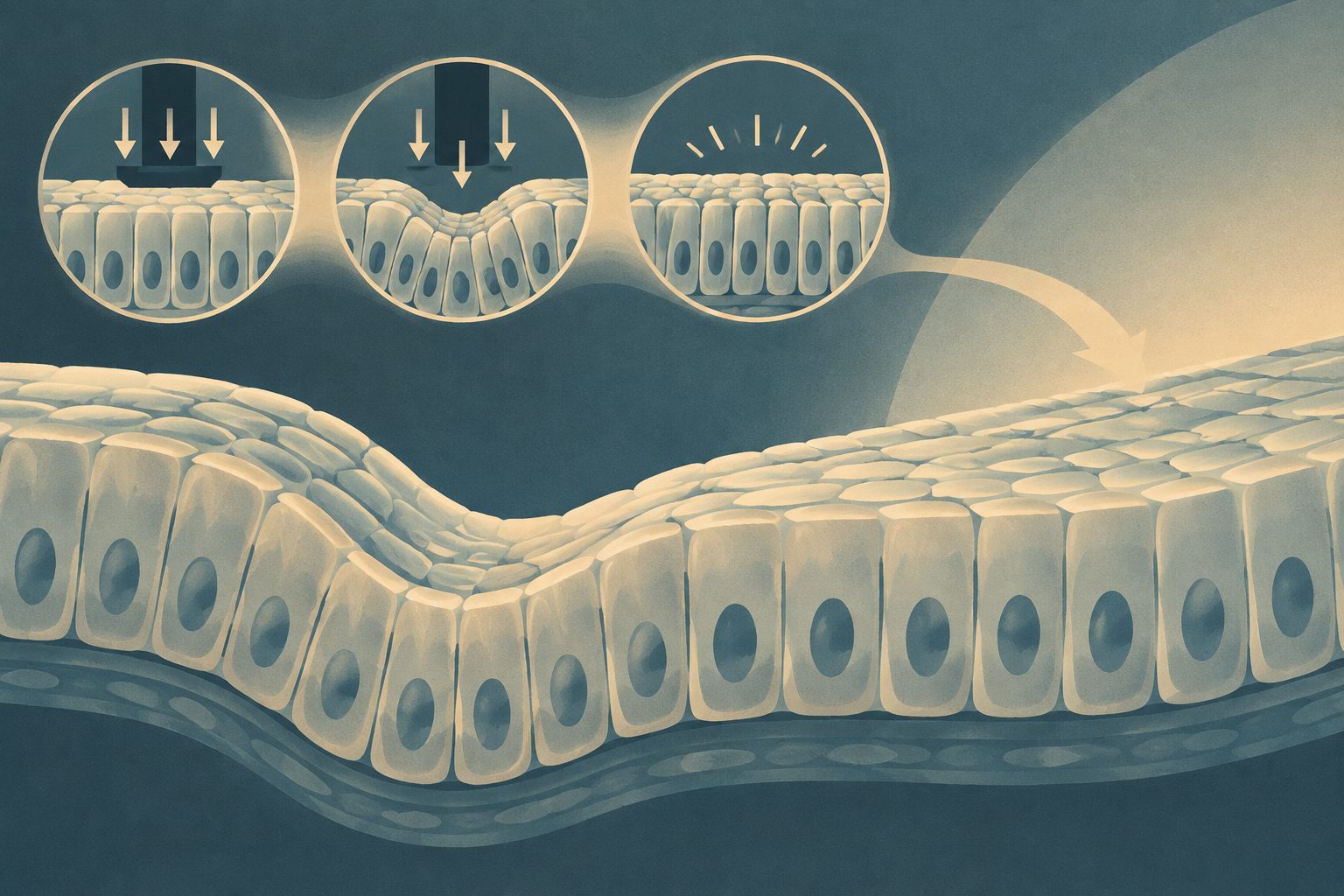
Researchers used an active vertex model of an epithelial sheet with one local rule that changes tension in response to mechanical forces. In the model, repeated contractile pulses produced habituation: the response became smaller in a history-dependent way, recording information about earlier stimulation.
A local stimulus also affected how the model tissue responded to a later stimulus applied elsewhere. Under repeated bulk stretching and compression, the tissue could be trained toward a target mechanical state and tune its Poisson ratio—the way a material changes width when stretched—to negative values, a behavior known as auxeticity.
How the model learns
The model displayed three forms of mechanical learning. At individual cell junctions, repeated contractile pulses caused habituation, with responses that diminished according to the tissue's history. At the tissue scale, a local stimulus created a long-range mechanical memory that changed the response to a later, distant stimulus.
The researchers' continuum theory describes this memory as a system-wide elastic bias and predicts that it depends on tissue size and the rate of remodeling. During cyclic bulk driving, the model could autonomously tune its Poisson ratio to negative values through directed remodeling rather than a specially designed geometry. The researchers also derived a memory function that distinguishes the adaptive model from a passive vertex model. The ratio of contraction to extension remodeling rates emerged as the central control parameter for the model's history-dependent mechanical behavior.
Why tissue memory matters
The work proposes a possible physical mechanism by which epithelial tissues could retain and use information about earlier forces without a separate memory system. It suggests that local changes in tension might produce programmable, history-dependent behavior across an entire tissue, including changes in how the tissue deforms.
Because the study is based on a model, it does not establish that real epithelial tissues use this mechanism. Its significance is that it identifies specific predictions—such as long-range mechanical memory and control through the balance of contraction and extension remodeling—that can be tested in biological tissues.
Model evidence and limits
This is a theoretical and computational study based on an active vertex model of an epithelial sheet, a mathematical representation of cells and their junctions. The reported learning behaviors arise from a single local, mechanosensitive tension-remodeling rule, supported by a continuum theory and an effective memory function.
The abstract does not report experiments on living tissues or quantitative measurements from biological samples. The conclusions therefore depend on the model's assumptions, including its remodeling rule and control parameters. The study identifies a candidate mechanism and testable predictions, rather than demonstrating physical learning in real epithelia.
// Source
PNAS Nexus · 2026 · DOI: 10.1093/pnasnexus/pgag367
Authors: Sadjad Arzash, Shiladitya Banerjee
Institutions: Georgia Institute of Technology