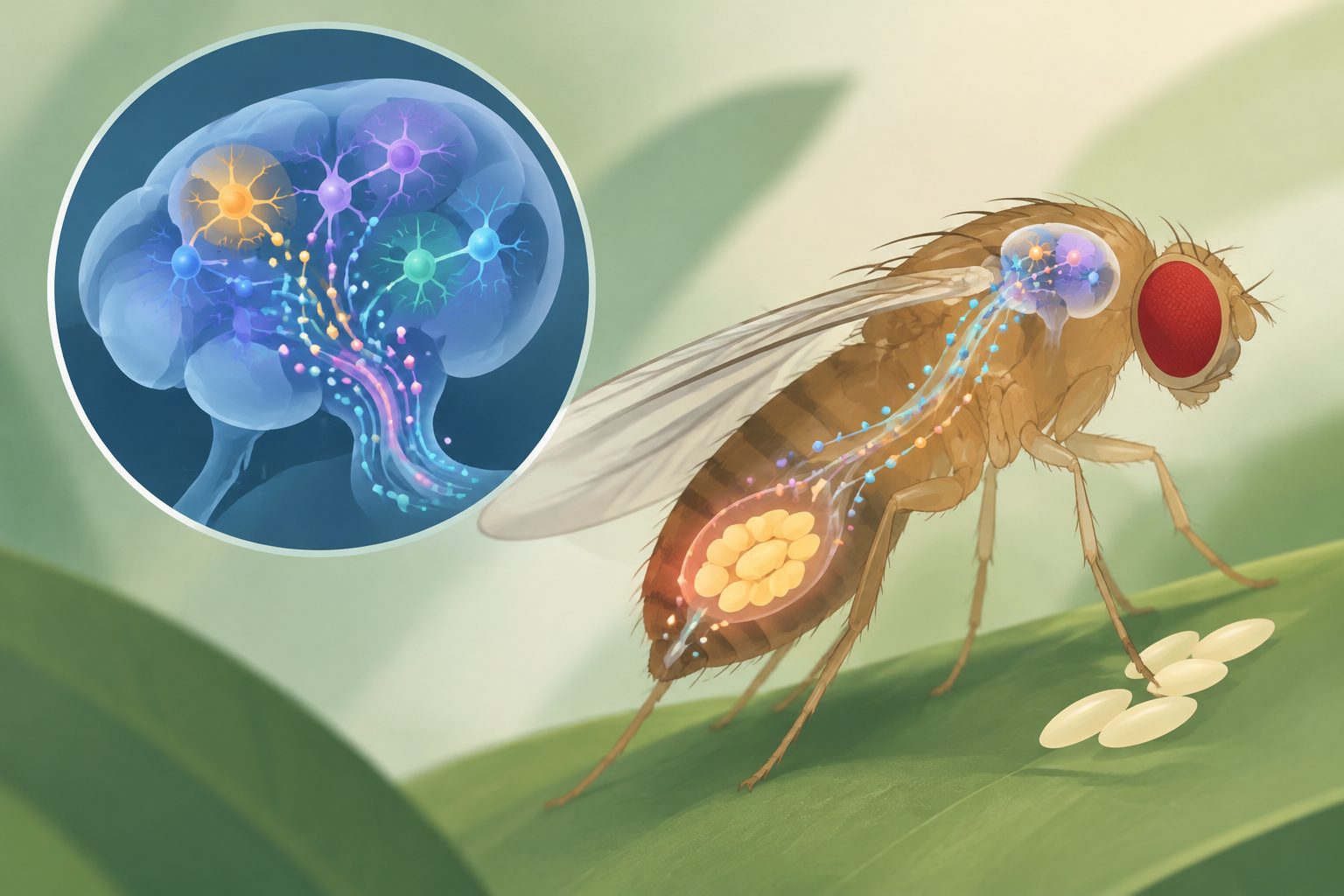
The wiring diagram shows how sensory and descending brain signals reach hormone-producing cells, including a pathway tied to reproduction.
The study describes the synaptic connectome—the map of nerve-cell connections—of neurosecretory cells in the adult Drosophila brain. These cells release peptide hormones that help coordinate processes such as reproduction, metabolism and behavior. The researchers identified neurons that connect to several hormone-producing cell types and traced routes carrying sensory and descending brain signals into the network.
The analysis pointed to diuretic hormone 44-producing cells as an important coordinator of physiology and behavior. It also found that corazonin-producing cells have much of the network’s outgoing synaptic signaling, and that both these cells and a downstream neuron called DNg27 influence egg-laying.
How the network is wired
The researchers mapped inputs to and outputs from neurosecretory cells in the adult fruit-fly brain. Several findings emerged:
- Diuretic hormone 44-producing neurosecretory cells receive inputs from neurons connected to multiple neurosecretory classes, suggesting they may coordinate physiological and behavioral signals.
- Although many neurosecretory cells have dendrites in the subesophageal zone, the brain’s main taste-processing center, signals from peripheral taste neurons reach them largely through intermediate neurons rather than directly.
- The researchers traced routes by which different smell-related signals reach neurosecretory cells.
- Linear dynamical modeling of the connectome identified enteric neurons—neurons associated with the digestive system—as the strongest modeled influences on neurosecretory-cell activity among the sensory sources examined.
- Many signals also come from descending neurons, which carry information from the brain toward other parts of the nervous system. This suggests they may help coordinate hormonal and motor outputs with behavior.
- Neurosecretory cells have relatively sparse synaptic outputs, most of which are mediated by corazonin-producing cells.
- Corazonin-producing cells and their downstream synaptic partner DNg27 both influence egg-laying.
- Analysis of single-cell gene-activity datasets suggested possible direct, or paracrine, communication among neurosecretory classes and possible hormone signaling from these cells to peripheral tissues.
// Source
eLife · 2026 · DOI: 10.7554/elife.102684.3
Authors: Theresa H. McKim, Jayati Gera, Ariana Julia B. Gayban, Nils Reinhard, Giulia Manoli, Selina Hilpert, Charlotte Helfrich‐Förster, Meet Zandawala
Institutions: KU Leuven, University of Würzburg, University of Nevada, Reno