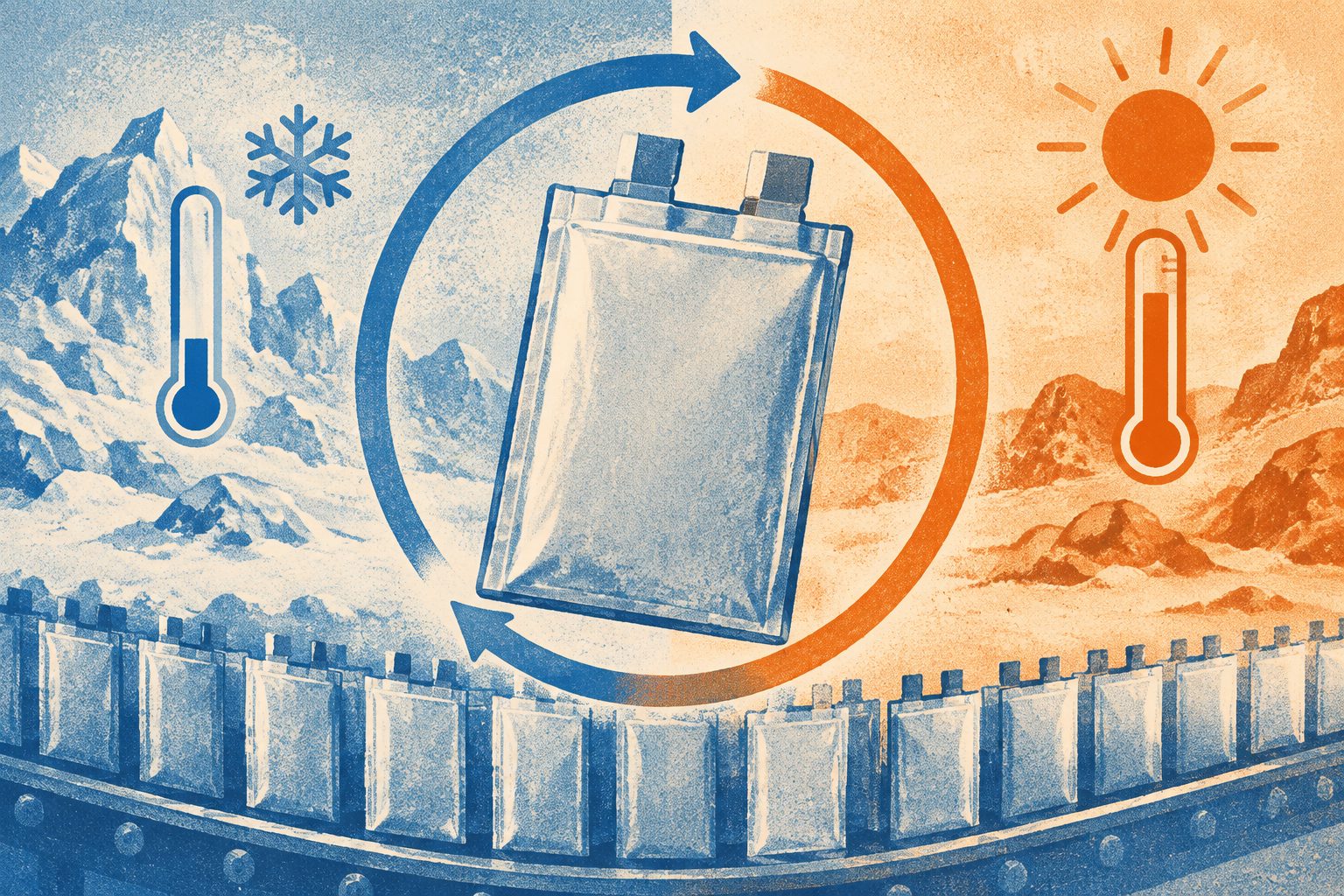
A specially adjusted liquid electrolyte helped protect the graphite electrode in a high-capacity pouch cell across a wide temperature range.
Propylene carbonate can work across a broad temperature range, but it can react with graphite electrodes when lithium ions enter the graphite together with solvent molecules. The researchers used one additive to weaken this interaction and another to build a continuous protective layer on the graphite surface.
They found that weakening the interaction was enough at low currents but not at higher currents, where the reaction could occur at exposed graphite sites. With both forms of protection, an optimized electrolyte supported 1.0-ampere-hour graphite||nickel-rich cathode pouch cells that remained stable for 2,000 cycles and operated from −50 to 120°C.
What the electrolyte changed
The researchers separated two roles of the electrolyte additives. Ethoxy(pentafluoro)cyclotriphosphazene, abbreviated PFPN, weakened the attraction between lithium ions and propylene carbonate, reducing the tendency of the solvent to enter graphite with the lithium ions. Fluoroethylene carbonate, or FEC, formed a continuous solid protective layer called the solid electrolyte interphase on the graphite.
Solvent adjustment suppressed unwanted co-entry at low currents, but became insufficient at higher currents. Under those conditions, greater voltage stress at the graphite surface allowed the reaction to occur at exposed sites. The protective layer acted as an additional barrier to lithium-ion–solvent transport and was needed for sustained demanding cycling.
Using the optimized electrolyte, 1.0-ampere-hour graphite||NCM83 pouch cells had an initial charge efficiency of 93.5% and remained stable over 2,000 cycles. The cells also operated from −50 to 120°C.
Evidence and caveats
This is an experimental journal study using optimized electrolytes in 1.0-ampere-hour pouch cells. The abstract reports the initial charge efficiency, cycle life and operating-temperature range, but does not specify the cycling currents, the temperature-testing protocol, the capacity-retention threshold used to define stability, or how performance compared with a commercial electrolyte. The findings therefore describe the reported cell tests and do not by themselves establish performance in commercial batteries or under all conditions within that temperature range.
// Source
Advanced Functional Materials · 2026 · DOI: 10.1002/adfm.78833
Authors: Haijin Ji, Yaqi Liao, Zezhuo Li, Zhangyating Xie, Yanda Li, Lin Du, Shuang Chen, Shuaipeng Hao, Yuelin Kong, Shengdong Yu, Henghui Xu, Yunhui Huang, Ruixiang Feng, Lixia Yuan
Institutions: City University of Hong Kong, Huazhong University of Science and Technology, Zhongnan University of Economics and Law, State Key Laboratory of Materials Processing and Die & Mould Technology