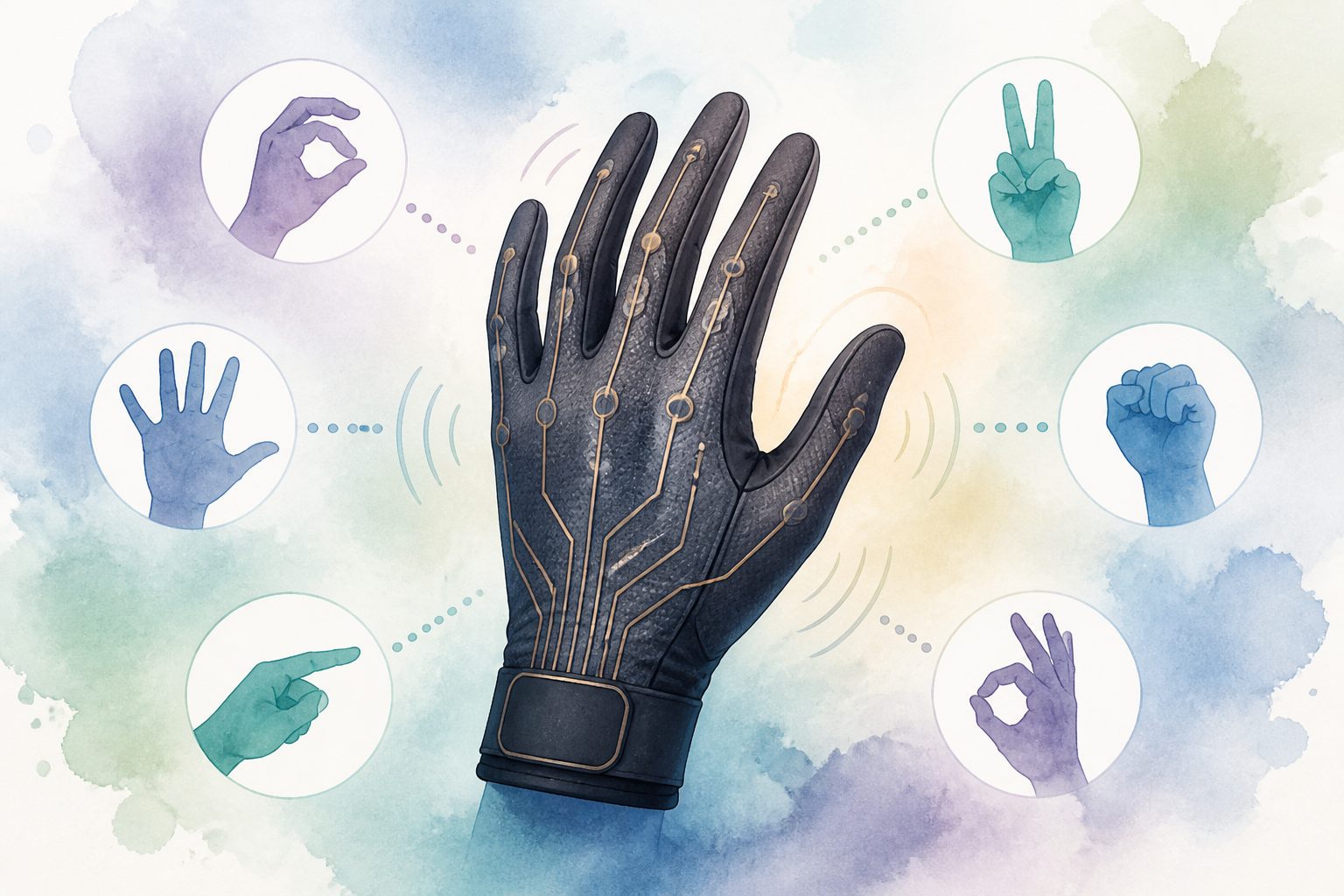
The MXene-and-graphene glove translated hand movements with little or no personal calibration.
The glove uses a stretchable sensing layer made from MXene, graphene and spandex to record changes caused by hand movements. Its sensing material had a linear response across stretches of 0% to 90%, while a compact impedance-measurement module collected the signals for classification by a Random Forest algorithm, a relatively lightweight machine-learning method.
The system reached 99.43% accuracy for recognizing 12 complex gestures from the same subjects used in its training and testing setup. For cross-subject recognition, it achieved 91.04% accuracy without individual calibration; adding 5% calibration data raised this to 97.85%. The researchers also demonstrated sign-language translation and low-latency game control.
What the glove recognized
The MXene/graphene/spandex sensing layer showed a linear tensile response from 0% to 90%, with R² = 0.995. The measurement module had a signal-to-noise ratio of 61.6 decibels and an average measurement accuracy of 99.79%, and it collected data at 30 frames per second.
Using the glove and a Random Forest classifier, the researchers reported 99.43% accuracy for classifying 12 complex gestures within subjects. When recognizing gestures from different subjects without subject-specific calibration, accuracy was 91.04%. With calibration data amounting to 5% of an individual’s samples, accuracy increased to 97.85%. Demonstrations included an intelligent sign-language translation platform and a game-control system that mapped hand movements to commands.
Why limited calibration matters
Differences in hand size and in how people wear a glove can make gesture-recognition systems less consistent between users. This system was designed to reduce those effects through a wide-range sensing material and dual-mode measurements, and it retained relatively high recognition accuracy without requiring data from each new user.
The limited calibration needed to reach 97.85% accuracy could make adapting a wearable gesture interface faster than collecting a large personal training set, according to the reported results. The sign-language translation and game-control demonstrations show how the system could be used for communication and other human-machine interfaces, although the study does not establish performance in long-term or broader real-world use.
Evidence and open questions
This is a journal article reporting material tests, electronic measurements, machine-learning classification results and demonstrations of two applications. The reported results include sensor linearity, measurement quality and recognition accuracy, but the provided abstract and excerpts do not give the number or demographic range of participants, the exact gesture set, or details needed to assess how broadly the results generalize.
The researchers identify long-term skin biocompatibility and durability as unresolved issues. Future work is planned to examine washing, sweat and abrasion resistance. The excerpts also do not establish how the glove performs during extended everyday wear or outside the reported demonstrations.