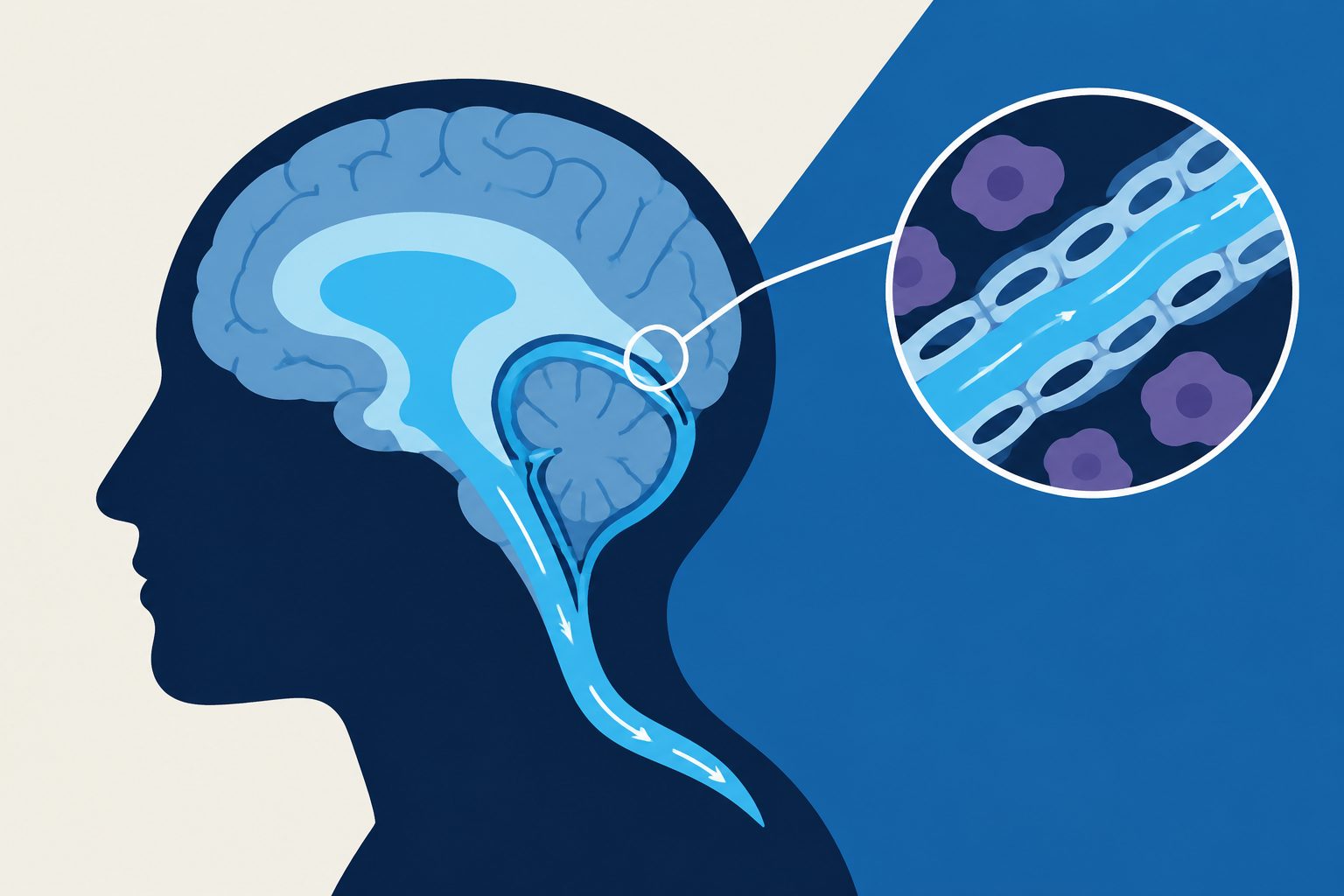
A review traces how cerebrospinal fluid moves through the brain and toward lymphatic vessels, while assessing possible treatment targets.
The review describes the glymphatic–lymphatic axis: a connected set of pathways through which cerebrospinal fluid and brain tissue fluid move within the brain and drain toward extracranial routes. It discusses how these pathways may communicate with peripheral immune and metabolic systems, and how their impairment is associated with protein accumulation, neuroinflammation and vascular dysfunction in diseases including Alzheimer’s and Parkinson’s.
The authors also assess emerging biomarkers and treatments aimed at improving brain-fluid transport or lymphatic drainage. In animal models, the review reports that enhancing parts of this system has been associated with better cerebrospinal-fluid drainage, greater clearance of pathological proteins and less inflammation, but it identifies major unanswered questions about how the pathways work together and whether they can be safely manipulated in people.
How brain clearance connects
This article is a review rather than a new experiment. It organizes evidence that the brain’s fluid-clearance network connects cerebrospinal fluid movement, exchange with brain tissue fluid and drainage through several routes, including meningeal and other lymphatic pathways.
The review describes impaired clearance as being associated with pathological protein accumulation, neuroinflammation, vascular dysfunction and progressive neurodegeneration. It also summarizes preclinical studies in which modulation of glymphatic transport, meningeal lymphatic drainage or related regulatory pathways was associated with improved fluid drainage, enhanced removal of pathological proteins, reduced inflammation, more normal cerebrospinal-fluid dynamics and improved disease-related features in animal models.
Why the network matters
The framework connects brain-fluid movement with immune regulation, vascular biology and communication between the brain and the rest of the body. If these links are confirmed in humans, treatments that support the brain’s own clearance pathways could complement therapies directed at disease-related proteins.
For now, the review presents this as a possible therapeutic direction rather than an established treatment. It also highlights that researchers still do not know whether impaired clearance initiates disease, results from other disease processes or amplifies damage after it begins.
Evidence and open questions
The article synthesizes anatomical, physiological and preclinical evidence rather than reporting a single clinical study or a new patient trial. Its conclusions about possible benefits of manipulating the clearance network are based predominantly on experimental models, especially animal studies.
Important uncertainties remain about the relative contributions of different drainage routes, how they interact across brain compartments and their causal role in human neurological disease. The review therefore calls for rigorous validation in humans before these strategies can be considered established treatments.
// Source
Translational Neurodegeneration · 2026 · DOI: 10.1186/s40035-026-00588-8
Authors: Yumeng La, Jin Yuan, Jun Chen, Kejia Lv, Xiaoxi Wang, Gao qiqi, Yujue Wang, Chen Wang, Bin Xu, Ying Yang, Jing Zhang
Institutions: First Affiliated Hospital Zhejiang University, Zhejiang University