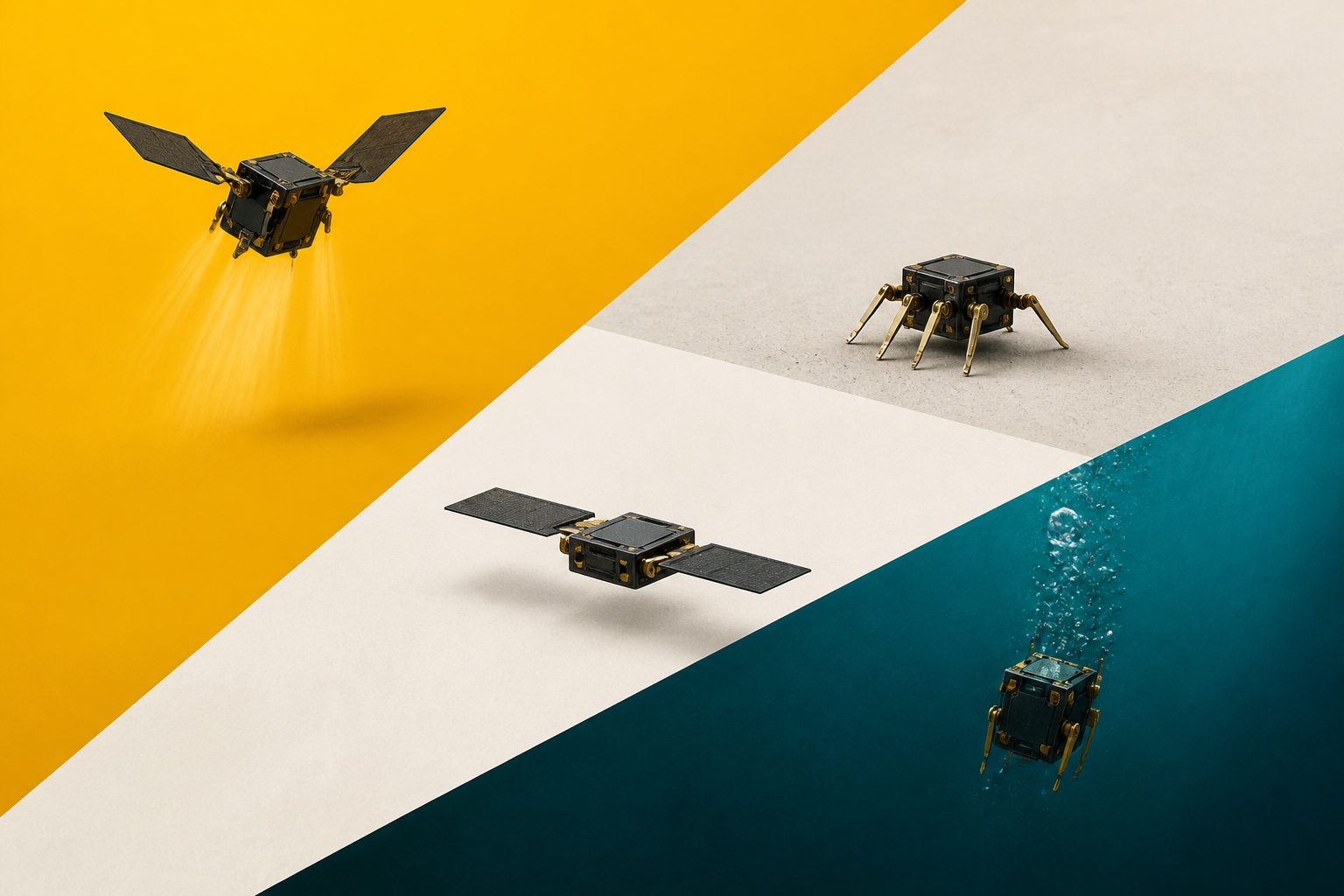
Its shape-changing body reuses the same structure to move through air, across land and on water.
The robot’s multifunctional frame is driven by shape-memory alloy artificial muscles. By changing shape, the frame can steer asymmetric wing flapping for aerial takeoff, oscillate to produce crawling through differences in friction, and adjust flexible footpads for movement and support at the water surface.
The footpads also enable electrically controlled wetting of the water surface. Applying 225 volts ruptured the surface and allowed controlled immersion, while the system increased its load capacity to 1.7 times the robot’s body weight. The demonstrations were separate open-loop functional tests, not one continuous autonomous mission.
How the robot changes modes
The 140-milligram robot demonstrated four forms of movement or positioning: aerial takeoff with open-loop attitude modulation, terrestrial crawling, water-surface gliding and electrowetting-triggered controlled immersion. Its single morphing frame served different roles in each mode: a steering transmission for asymmetric wing flapping, a linear oscillator for crawling, and a deformation actuator for adjusting kirigami-inspired footpad gaps.
At 225 volts, the footpads ruptured the water surface and enabled controlled immersion. The robot’s load capacity reached 1.7 times its body weight.
Why one body matters
Small robots face a trade-off between carrying mechanisms for different tasks and staying light enough to move. This design addresses that constraint by repeatedly assigning different functions to one reconfigurable body structure, rather than relying on a separate actuator-heavy system for each environment.
The approach could help explain how a very small platform can combine movement across air, land and water while remaining within a 140-milligram mass limit. The reported work demonstrates the underlying design principle, but does not show a single robot completing all modes autonomously in sequence.
Tests and limits
The evidence comes from representative open-loop functional tests of a robot prototype. The abstract reports demonstrations of takeoff, attitude modulation, crawling, water-surface gliding and controlled immersion, along with the voltage used for immersion and the measured load capacity.
These were not presented as one continuous autonomous mission. The abstract also does not provide details such as endurance, operating range, repeatability, energy use or performance in natural environments, so those aspects remain unestablished by this report.
// Source
Microsystems & Nanoengineering · 2026 · DOI: 10.1038/s41378-026-01449-0
Authors: Yunfei Wang, Zhonglai Wang, Zequn Wang, Yichuan Wu, Shan Lu, Wei Zhang, Yi Guan, Pengpeng Zhi, Zhibo Geng, Junfu Zhang, Yaoming Fu
Institutions: Huzhou Normal University, Civil Aviation Flight University of China, University of Electronic Science and Technology of China, Xihua University