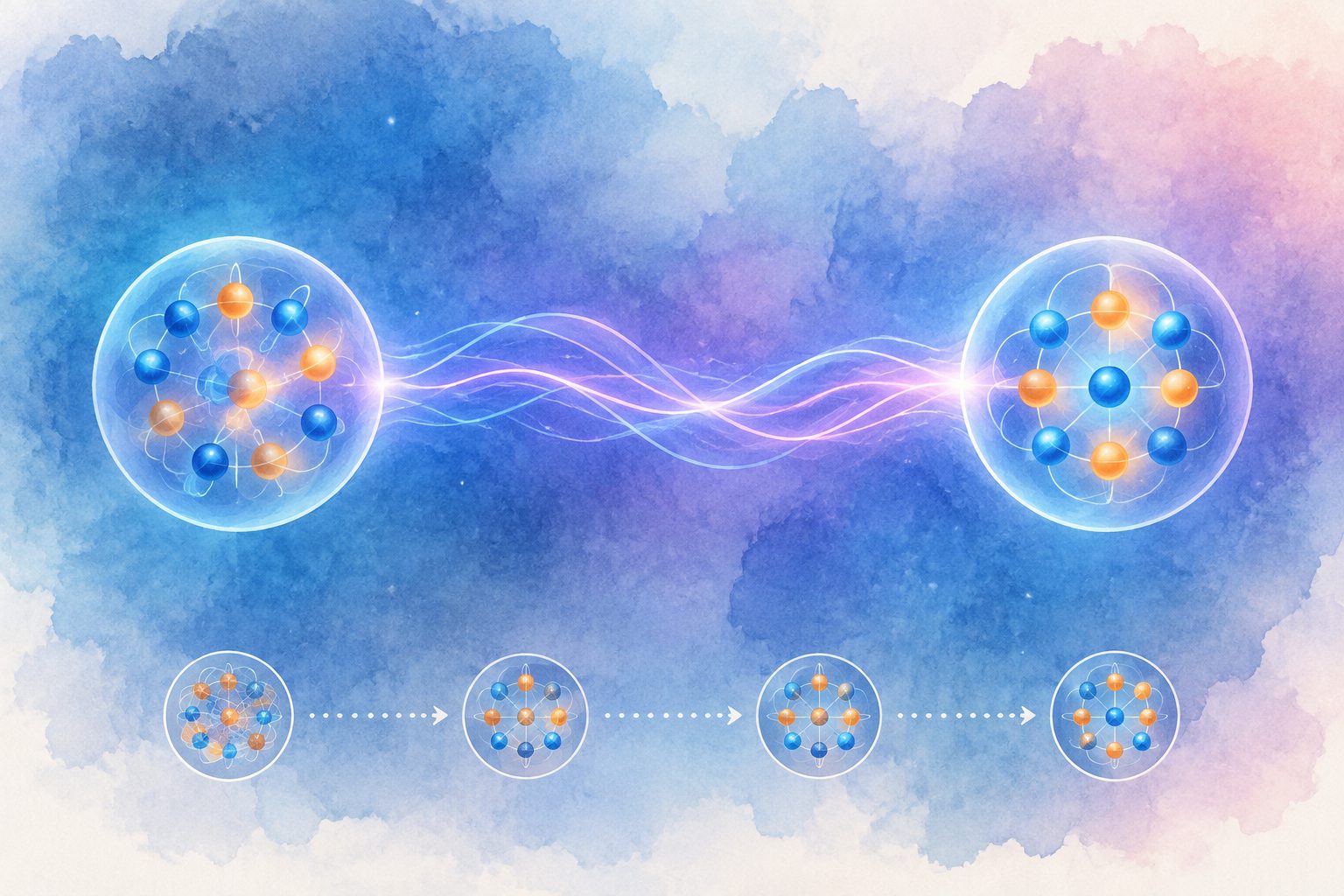
A theoretical study links this counterintuitive relaxation pattern to systems with several conserved quantities.
The study examines many-body quantum systems that are weakly coupled to an environment and begin in different thermal states. The researchers ask when the state initially farther from the system’s eventual steady state can approach it more quickly than a state that starts closer—a pattern known as the quantum Mpemba effect.
They argue that additional extensive conserved quantities, or integrability, are important because they allow the system to evolve through a multidimensional family of states called generalized Gibbs ensembles. With energy as the only approximately conserved quantity, the evolution remains on a one-parameter path of ordinary thermal states, where the researchers find that the effect cannot occur within their approximation.
The role of conserved quantities
The researchers provide numerical evidence that additional approximately conserved quantities are necessary for the quantum Mpemba effect in the weakly open systems they studied, but they do not find that they are sufficient on their own. For Hamiltonians without other conserved quantities, the dynamics can be described by changing temperature along a one-dimensional family of thermal states, and no crossings between relaxation curves appear in that description.
For integrable systems with additional conserved quantities, the dynamics instead involve several changing parameters associated with nearly conserved quasiparticle occupations. This multidimensional evolution can produce crossings: an initially more distant thermal state approaches the steady state faster than one initially closer to it. Tensor-network simulations of systems with 80 to 160 sites, along with free-fermion calculations for an integrable case, support this picture. Simulations of the full density matrix and analysis of its relaxation modes also suggest that the effect can persist at finite bath couplings relevant to the study.
Why the result matters
The work identifies a physical condition that may help explain when a quantum system can relax in the counterintuitive Mpemba order. It connects the effect to the number of quantities that remain nearly conserved during the system’s internal evolution, rather than treating the faster relaxation as an isolated feature of a particular initial state.
This gives researchers a way to look for the effect in many-body systems: systems with integrable dynamics or several conserved quantities may be candidates for observation, including in proposed cold-atom experiments involving atom loss. The study does not provide a general recipe for producing the effect, because the choice of environmental coupling still matters.
Evidence and open questions
This is theoretical work supported by numerical calculations, not an experimental observation. The researchers simulated the Lindblad dynamics with tensor-network methods for systems of 80 to 160 sites and used free-fermion techniques for an integrable model. They measured distance from the steady state using a normalized Frobenius norm on reduced density matrices; the study notes that the appropriate distance measure remains debated and that this measure is used because it is practical for the calculations.
The central argument is based on a zeroth-order thermal or generalized-thermal approximation, although full-density-matrix simulations and relaxation-mode analysis support it at finite coupling. The study concludes that additional approximate conserved quantities appear necessary but are not sufficient. The general role of the environmental coupling, the stability of the effect at finite system-bath coupling, and how it depends on the number of conserved quantities remain unresolved.
// Source
Physical Review Letters · 2026 · DOI: 10.1103/xrfl-drcm
Authors: Iris Ulčakar, Rustem Sharipov, Gianluca Lagnese, Zala Lenarčič