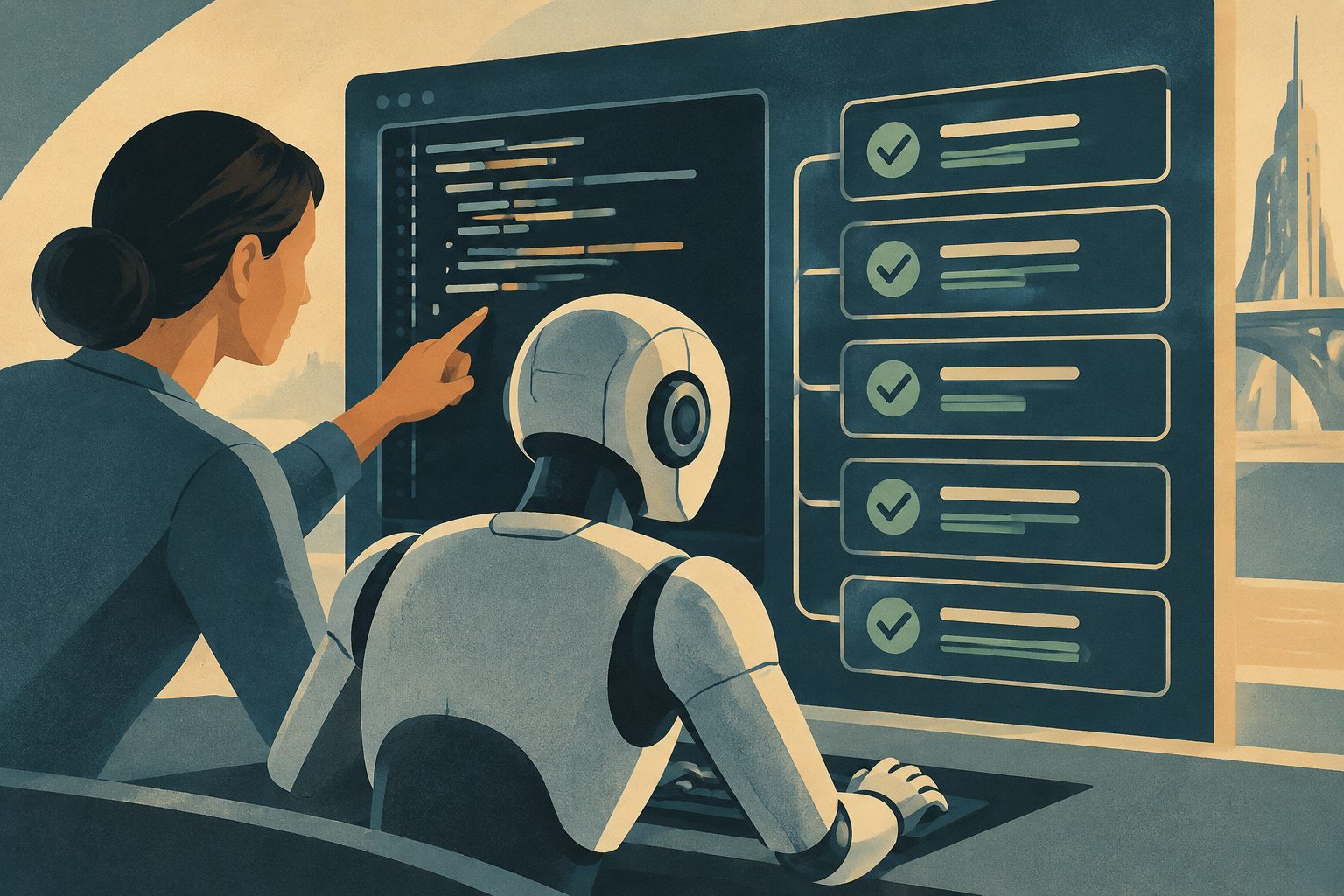
A study of software development workflows found that human–AI teamwork produced stronger test suites than working with AI alone.
Researchers compared human-only development, human–AI collaboration, fully automated AI coding and coding carried out autonomously by the MetaGPT X platform. They built test-driven development workflows for each approach and assessed the resulting code, tests and development process.
The human-centred comparison involved 16 IT professionals with experience in test-driven development and Python. Additional repeated executions of the autonomous workflows provided exploratory evidence. The researchers found that the best workflow depended on the goal: autonomous agents were fastest and produced the most functionally correct production code in the study, while collaboration with people produced better-organized tests.
How the workflows compared
The agentic workflow, in which the MetaGPT X platform handled development autonomously, consistently produced the most functionally correct production code according to the baseline test suite and was the fastest approach in the study. It also produced more structurally complex code and lower branch coverage when assessed with the same test suite. The researchers suggest that some uncovered branches reflected implementation choices beyond what the functional specifications required, creating additional untested decision points.
The collaborative workflow, in which developers worked with a conversational language model, produced higher-quality and better-organized test suites, with greater code coverage than the researchers observed in the autonomous approaches. Its production-code correctness was comparable to that of the agentic workflow, but it required more effort because developers often had to revise assertions and coordinate with the AI system. Fully automated, prompt-driven coding was faster than human-assisted approaches but did not match the agentic workflow's production-code correctness or the testing quality of workflows involving people.
Evidence and caveats
This was an exploratory study. The comparison of human-only and collaborative workflows was a controlled pre-experimental study involving 16 IT professionals from Italy, Denmark and Brazil, all experienced in test-driven development and Python. The fully automated and agentic workflows were assessed through repeated executions on the same development tasks rather than through the same participant-based comparison, so the evidence comes from two different evaluation settings.
The study used structured prompts, Python scripts and the MetaGPT X platform, and the results may not apply to other tasks, AI systems or development environments. The researchers also reported practical difficulties involving an open-ended task, time pressure and platform usability. They describe accurately reproducing development workflows with newer agentic technologies as an open problem.
// Source
Empirical Software Engineering · 2026 · DOI: 10.1007/s10664-026-10950-z
Authors: Moritz Mock, Barbara Russo
Institutions: Free University of Bozen-Bolzano