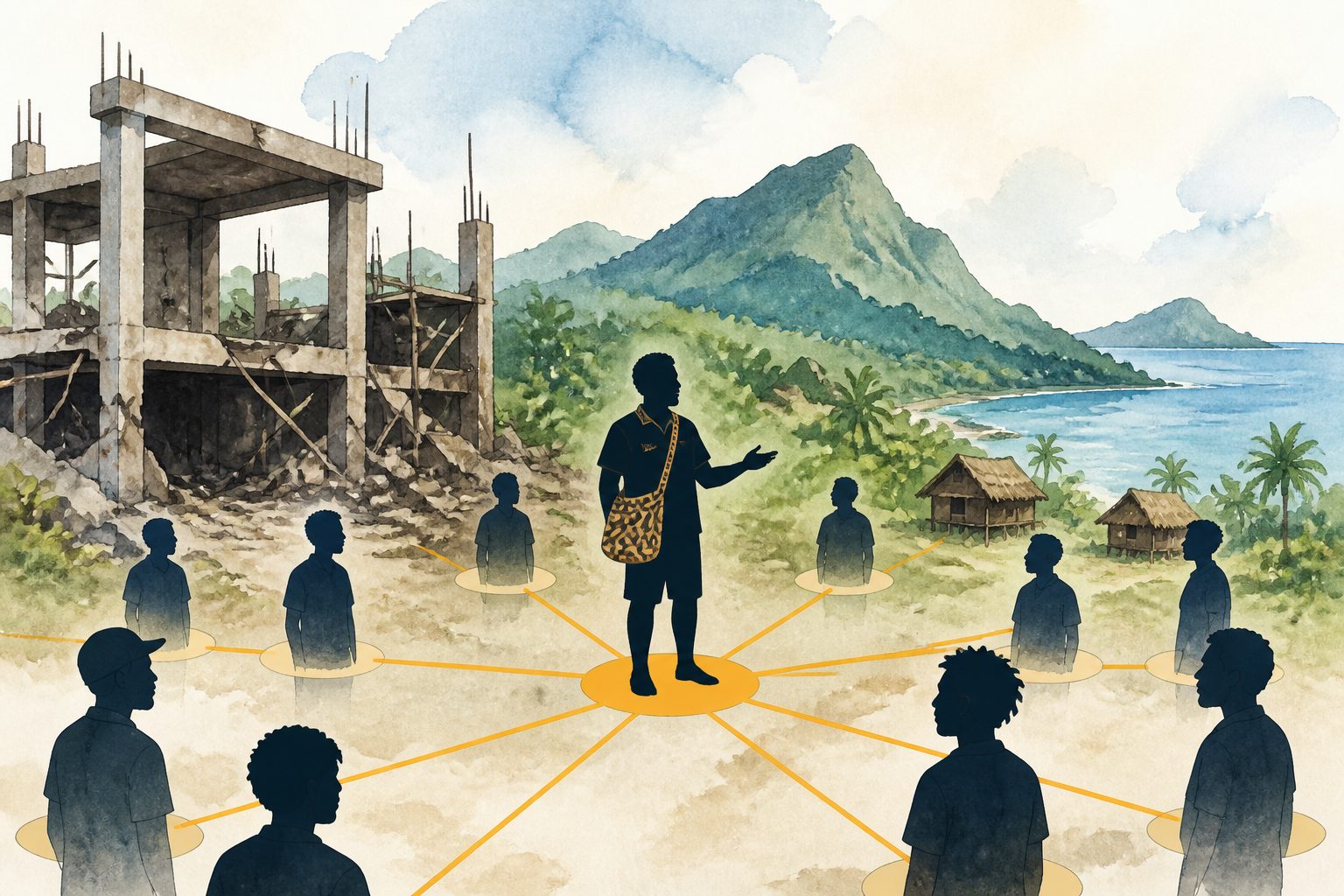
A study of Febi and Kubo communities finds that repeated project failures have produced successive generations of intermediaries promising access to development.
The study traces three overlapping waves of brokers among Febi and Kubo communities. These intermediaries differ in their social positions, how they claim to speak for others and the kinds of resources or recognition they seek.
The researchers focus on the second wave, placing it between earlier brokers and newer ones. They link changes in brokerage to generational change and greater engagement with governance, financial management and service-delivery systems that had previously seemed distant. Taken together, the waves have helped connect the communities to provincial, national and global systems that promise future advancement, while also tying people more closely to clientelistic relationships—exchanges of support and resources based on personal connections.
Three waves of brokers
The researchers identify three overlapping waves of brokerage among Febi and Kubo people. Each wave emerged in response to the limits of earlier brokers, within a longer pattern of failed brokers, incomplete development projects and wasted money.
The waves differ in the brokers’ social positions, the grounds on which they claim to represent the communities and the forms of capital they seek to build: material resources, social connections or public recognition. The researchers argue that these changes reflect generational shifts and growing involvement with governance, financial management and service-delivery systems. Brokerage has mediated gaps between the communities and wider provincial, national and global systems, but has also deepened clientelistic relationships.
Why the pattern matters
The study shows why repeated promises of development do not necessarily reduce dependence on intermediaries. When projects fail and public systems remain difficult to access, new brokers can arise to fill the gaps, helping communities engage with wider institutions while also reinforcing relationships based on personal connections and unequal access to resources.
This matters for understanding development in remote Papua New Guinea because the problem is not described as a single failed project or individual broker. It is a continuing pattern in which successive forms of brokerage offer a route toward future advancement but remain entangled with the conditions that made brokers necessary.
Evidence and limits
This is an anthropological analysis of development efforts and changing forms of brokerage among Febi and Kubo people in Western Province. The abstract does not specify the study’s field methods, the number of people consulted or the time period covered, so the scale and representativeness of the evidence cannot be assessed from the available information.
The findings describe a patterned history in these communities; they do not establish that the same sequence occurs across Papua New Guinea or elsewhere. The abstract also does not quantify the financial losses, the extent of project completion or the effects of particular brokers.
// Source
The Australian Journal of Anthropology · 2026 · DOI: 10.1111/taja.70102
Authors: Monica Minnegal, John Cox
Institutions: The University of Melbourne