Spectra of eight bright quasars from the young universe indicate that most were accreting well below the theoretical limit.
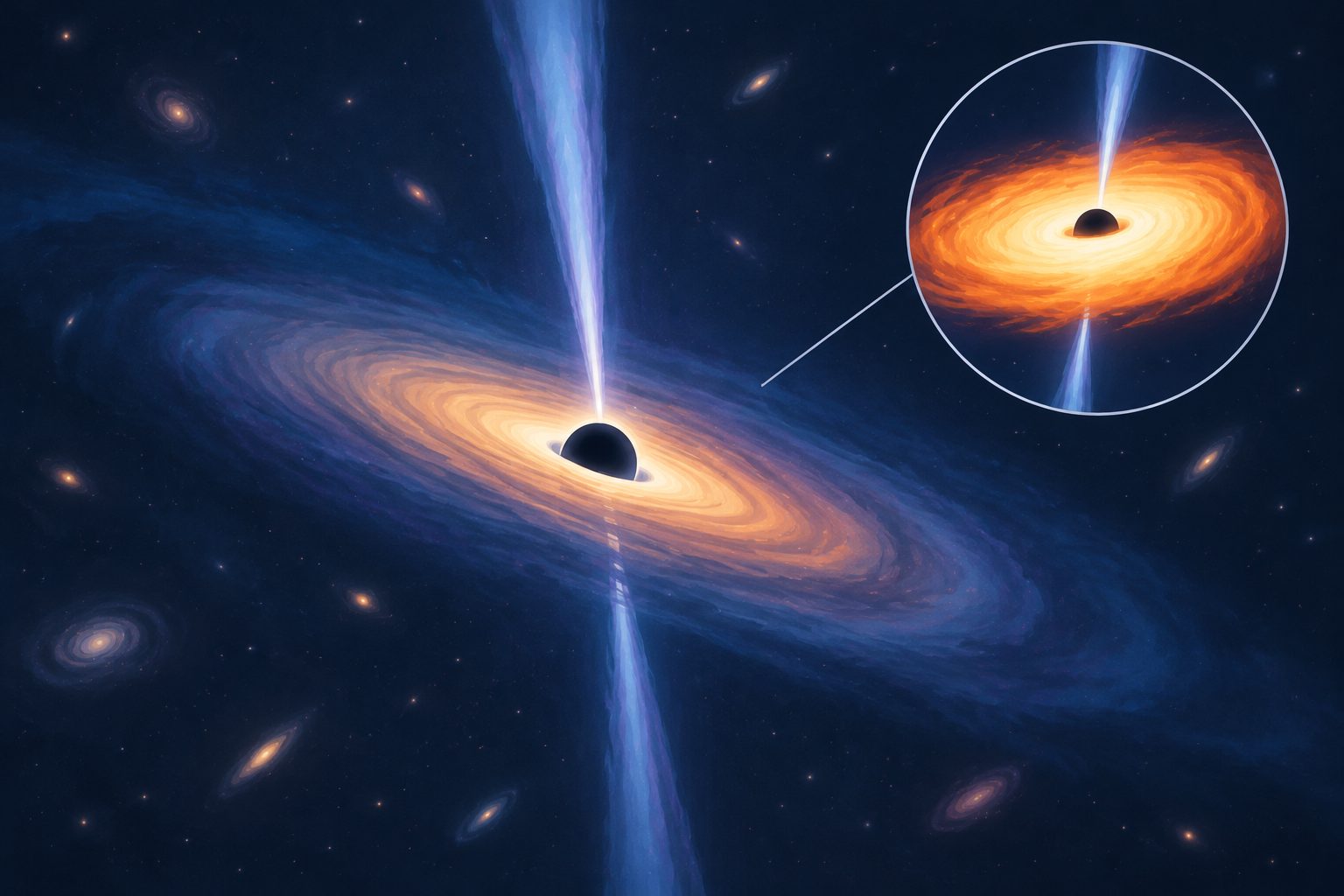
Researchers analysed Webb’s NIRSpec spectra of eight luminous quasars at redshifts of at least 5.9, when the universe was less than a billion years old. They used models of the light from each quasar’s accretion disc—the rotating flow of gas around its central black hole—to estimate black-hole masses, disc luminosities and accretion rates.
The quasars had an average Eddington ratio of about 0.13, expressed in the study as an average log value of about -0.9. This points to predominantly sub-Eddington accretion, rather than the near- or above-limit feeding rates often proposed to explain how massive black holes formed so early.
How fast they were feeding
The accretion-disc models gave consistent estimates of black-hole mass and disc luminosity across the sample. Their typical uncertainties were about 0.2 dex for black-hole mass and 0.1 dex for disc luminosity, smaller than the systematic uncertainties associated with commonly used single-epoch estimates and bolometric corrections.
The Eddington-ratio distribution had a mean log value of -0.86, with a standard deviation of about 0.23 dex. Assuming these eight bright, blue, optically selected quasars represent the wider population of such objects, the researchers estimated that about 0.2% were accreting above the Eddington limit—the point at which radiation pressure reaches the level expected to counter the black hole’s gravitational pull.
Why the rate matters
Supermassive black holes were already present when the universe was less than a billion years old, but how they reached such large masses so quickly remains unclear. One proposed explanation is that they grew continuously at, or above, the Eddington limit.
This study instead finds compelling evidence that the bright early quasars in its sample were generally accreting below that limit. The result challenges the idea that widespread near- or super-Eddington accretion was typical of quasars during the epoch of reionisation, while also showing that Webb spectra can provide a more self-consistent way to estimate their black-hole masses and emitted power.
Evidence and caveats
The study is based on Webb/NIRSpec observations and modelling of eight luminous quasars at redshifts of at least 5.9. The researchers compared several emission-line and continuum-based estimates with models that fit the overall accretion-disc emission, allowing black-hole mass and disc luminosity to be estimated together.
The sample is small and consists of bright, optically selected quasars, so the population-wide estimate depends on the assumption that these objects are representative of other bright blue quasars. The usual single-epoch methods carry larger systematic uncertainties, while the accretion-disc models themselves left the black holes’ spin and viewing angle largely unconstrained. The study therefore measures the accretion properties of this selected sample rather than all quasars in the early universe.
// Source
Astronomy and Astrophysics · 2026 · DOI: 10.1051/0004-6361/202558661
Authors: B. Trefoloni, E. Nardini, S. Carniani, Elisabeta Lusso, A. Marconi, Chiara Niccolai, Eleonora Parlanti, Andrea Sacchi, A. Shlentsova, Matilde Signorini, Guido Risaliti, Sandra Zamora