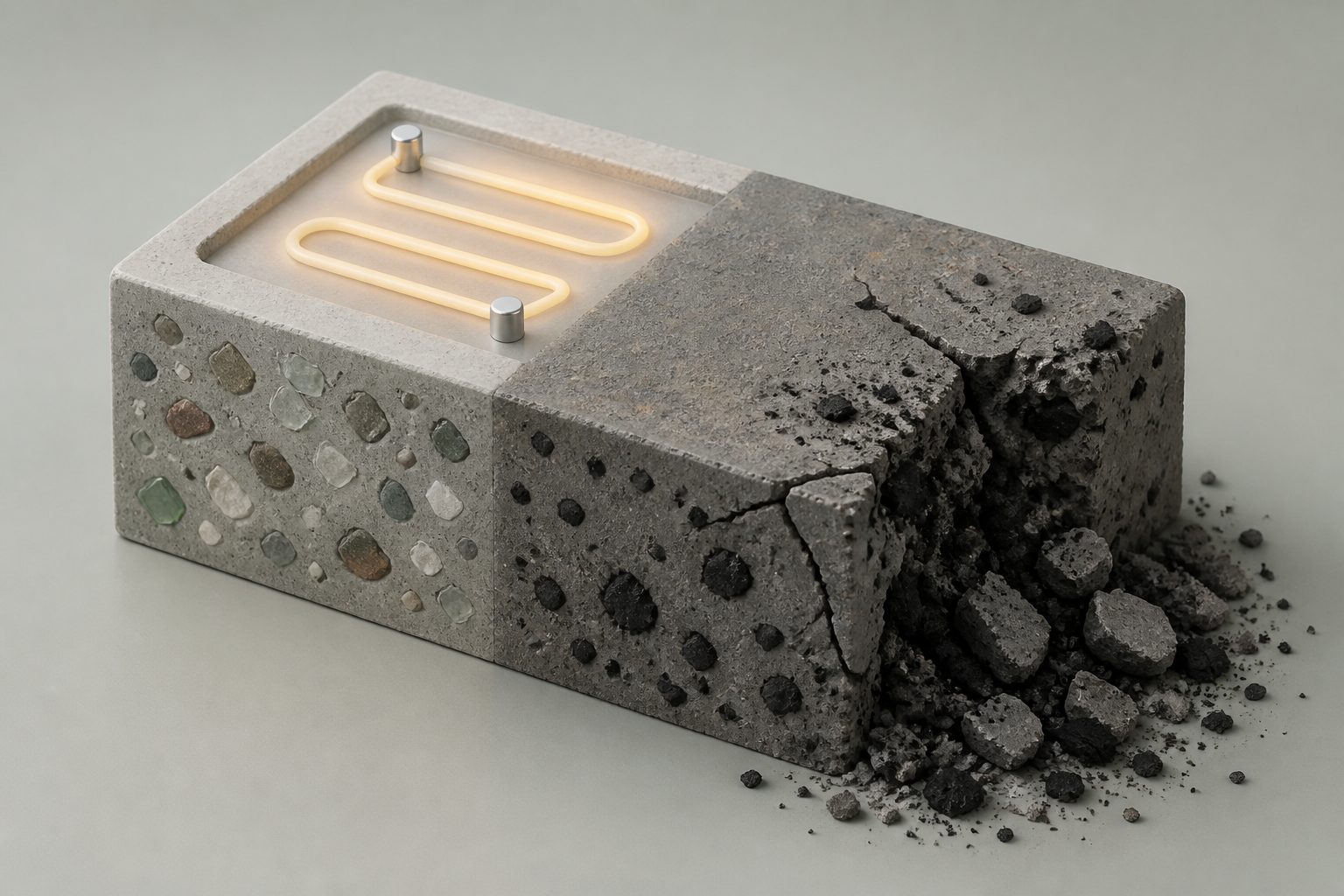
Graphene sheets delivered the largest increase in electrical storage, while carbon fibers better preserved performance during curing.
The study compared two carbon materials in solid-waste-based cementitious electrodes. Graphene nanoplatelets increased areal capacitance—the amount of electrical charge stored per unit area—by up to 1,040-fold, reaching 436.93 mF/cm². Carbon nanotubes produced a 499-fold increase.
Graphene provided the higher initial storage capacity but caused a larger loss of compressive strength. Carbon nanotubes produced a smaller strength loss and maintained more stable electrochemical performance as the material cured. The researchers used a combined score for strength, storage capacity and electrical behavior to assess the tradeoff and guide additive amounts.
What the carbon additives changed
Both carbon additives improved energy-storage performance but reduced compressive strength. Graphene nanoplatelets increased areal capacitance by up to 1,040-fold, to 436.93 mF/cm², compared with a 499-fold increase from carbon nanotubes. The strength loss was 64% with graphene and 46% with carbon nanotubes.
The researchers linked graphene’s stronger storage performance to its sheet-like structure, which provides a large surface for electrochemical reactions and supports electron movement across the sheets. During continued hydration—the chemical reaction in cement as it cures—hydration products increasingly covered the graphene and encouraged the sheets to clump and restack, reducing capacitance. Carbon nanotubes, which have a fibrous structure, better preserved connected pathways through pores and hydration products, giving them greater electrochemical stability with curing age.
Evidence and open limits
This is a materials study comparing cementitious electrodes made with graphene nanoplatelets or carbon nanotubes. The conclusions are based on measurements of compressive strength, areal capacitance, electrical behavior and changes associated with cement hydration, along with a combined score for structural and energy performance.
The abstract does not report sample sizes, the detailed mix designs, the duration of testing or whether the materials were tested in building components. It also does not establish how the electrodes would perform in a working building energy-storage system. The reported improvements therefore describe laboratory material performance, not demonstrated building-scale energy storage.
// Source
Materials Reports Solidwaste and Ecomaterials · 2026 · DOI: 10.26599/mrse.2026.9520037
Authors: Qian-Tong Tang, Wenjing Sun, Yue‐E Miao, Jie Yao, Yanming Su, Peng Jin, Mehdi Mehrali, Jun Yuan, Hilary Rutto
Institutions: Technical University of Denmark, University of the Witwatersrand, Donghua University, China Power Engineering Consulting Group (China), Northeastern University, Nanyang Technological University, Eastern University