Two rare events produced changes of up to 0.8 metres per second in current speed and 0.8 metres in water level.
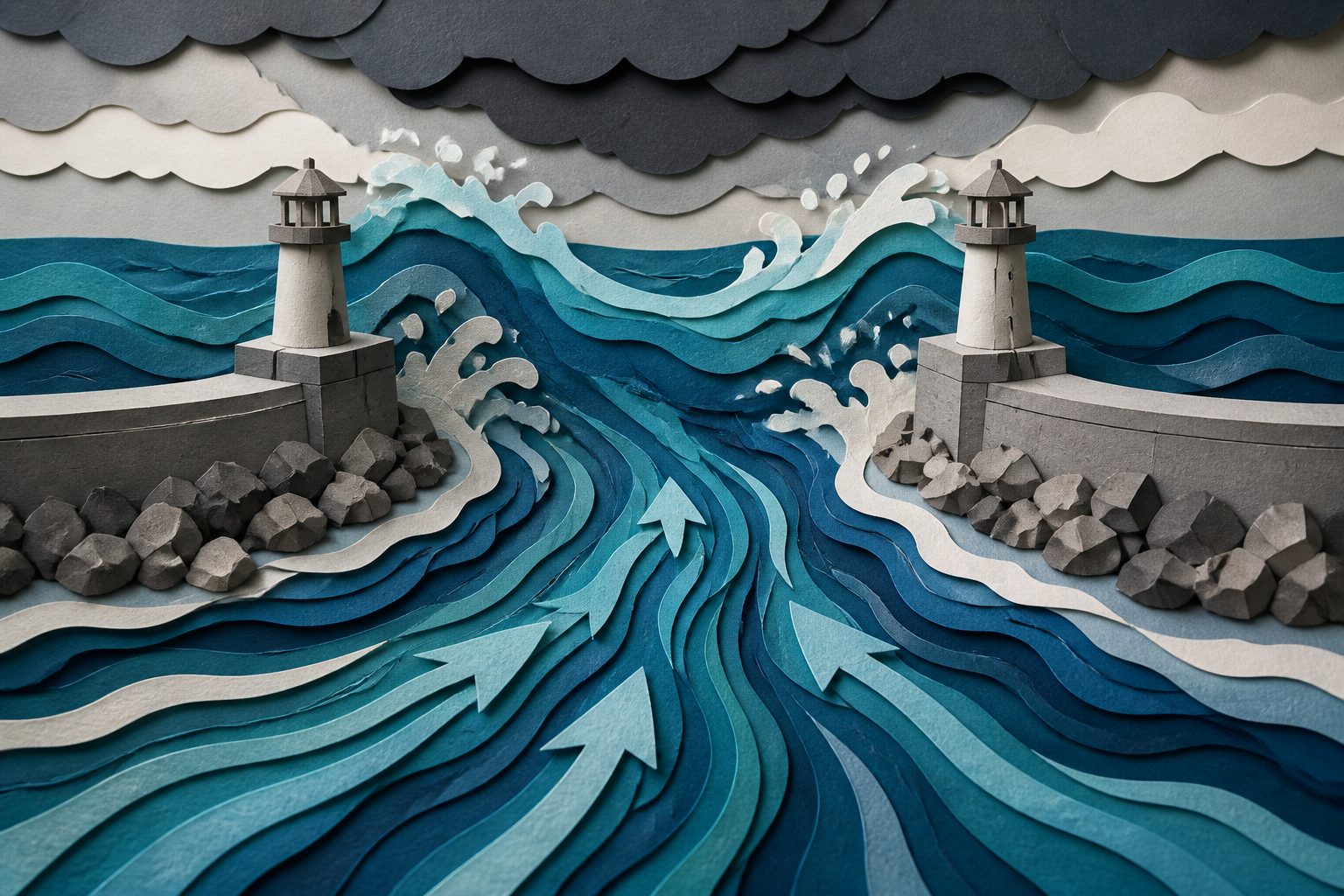
Researchers used three measuring stations to track currents and sea level in the 2.4-kilometre channel between Varna Lake and the Black Sea. Most sub-hourly changes were moderate, but two events produced much larger oscillations lasting several cycles.
The researchers linked the observed patterns to long waves resonating in the channel-and-lake system. One event may have been caused by a meteotsunami, while the other followed strong winds directed toward land more than five hours earlier.
Sudden channel oscillations
The measurements showed oscillations with periods of about 37 and 19 minutes. The 37-minute signal fits the first mode, or natural pattern of oscillation, of the channel-and-lake system. The 19-minute signal resembles both a quarter-wave pattern in the channel and a second system-wide mode.
Two high-amplitude events stood out. In one, strong channel oscillations began abruptly during otherwise moderate weather, which the researchers interpret as a possible meteotsunami. The other occurred more than five hours after winds toward land reached up to 20 metres per second. Across the events, current speed and sea level changed by up to 0.8 metres per second and 0.8 metres over 10 minutes.
Measurements and limits
The study is based on current and sea-level observations from three stations recording at one-minute intervals, together with one-dimensional analytical and numerical models of long waves. The models reproduce basic features of the observed oscillations and support the interpretation that resonance helped drive them.
Only two high-amplitude events are highlighted in the abstract, and the observation period is not specified there. The proposed cause of one event is an interpretation rather than a direct measurement of a meteotsunami, and the other event is associated with earlier strong winds. The results describe this Varna channel and do not establish how often similar events occur in other harbors.
// Source
Ocean science · 2026 · DOI: 10.5194/os-22-2471-2026
Authors: Jüri Elken, Laura Piho, Maarja Kruusmaa
Institutions: Tallinn University of Technology