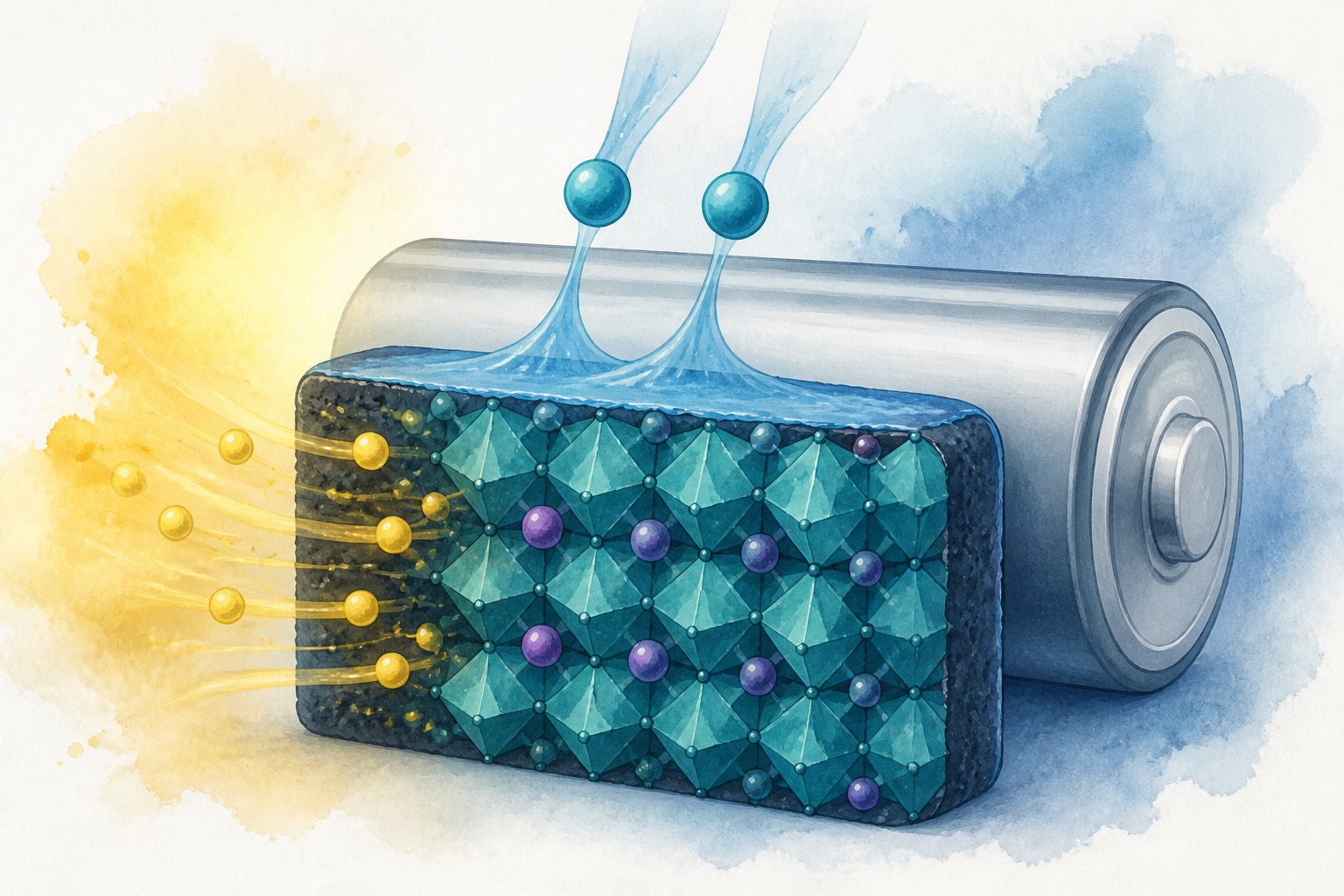
Putting scandium inside the electrode stabilized its crystal structure, while a surface coating appeared to protect the electrode interface.
Researchers tested two ways of adding scandium to O3-NaNi1/2Mn1/2O2, a layered oxide used as a positive electrode in sodium batteries: placing scandium within the material and adding a scandium oxide coating to its surface.
Both approaches improved cycling in experiments, but they worked differently. Internal scandium helped stabilize the electrode’s crystal structure, while the coating appeared to improve stability at the electrode’s surface, possibly by reducing the loss of metal atoms.
How scandium helped
In sodium half-cell tests, capacity retention after 100 cycles increased from 18.6% for the untreated material to 67.8% for the scandium-doped sample and 75.4% for the scandium-coated sample. Both treatments also enabled sustained operation for more than 300 cycles in sodium-ion cells.
The researchers found that the two methods improved cycling through different mechanisms. Scandium doping created a structural sodium “pillar” between layers of the electrode. The redox-inactive Sc3+ ions attracted nearby sodium ions and helped suppress rapid lattice shrinkage as sodium was removed during charging. The doping also suppressed an unwanted O’3 phase, which the researchers found could smooth the discharge potential; this interpretation was supported by ex situ X-ray diffraction and density functional theory calculations.
The scandium oxide coating appeared to improve stability at the electrode’s interface, possibly by suppressing the dissolution of transition-metal elements from the material.