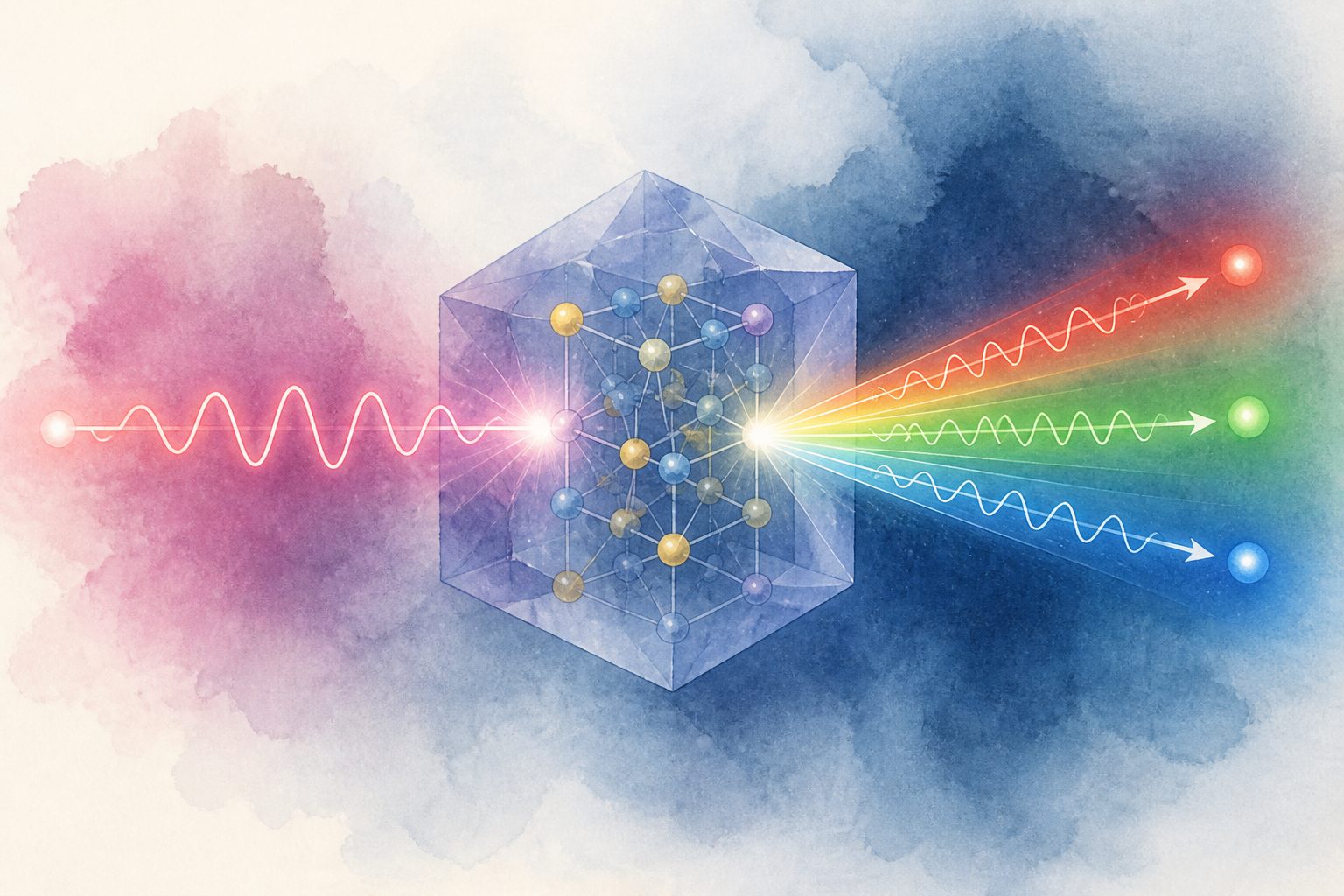
The study addresses limits in photon upconversion, a process that can move light from infrared to visible wavelengths. The authors propose a “LEGO-inspired photon stacking” approach using cascade pumping, guided by machine learning, in which an intermediate state of lanthanide ions acts like a “virtual ground state” to enable direct pumping into energy levels that produce desired emissions.
As a proof of concept, they focus on NaYS2:Ho3+. By controlling populations precisely, they report selective emission enhancements of 2–3 orders of magnitude, extend efficient response to about 2100 nm, and reduce response time from 30 milliseconds to 54 microseconds. They also show the strategy can generalize to other lanthanides and that energy-transfer tuning in Ho3+-sensitized systems can yield near-pure RGB emission, along with narrowband CO2 sensing performance using the resulting rapid upconversion photodetection.