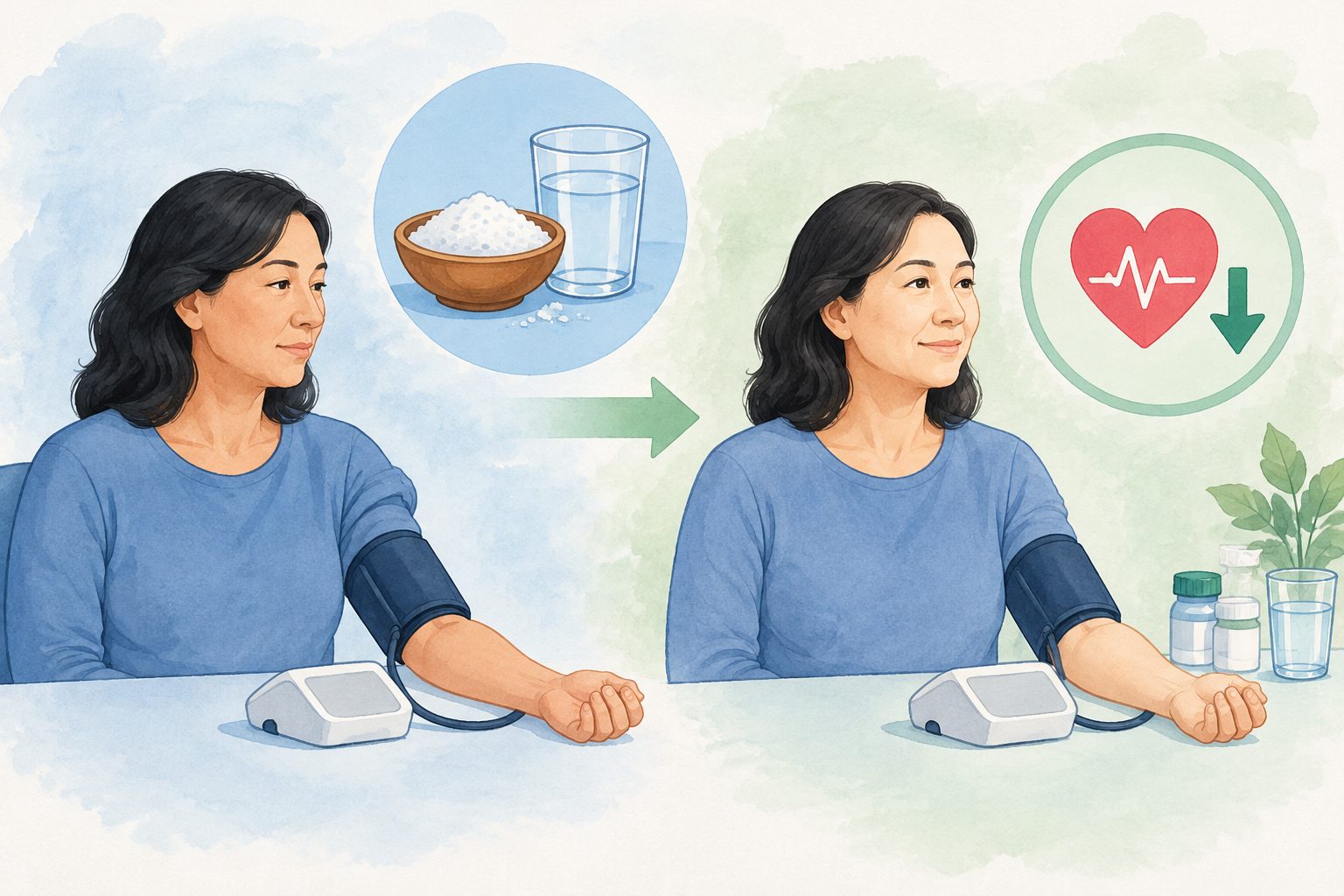
Researchers tested whether drinking NNS beverages instead of water would lead to different long-term weight change. Participants joined a structured behavioral program with weekly assisted meetings during an initial 12-week weight-loss phase, followed by monthly meetings during a 40-week maintenance phase.
Health & Medicine2 months ago
Trial found non-nutritive sweetened drinks were similar to water for weight over 2 years
In adults in a behavioral weight-management program, weight change after 104 weeks was not significantly different between NNS drinks and water.
Moderate evidenceHuman studySome caution advised
Medical disclaimer: This article summarizes research findings and is for informational purposes only. It is not medical advice.

The question examined
The study asked whether non-nutritive sweetened (NNS) beverages and water lead to different body-weight changes over a long period in adults. Design: parallel-group, open-label, controlled equivalence randomized trial. Participants: 493 adults (body mass index 27–35 kg/m²) who regularly consumed cold beverages. Groups: water (n=246) vs NNS beverages (n=247). Follow-up: 1 year of assisted weight management, then a voluntary, unassisted 1-year extension, with a final meeting at week 104.
What the trial found
In the unassisted monitoring phase, the primary endpoint was weight change from baseline at week 104. People assigned to water maintained a weight loss of 3.7 kg over 104 weeks, compared with 4.8 kg with NNS beverages, and the between-group difference was not significant. After the final 52-week unassisted phase (total 104 weeks), water and NNS beverages were reported as showing equivalence for weight change from baseline.
Who this may apply to
These findings may apply to adults with overweight (BMI 27–35 kg/m²) who regularly drink cold beverages and who participate in a structured behavioral weight-management program for up to 2 years. They may not apply to people outside similar settings, people with different baseline health conditions, or to situations without comparable weight-management support. This study addresses weight change outcomes in the context described, not broader effects (such as impacts on specific metabolic outcomes), and it is not an all-purpose recommendation for beverage choice in all circumstances.
Why it matters
For people managing weight, this trial provides human data suggesting that, within a behavioral weight-management program, choosing NNS beverages versus water was not associated with a clearly different long-term weight outcome over 2 years. These findings are most relevant to adults with similar BMI and who participate in similar structured weight-management support.
Limitations & evidence assessment
Key limitations include that the trial was open-label, meaning participants and researchers knew which beverage group they were assigned to, which can influence behavior and reporting. Although it was randomized, 220 participants completed the final unassisted phase (water: 117; NNS: 103), so results may reflect those who stayed in the study. The abstract reports equivalence using two-sided P>0.05, but it does not provide the full equivalence margins or detailed statistical methods. Also, the study took place within a specific behavioral weight-management program, so outcomes may not generalize to people not receiving similar structured support. Finally, the abstract provides limited detail about other factors that could affect weight (for example, changes in diet composition or physical activity), which constrains interpretation.
Why this evidence level: Randomized trial with a smaller detected sample (n≈493).
Evidence levels are editorial estimates derived from study metadata — they are not clinical appraisals.
// Source
British Journal Of Nutrition · 2026 · DOI: 10.1017/s0007114526108150
Authors: Joanne A. Harrold, Scott Hill, Cristina Radu1, Paul Thomas, Paula Thorp, Charlotte A. Hardman, Paul Christiansen, Una Masic, Lauren McGale, Daniel J. Cuthbertson, Jason C. G. Halford
Institutions: University of Liverpool, University of Leeds, Edge Hill University