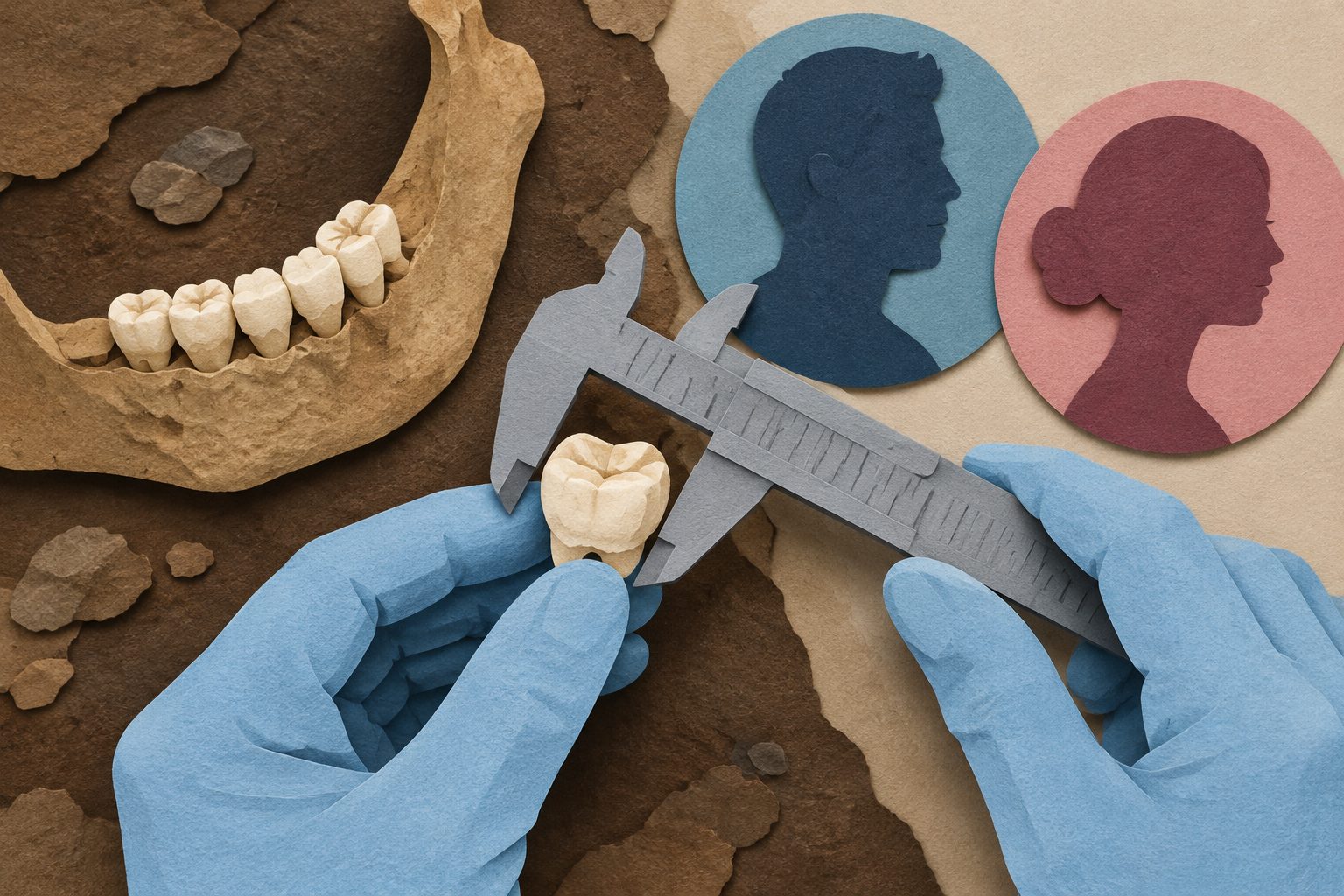
A study of 166 cadavers found that male tooth crowns were generally larger than female crowns and used those differences to develop sex estimates.
Researchers measured the length and two widths of preserved tooth crowns from 166 cadavers: 127 male and 39 female. They compared tooth size and shape between the groups, tested relationships among measurements, and used all three measurements in statistical analyses to derive sex discriminants.
Male crowns were generally larger across the teeth examined. Differences in proportions were clearest for the upper second premolar and lower canine, while the researchers reported that a single intact tooth type could produce three discriminants, with 42 discriminants derived across the tooth types studied.
What the teeth showed
All measured tooth-crown dimensions were significantly larger in males than in females. The study measured crown length, mesiodistal width—the distance from one side of a tooth to the other—and buccolingual width, the distance from the cheek-facing side to the tongue-facing side.
Most tooth-crown proportions did not differ significantly between males and females. The clearest proportional differences involved the upper second premolar and lower canine. In males, the upper second premolar had a greater crown-length-to-mesiodistal-width ratio and a greater crown-length-to-buccolingual-width ratio. For the lower canine, the mesiodistal-to-buccolingual ratio was larger in females.
The researchers used Fisher’s linear discriminant analysis, a statistical method for separating groups, to derive sex-related equations from the measurements. Three discriminants could be obtained from one type of intact tooth, and 42 were derived in total across the tooth types. The excerpts provided do not report the accuracy for each discriminant.
Evidence and caveats
This was a measurement study of extracted teeth from 166 cadavers, including 127 males and 39 females aged 20 to 93 years. A single trained examiner measured preserved, measurable crowns three times with the same digital caliper; repeat measurements showed excellent consistency. The sample had substantially more males than females, and the female group was older on average than the male group.
The study examined cadaver teeth described in the article as belonging to modern adults, and the results may not apply equally to other populations or settings. Only crowns that remained measurable were included. The excerpts do not provide the accuracy values for the discriminants or describe testing in an independent group, so they do not establish how well the method would perform on new forensic cases.