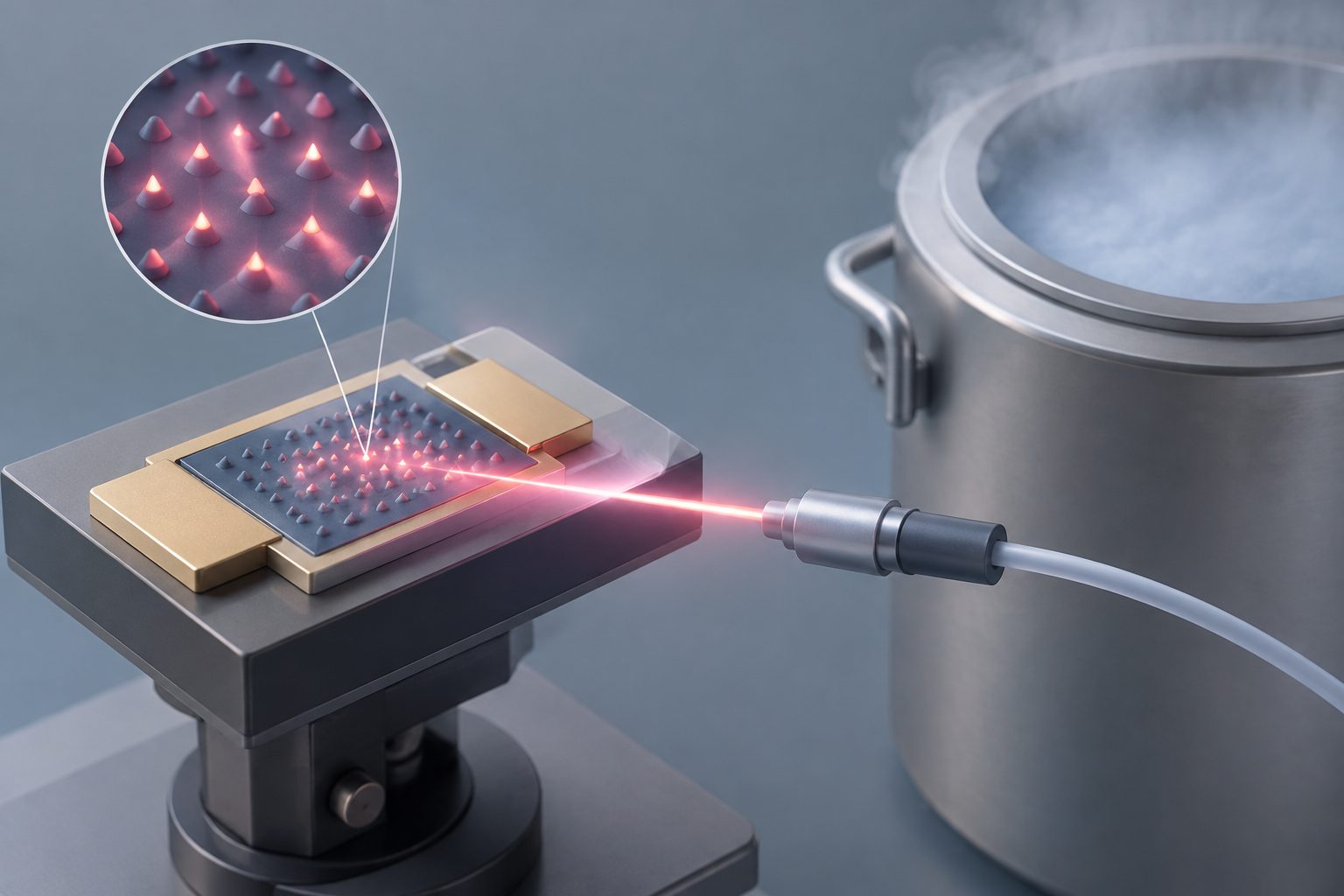
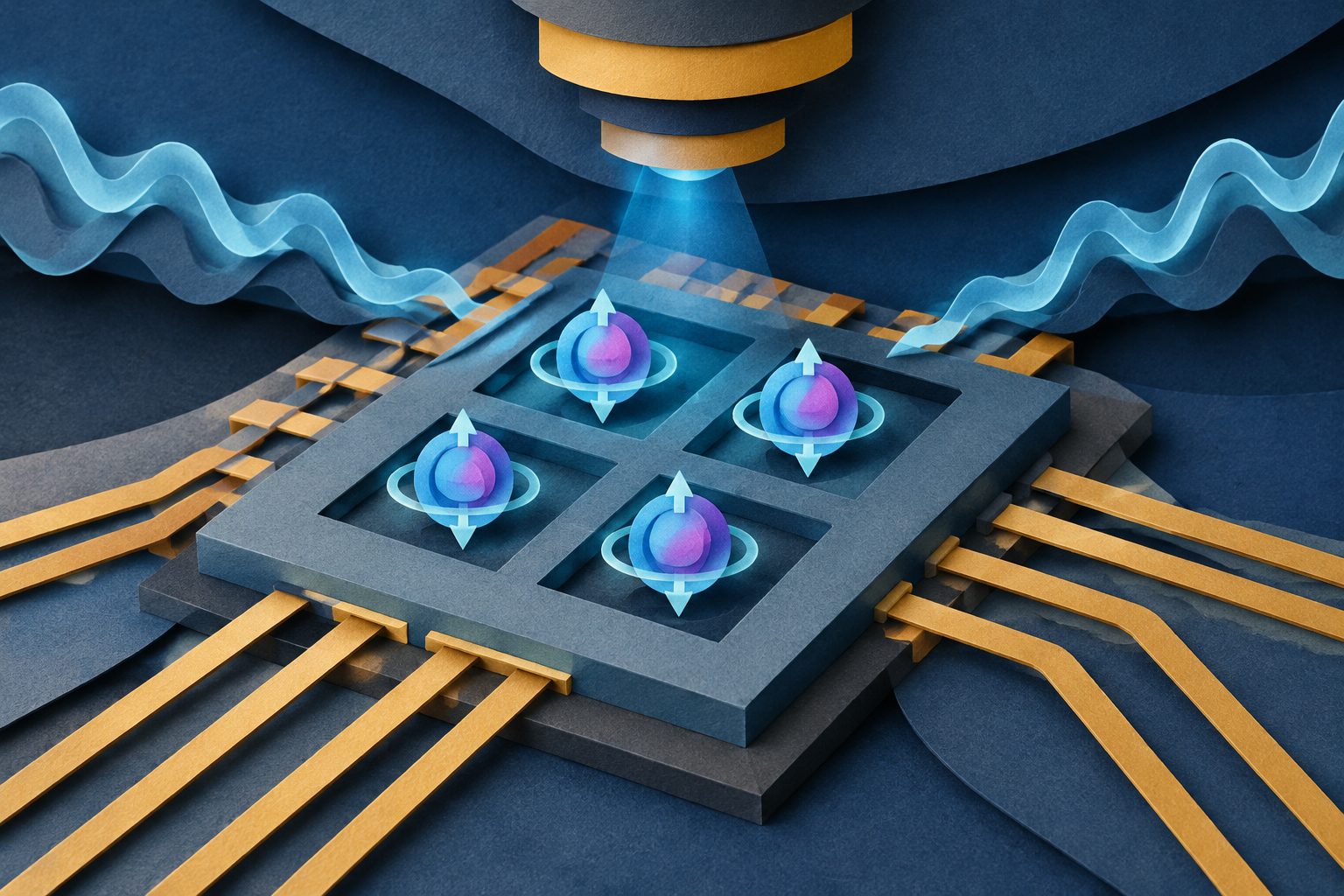
The emitters produced single photons in a telecommunications wavelength band, while their properties still need tuning for entangled-photon sources.
The team used local droplet etching and metal-organic vapor phase epitaxy to make low-density indium gallium arsenide quantum dots in an indium aluminum arsenide material. Microscopy showed that the dots formed in nearly symmetric nanoholes, and optical measurements found distinct emission lines with little evidence that nonradiative losses affected them.
The dots had emission lifetimes of about 1–2 nanoseconds and produced single-photon signals under both continuous and pulsed excitation. Numerical modeling identified thermal excitation pathways that explain why emission persisted as the samples were heated to liquid-nitrogen temperatures.
What the dots produced
The quantum dots emitted in the telecom C-band and had a low density of about 10⁹ dots per square centimeter. Their emission lines had linewidths of about 0.2 millielectronvolts, while the excitonic fine-structure splitting—a small energy difference between two polarization states—was about 60 microelectronvolts. Emission decayed over roughly 1–2 nanoseconds, consistent with the researchers’ simulations.
Second-order autocorrelation measurements, which test whether photons arrive one at a time, gave g²(0) values of 0.07 ± 0.02 under continuous-wave excitation and 0.16 ± 0.18 under pulsed excitation. The researchers report single-photon purity of about 93%. Modeling based on the dots’ electronic structure identified thermal excitation pathways that account for emission continuing up to liquid-nitrogen temperatures.
Why the temperature result matters
Telecommunications-band single-photon sources are being developed for quantum communication applications. A fabrication approach that produces low-density, relatively symmetric emitters and preserves their light emission at liquid-nitrogen temperatures could provide a foundation for studying more practical quantum light sources.
The result does not yet establish a source of polarization-entangled photons. The researchers say that further growth optimization and electrical or mechanical tuning will be needed to reduce or control the fine-structure splitting sufficiently for that goal.
Evidence and remaining limits
The study combines transmission electron microscopy for structural analysis, photoluminescence and lifetime measurements for optical properties, and photon-correlation measurements for single-photon emission. Numerical calculations were used to identify the thermal pathways associated with the persistence of emission at higher temperatures.
The measured fine-structure splitting was on the order of tens of microelectronvolts, rather than at the few-microelectronvolt scale the researchers identify as more suitable for high-quality polarization-entangled photon sources. The work demonstrates the fabrication and optical behavior of the emitters, but scalable production and entangled-photon generation were identified as goals for future work rather than results shown here.