Tiny ozone bubbles removed up to 89% of aflatoxins in peanut meal
The treatment broke down four major aflatoxins, and tests predicted that the resulting products would be safe.
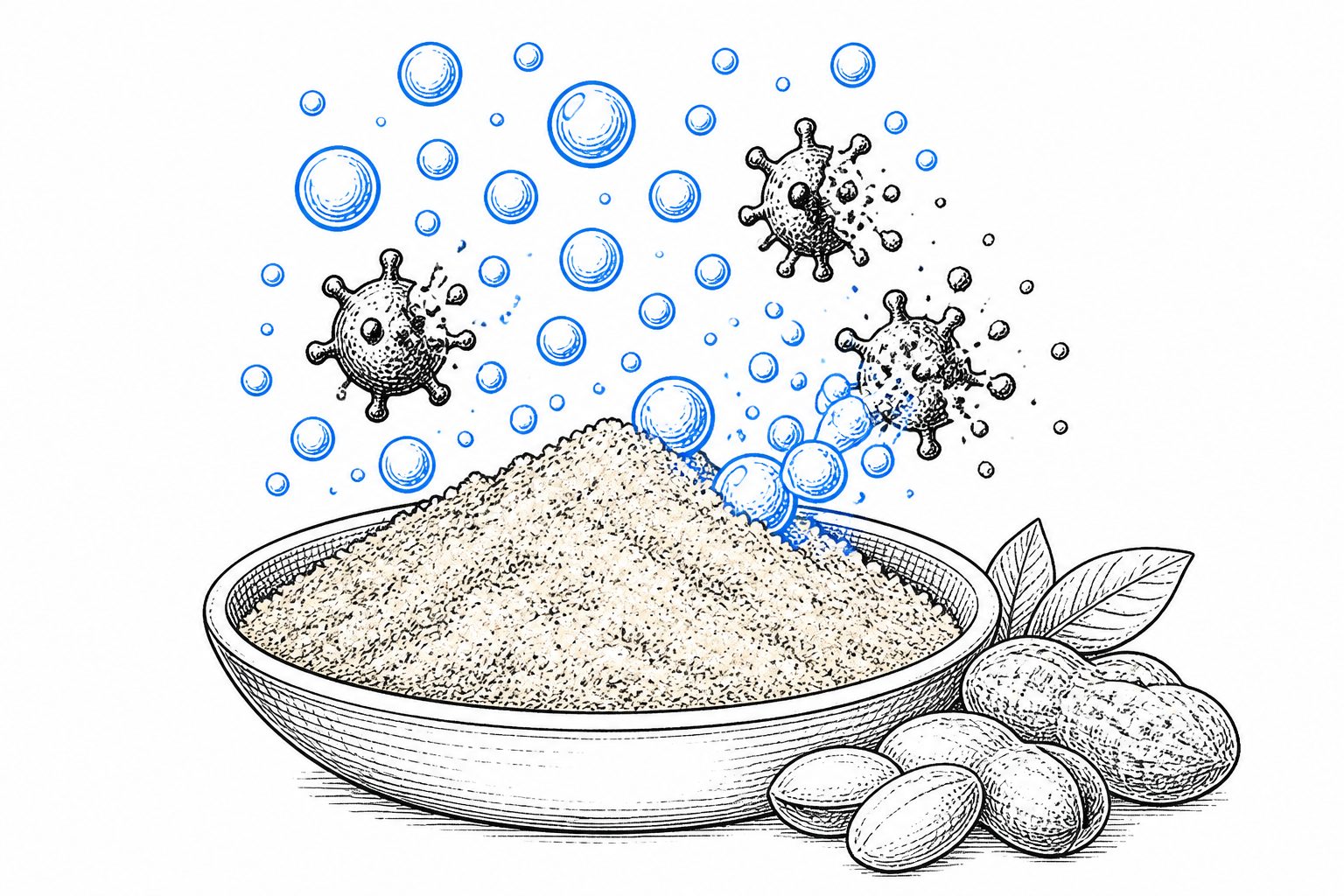
Editorial illustration — not from the study.
Researchers developed a system that mixes ozone with micro- and nanoscale bubbles to treat peanut meal contaminated with aflatoxins. Under the best tested conditions, the system removed 87.76% of AFB1, 77.93% of AFB2, 79.91% of AFG1 and 88.56% of AFG2, performing better than five other treatments examined in the study.
Chemical tests indicated that hydroxyl radicals were the main reactive species involved in breaking down the toxins, with superoxide radicals and ozone also contributing. The researchers identified multiple breakdown products and pathways, and reported that nutrient analysis, toxicity predictions and cell-based tests supported the safety of the treated peanut meal and the resulting products.
What the ozone bubbles did
The researchers tested a customized micro-nano bubble and ozone system on four aflatoxins in peanut byproduct: AFB1, AFB2, AFG1 and AFG2. The optimized settings were an outlet pressure of 0.34 MPa, an ozone flow rate of 2.5 L/min, a treatment time of 120 minutes and a solid-to-liquid ratio of 12.5 g/L.
Under those conditions, removal rates were 87.76% for AFB1, 77.93% for AFB2, 79.91% for AFG1 and 88.56% for AFG2. The system retained high degradation efficiency over 12 consecutive reuse cycles. Experiments indicated that hydroxyl radicals played the largest role in the reactions, alongside superoxide radicals and ozone.
The breakdown of the four toxins produced 37, 14, 19 and 10 identified products, respectively, through 18, 6, 7 and 4 proposed pathways. The researchers said the first attacks generally occurred at the toxins’ terminal furan ring, followed by changes to other chemical groups. Nutrient analysis, toxicity predictions and cytotoxicity tests supported the safety of the treated peanut meal and degradation products.
Why safer breakdown matters
Aflatoxins can threaten food safety and human health, while effective ways to remove them remain limited. The study suggests that combining ozone with tiny bubbles could be a practical way to reduce several major aflatoxins in peanut byproduct, with possible use in the feed industry.
The reported safety results are important because removing a toxin can produce new chemicals that also need to be assessed. Here, the researchers reported that their analyses and cell-based tests supported the safety of the treated material and its breakdown products, although the study does not establish how the system would perform across all peanut products or industrial settings.
Evidence and open questions
This was a laboratory study of a customized treatment device, using optimized operating conditions and comparisons with five other treatments. The researchers used chemical analyses, experiments that identified reactive species, nutrient analysis, toxicity predictions and cytotoxicity assays. The system was also tested for effectiveness over 12 reuse cycles.
The abstract does not report the sample size, detailed test conditions for the safety assays or validation in large-scale feed production. It also reports predicted and tested safety for the treated peanut meal and identified products, rather than evidence of safety across all foods, animals or people. The proposed degradation pathways and product identities should therefore be understood within the scope of the study.
// Source
npj Science of Food · 2026 · DOI: 10.1038/s41538-026-01129-3
A 20-year comparison in California’s Central Valley found that reduced tillage with cover crops produced more stable soil aggregates, greater water retention and different forms of carbon protection than standard tillage without cover crops. The conservation system also retained room for additional carbon storage, although the study measured potential rather than future gains.
Human forebrain organoids classified artificial tactile Braille signals after a sensor converted the touch data into electrical stimulation. Accuracy averaged 61% with one organoid and rose to 83% when responses from three organoids were combined.
A study in mice found that a peptide targeting the memory-related protein CPEB3 reduced the persistence of traumatic memories and anhedonia, a loss of pleasure. The findings are an early genetic preclinical test of a possible approach for PTSD, not evidence of a treatment in people.