A theoretical study finds that the particle’s predicted decays match measurements, supporting the idea that it is made from three gluons.
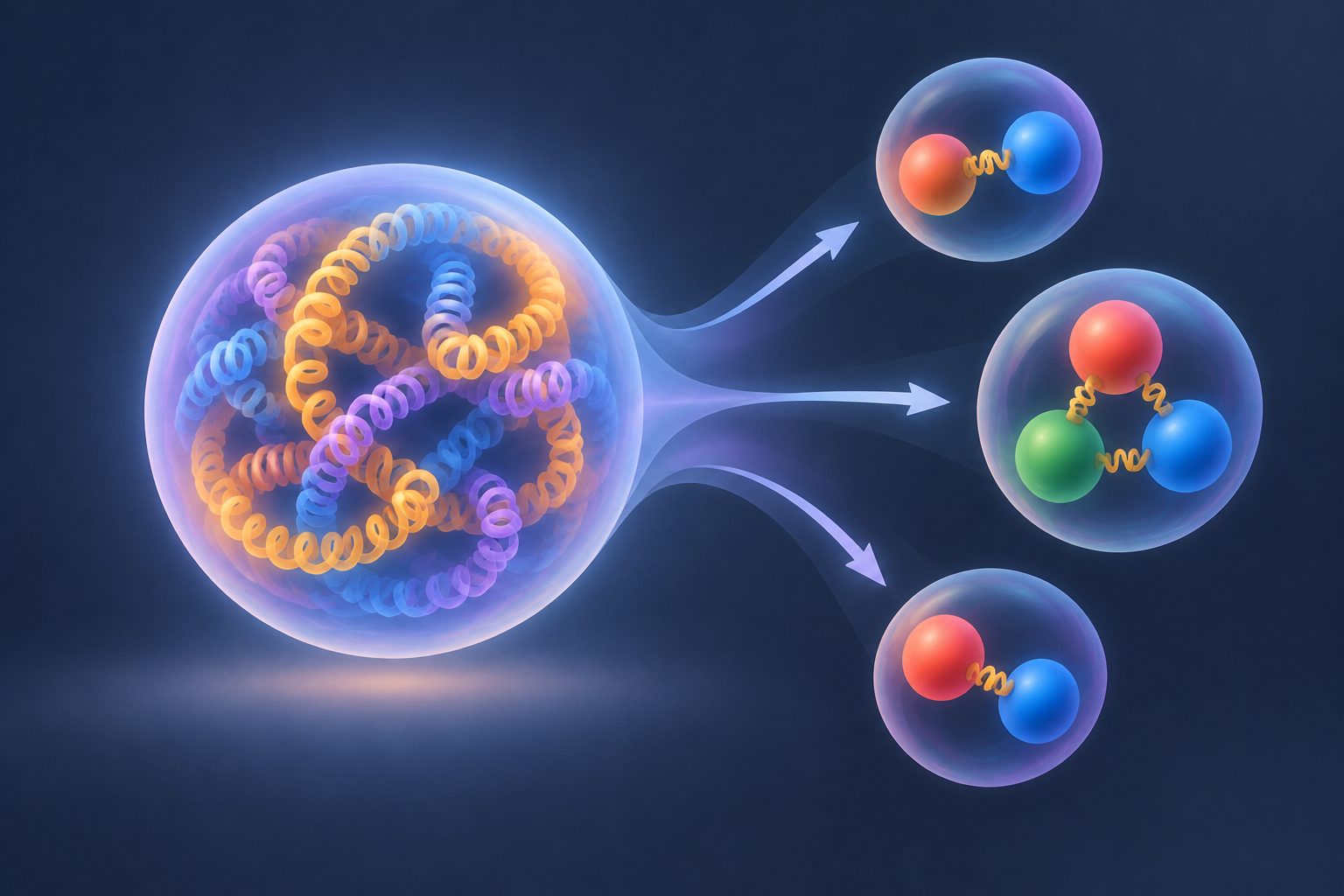
Researchers studied the X(2370) as a particle with quantum properties labeled 0−+, assuming it is a glueball made from three valence gluons. They built a six-quark description of its interaction with matter particles and used mathematical rearrangements to calculate how it could decay into three particles such as pions, kaons and eta mesons.
The calculation produced ratios between the rates of these different decay routes. The researchers report that the ratios agree with available BESIII measurements, which supports assigning the X(2370) a glueball interpretation.
What the decay calculation found
The researchers assumed that the X(2370) is a three-gluon glueball and derived its interactions with quarks using a six-quark current. They then transformed that description into interactions involving three pseudoscalar mesons, a group that includes pions, kaons and eta mesons. The resulting ratios of partial decay widths—the relative rates of different decay channels—were compatible with BESIII data. On that basis, the study supports interpreting the X(2370), with quantum numbers 0−+, as a glueball.
// Source
The European Physical Journal C · 2026 · DOI: 10.1140/epjc/s10052-026-16450-0
Authors: Zhi-Gang Wang
Institutions: North China Electric Power University