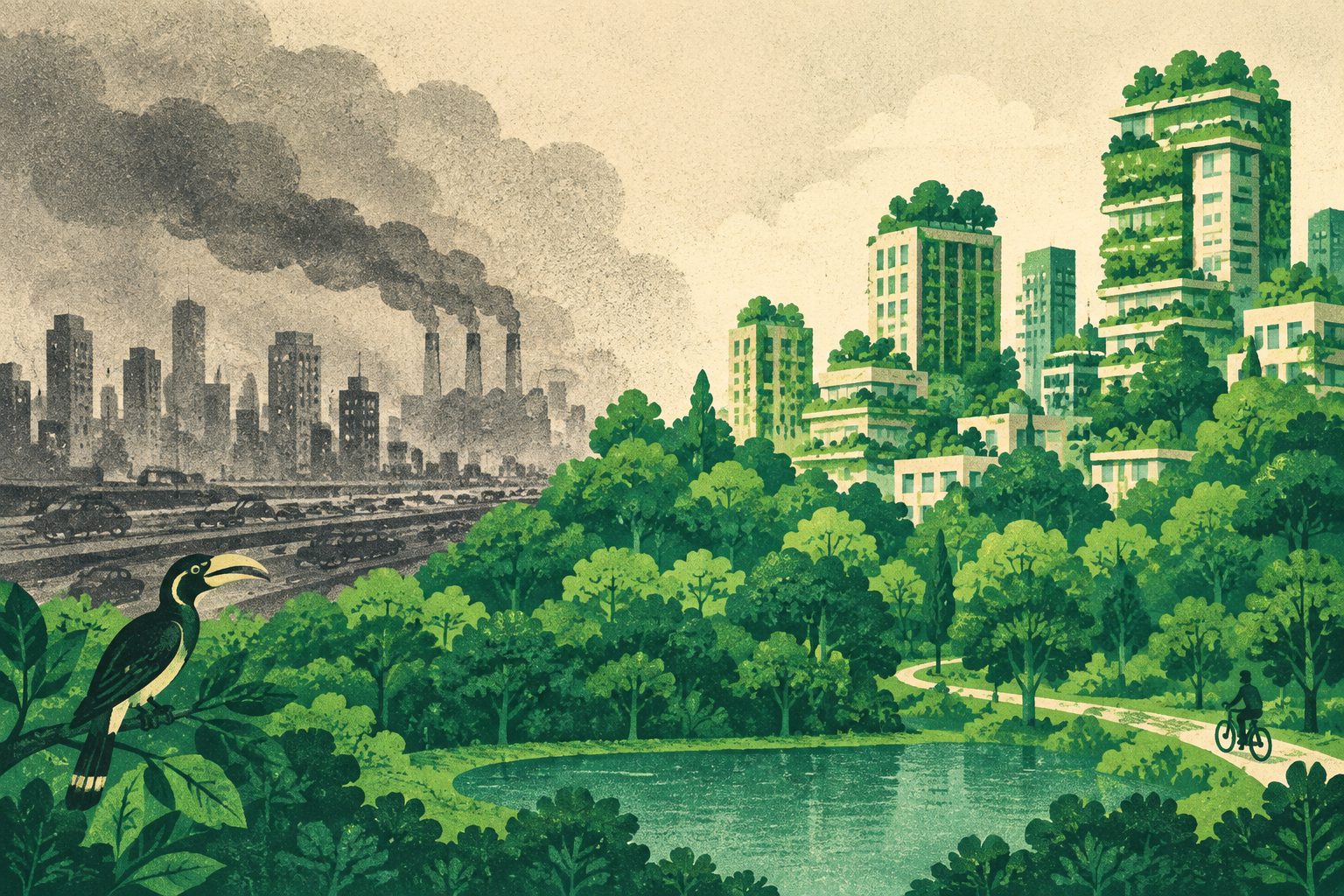
A study of Ban San Chao in Rayong argues that green-space policy can bring forests under industrial and municipal control while leaving pollution’s material causes unresolved.
The paper examines Ban San Chao Community Forest in Rayong, where state and industrial actors worked through Thailand’s Eco-Industrial City policy. It identifies three linked changes: presenting the forest as a shared space for coexistence and cooperation, placing its governance under municipal and industrial oversight, and using annual technical assessments to certify and repeat that arrangement.
The authors argue that this process absorbed an existing community forest into an eco-city system. It temporarily helped restore trust in institutions and reduce political conflict over pollution, but deferred attention to the material causes of that pollution rather than resolving them.
How the forest was reshaped
The researchers describe three mechanisms behind the forest’s restructuring. First, the forest was presented in more uniform terms, centered on coexistence and cooperation among different sectors. Second, municipal and industrial actors gained a stronger role in governing the Community Forest. Third, an annual technical assessment cycle certified and reproduced the new arrangement.
Together, the authors argue, these changes turned the forest into an eco-city project that could restore institutional legitimacy while depoliticising challenges to industrial pollution. The paper characterises this as a local form of an environmental and urban policy fix: absorbing and reorganising an existing community-created green space without addressing the underlying sources of pollution.
Why the case matters
The case shows how environmental policy can respond to conflict over pollution by reorganising community forests and presenting cooperation as the solution. That may create a more stable institutional arrangement, but the study argues it can also move attention away from the industrial practices and material conditions that generated the conflict.
The findings are relevant to debates about green development and forest governance in Southeast Asia because they show how community-created green spaces may be incorporated into state and industrial projects rather than remaining independent sites of political challenge.
Evidence and limits
This is a journal article examining one community forest, Ban San Chao, in Rayong Province. The abstract presents a qualitative interpretation of how policy, governance and political claims were reorganised around the forest; it does not report pollution measurements, population-level outcomes or numerical estimates of the policy’s effects.
Because the analysis focuses on one local case, the abstract does not establish that the same process occurs in all Thai community forests or eco-city projects. It also describes the changes as temporarily restoring legitimacy and deferring pollution’s causes, rather than showing that the underlying pollution was reduced or eliminated.
// Source
Geoforum · 2026 · DOI: 10.1016/j.geoforum.2026.104832
Authors: Sophie Rose Lewis, Pitch Pongsawat, Artit Phuboonkong
Institutions: Chulalongkorn University