Study links family history and gallstones to higher bile cancer risk
A large Korean cohort found the highest reported risk among offspring with both a parent affected by biliary cancer and gallstones.
Moderate evidenceHuman studyInterpret with caution
Medical disclaimer: This article summarizes research findings and is for informational purposes only. It is not medical advice.
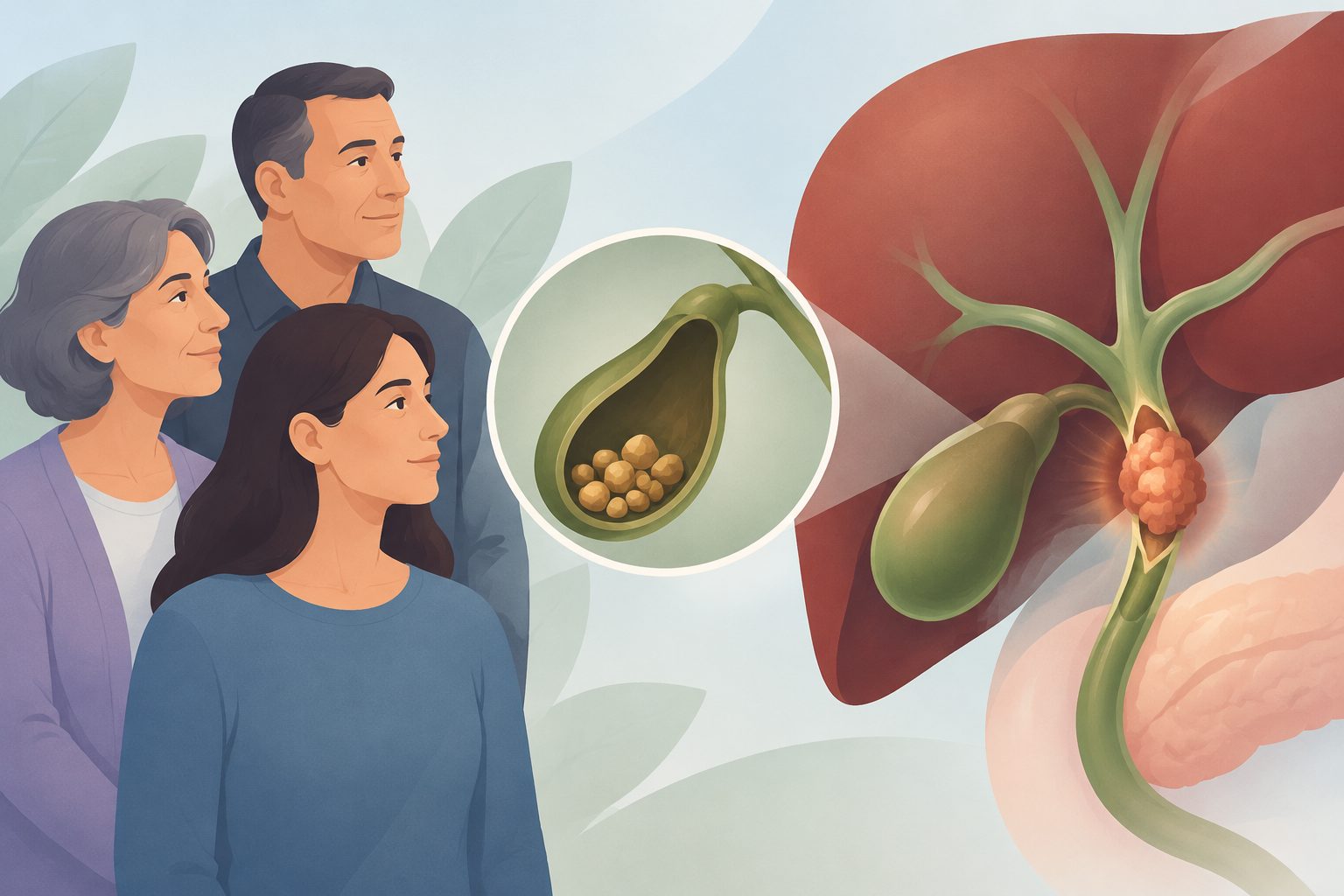
Editorial illustration — not from the study.
Using linked Korean National Health Insurance and health-screening records from 2002 through 2018, researchers followed 6,217,057 offspring from about 1.4 million families. They compared biliary tract cancer rates in people with and without an affected parent and examined whether gallstones were associated with a different level of risk among those with a family history.
Overall, offspring with an affected parent had about 2.17 times the recorded biliary tract cancer risk of those without an affected parent. The combined group with gallstones and a family history had a reported hazard ratio of 17.36, but the statistical test for an interaction between the two factors was not conclusive.
What was studied
The researchers examined familial risk for biliary tract cancer, which includes bile duct cancer and gallbladder cancer, among offspring. They used Korean health-insurance claims and health-screening databases covering 2002-2018 and included 6,217,057 offspring and 3,655,642 parent couples from about 1.4 million families. The cohort analysis compared cancer incidence and hazard ratios in offspring with versus without an affected parent. It also assessed whether gallstones changed the association between family history and cancer risk, using a measure called the relative excess risk due to interaction.
What researchers observed
Offspring with an affected parent had 0.35 biliary tract cancer cases per 10,000 person-years, compared with 0.08 cases per 10,000 person-years among those without an affected parent. This corresponded to a reported 2.17-fold higher risk. Maternal history was associated with a higher reported risk than paternal history, with hazard ratios of 3.20 and 1.33, respectively, and the relative association was higher among younger offspring.
The study reported that maternal history of one biliary cancer type was associated with the other type in offspring, while paternal history was not; it did not find significant same-site associations. Familial risk was lower in areas where Clonorchis sinensis, a parasitic infection, is endemic than in other regions. Offspring with both gallstones and a family history had a reported hazard ratio of 17.36, with a 95% confidence interval of 9.80-30.81. However, the interaction estimate was not statistically conclusive: the relative excess risk due to interaction was 7.63, with a 95% confidence interval from -2.32 to 17.58. These findings are associations, not proof that family history or gallstones caused cancer.
Who this may apply to
The findings are most directly relevant to populations resembling the people included in this large Korean cohort, particularly offspring with a recorded parental history of biliary tract cancer and gallstones. They do not show that every person with a family history or gallstones will develop cancer, and they may not apply in the same way to people from other countries, ethnic groups, or healthcare systems. The study also does not establish a screening or surveillance plan for any individual.
The significance
Biliary tract cancers are uncommon, so identifying groups with higher recorded risk could help researchers understand how inherited or shared family factors relate to these cancers. The findings also suggest that gallstones and family history may be important factors to study together. However, the study does not establish an individual person's future risk, determine why maternal and paternal associations differed, or show that intensified monitoring would improve outcomes. The authors stated that early and intensive surveillance should be considered for this group, but this cohort study by itself does not establish the benefits or harms of such an approach.
Limitations & evidence assessment
This was an observational study, so differences between families and individuals may explain some or all of the associations; it cannot establish cause and effect. Health-record and claims data can have limitations in how diagnoses, family relationships, gallstones, and other relevant factors are recorded. The abstract does not provide full details about follow-up duration, missing data, adjustment for all potential confounders, or how cancer diagnoses were confirmed. Some estimates, especially the combined gallstone and family-history result, have wide confidence intervals, and the formal interaction test was not statistically conclusive. Results from Korean populations and the studied calendar period may not apply equally to other populations or health systems.
Why this evidence level: Cohort study on humans; observational but structurally stronger than cross-sectional designs.
Evidence levels are editorial estimates derived from study metadata — they are not clinical appraisals.
// Source
Cancer Research and Treatment · 2026 · DOI: 10.4143/crt.2025.0664
Researchers combined genetic data from more than 1 million human participants to study factors associated with endometriosis. They identified 58 genomic regions, including 27 not previously reported, and used additional molecular analyses to implicate 314 genes. These findings point to possible biological pathways for further research, but they do not establish causes or demonstrate that any treatment will work.
Researchers systematically reviewed laboratory studies of how temperature affects the time it takes arboviruses to become transmissible inside mosquitoes. Across 53 studies covering 17 viruses, higher temperatures were generally linked with greater transmission efficiency and a shorter time to infectiousness for Zika and West Nile viruses, while results for several other viruses were unclear.
This systematic review and meta-analysis examined whether ultra-low-dose computed tomography (CT) can detect pulmonary, or lung, nodules while using less radiation than standard-dose CT. Across 42 studies involving 15,792 patients, pooled sensitivity for nodule detection was 91.9%, but results varied greatly between studies. The review also found that ultra-low-dose CT used an average effective dose of 0.22 millisieverts (mSv), while detection was less reliable for some small or hazy nodules and in patients with a high body mass index.