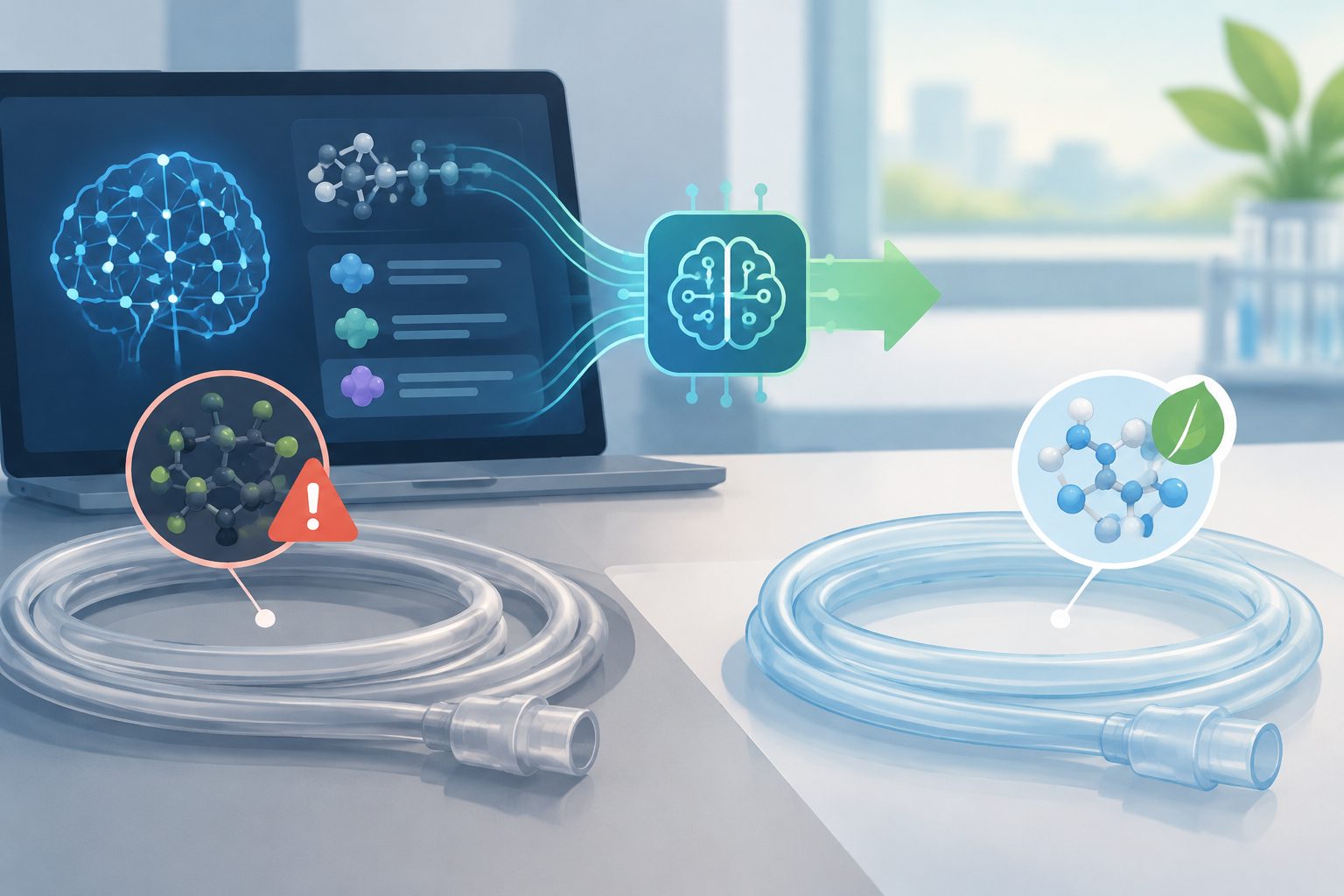
A system combining scientific maps with specialized AI agents produced early PFAS-free material candidates, but they still need testing.
The framework divides the task among AI agents responsible for breaking down the problem, finding evidence, extracting design requirements and searching connections in a knowledge graph. Applied to biomedical tubing, it generated PFAS-free material ideas intended to balance friction and wear, heat stability, chemical resistance and compatibility with living tissue.
An evaluation comparing different versions of the system found that the full multiagent pipeline generally performed best across the study’s criteria. The researchers also used different graph-search strategies: some focused on known, important properties, while others searched more broadly for unexpected connections.
What the system produced
The full multiagent system surpassed or matched the versions with components removed across all evaluation criteria except cross-subtask integration and novelty. A setup that directly explored the graph scored higher for novelty, while the full system produced more grounded hypotheses based on a broader retrieved knowledge base. By combining graph searches with specialized agents, the framework generated several initial PFAS-free candidates for biomedical tubing. These candidates were intended to address several requirements at once, including wear and friction, thermal stability, chemical resistance and biocompatibility.
Evidence and caveats
The evidence comes from an ablation study comparing configurations of the AI framework and from the design candidates it generated in a biomedical-tubing example. The candidates are early-stage hypotheses, not implementation-ready substitutions: the study did not report physics-based simulations or experimental validation of their performance, safety or manufacturability. The researchers also note that the knowledge graphs are currently rooted in an academic corpus, which can favor novel or unusual materials that are not always industrially viable. They propose adding patents and technical datasheets and creating a future loop of critique, revision, simulation and experiments.
// Source
ACS Materials Au · 2026 · DOI: 10.1021/acsmaterialsau.6c00100
Authors: Isabella Stewart, Tarjei Paule Hage, Yu-Chuan Hsu, Markus J. Buehler
Institutions: Massachusetts Institute of Technology