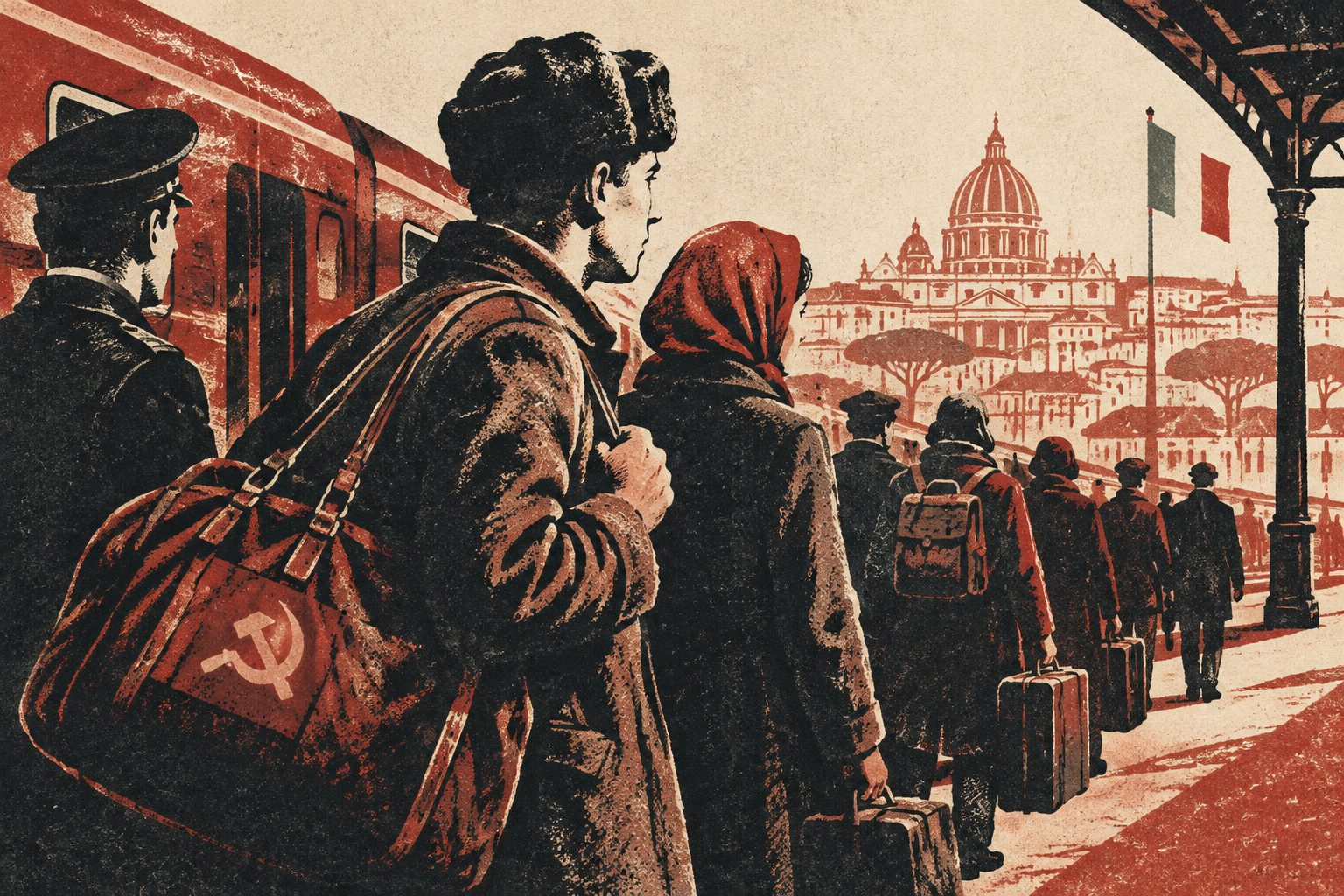
Archival records trace how Italy managed thousands of people awaiting visas in the 1970s and 1980s.
The article examines the experience of Soviet citizens who passed through Italy during the 1970s and 1980s, with many staying in the maritime area around Rome. It connects national policy with the reactions of residents in the towns and cities where migrants lived.
The study finds that Italy’s government largely avoided funding or integrating the migrants, seeking instead to move them onward and reduce social tensions. Pressure from Rome also helped disperse large groups around the capital, making the transit an early test of a country shifting from emigration to immigration.
How Italy managed the transit
Italian officials treated the Soviet migrants as people who should leave Italy as quickly as possible. The government avoided financial responsibility and provided little support for schooling, employment, health care, social services or cultural orientation. The article links this deliberate non-involvement to the migrants’ impoverished living conditions and to their dependence on relief agencies and their own resources.
Rome also tried to manage the political and social risks surrounding the transit. Because the migration was officially connected to Jewish emigration, Italy sought to maintain ties with Western allies while avoiding conflict with Arab countries and monitoring efforts to redirect migrants to Israel. In the late 1980s, pressure to ease local tensions contributed to the dispersal of large migrant groups from a few sites into a wider area around Rome.
The records also show that local residents were not merely bystanders. Italians living near the migrants helped shape how the transit operated, while the encounters exposed difficulties that resembled those faced by immigrants from other countries, even though the Soviet citizens were passing through rather than settling permanently.
An early test for Italy
The study places Soviet transit migration within Italy’s broader change from a country associated with emigration to one receiving people from abroad. It shows that this shift was visible not only in national laws and diplomacy but also in everyday encounters in local communities.
The authors argue that the treatment of Soviet transit migrants offered an early view of issues that later became more contested in Italy and elsewhere in Western Europe: limited public support, pressure to move migrants onward, local tensions and the challenge of responding to new population movements.
Records behind the findings
The article draws on records from Italy’s Ministry of the Interior and the Roman Jewish community, as well as U.S. archives of the American Jewish Joint Distribution Committee and Hebrew Immigrant Aid Society. It also uses eyewitness accounts and observations, including some published in the Italian press, to compare official views with local reactions.
This is a historical interpretation of archival documents and firsthand accounts, not a survey or statistical measurement of Italian public opinion. The provided material does not give a detailed count of the records examined or show how representative the documented local experiences were of all Italian communities.
// Source
Comparative Studies in Society and History · 2026 · DOI: 10.1017/s0010417526100711
Authors: Denis Kozlov
Institutions: Dalhousie University