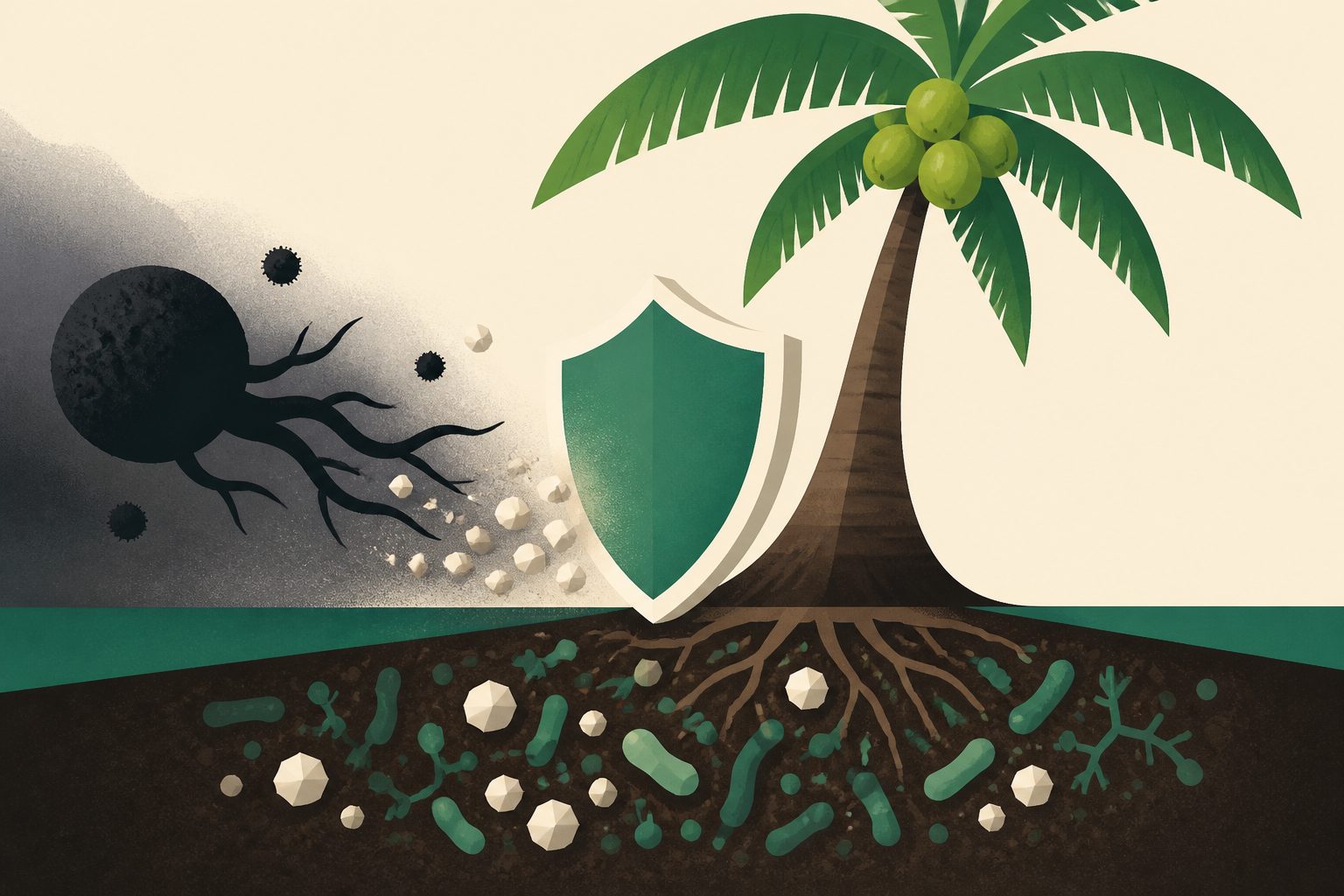
In soil tests, adding calcium carbonate to communities of helpful microbes increased suppression of Ceratocystis paradoxa, especially at neutral pH.
Researchers compared five soils that suppressed C. paradoxa with five soils that allowed it to thrive. The suppressive soils had more culturable bacteria and were enriched in several bacterial groups, including Actinobacteria, Proteobacteria, Firmicutes and Acidobacteria. They also had higher pH, calcium content, cation exchange capacity, base saturation and sand content.
Adding calcium carbonate increased suppressiveness, especially when soil pH was 7.0. Transferring microbes from suppressive soils into soils that had been conducive to the pathogen, together with calcium carbonate, also induced suppressiveness. The findings point to a combined role for soil microbial communities and soil chemistry in limiting the fungus.
What made soils suppressive
The researchers assessed soil suppressiveness using banana peel baits and compared microbial communities and soil properties in five suppressive and five conducive soils. Suppressive soils contained higher culturable bacterial populations and were enriched in Actinobacteria, Proteobacteria, Firmicutes and Acidobacteria. The genera Solirubrobacter, Actinoplanes and Conexibacter were particularly enriched.
These soils also had higher pH, calcium content, cation exchange capacity, base saturation and sand content. Calcium carbonate amendments enhanced suppression, most notably at pH 7.0. When researchers transferred microbiota from suppressive soils into conducive subsoils, adding calcium carbonate induced suppressiveness as well. The abstract says calcium promoted microbial activity and stabilized pH, contributing to reduced disease incidence.
Evidence and caveats
The study used comparative analyses of 10 soils and laboratory or controlled soil experiments involving banana peel baits, calcium carbonate and transferred microbiota. This evidence supports an association between suppressiveness and particular microbial and chemical soil features, and it shows that the tested amendments and microbiota transfers increased suppressiveness under the study conditions.
The abstract does not report field trials, crop-yield effects, exact disease reductions or how long the induced suppressiveness lasted. It also does not establish that the named bacterial groups directly caused pathogen suppression; other microbes or soil properties may have contributed.
// Source
Archives of Microbiology · 2026 · DOI: 10.1007/s00203-026-05108-w
Authors: Kize Alves Almeida, Priscilla de Fátima Pereira, Rafaela Araújo Guimarães, Muhammad Siddique Afridi, Júlio Carlos Pereira da Silva, Bruna Andrade, John Quensen, James Tiedje, Jorge Teodoro de Souza, Viviane Talamini, Eudes de Arruda Carvalho, Flávio Henrique Vasconcelos de Medeiros
Institutions: Universidade Federal de Santa Maria, Michigan State University, Universidade Federal de Lavras, Brazilian Agricultural Research Corporation, Institute of Crop Science, Fundação de Tecnologia do Estado do Acre