The modified cathode supported reversible manganese reactions and a reported capacity of 658 mAh per gram over more than 15,000 cycles.
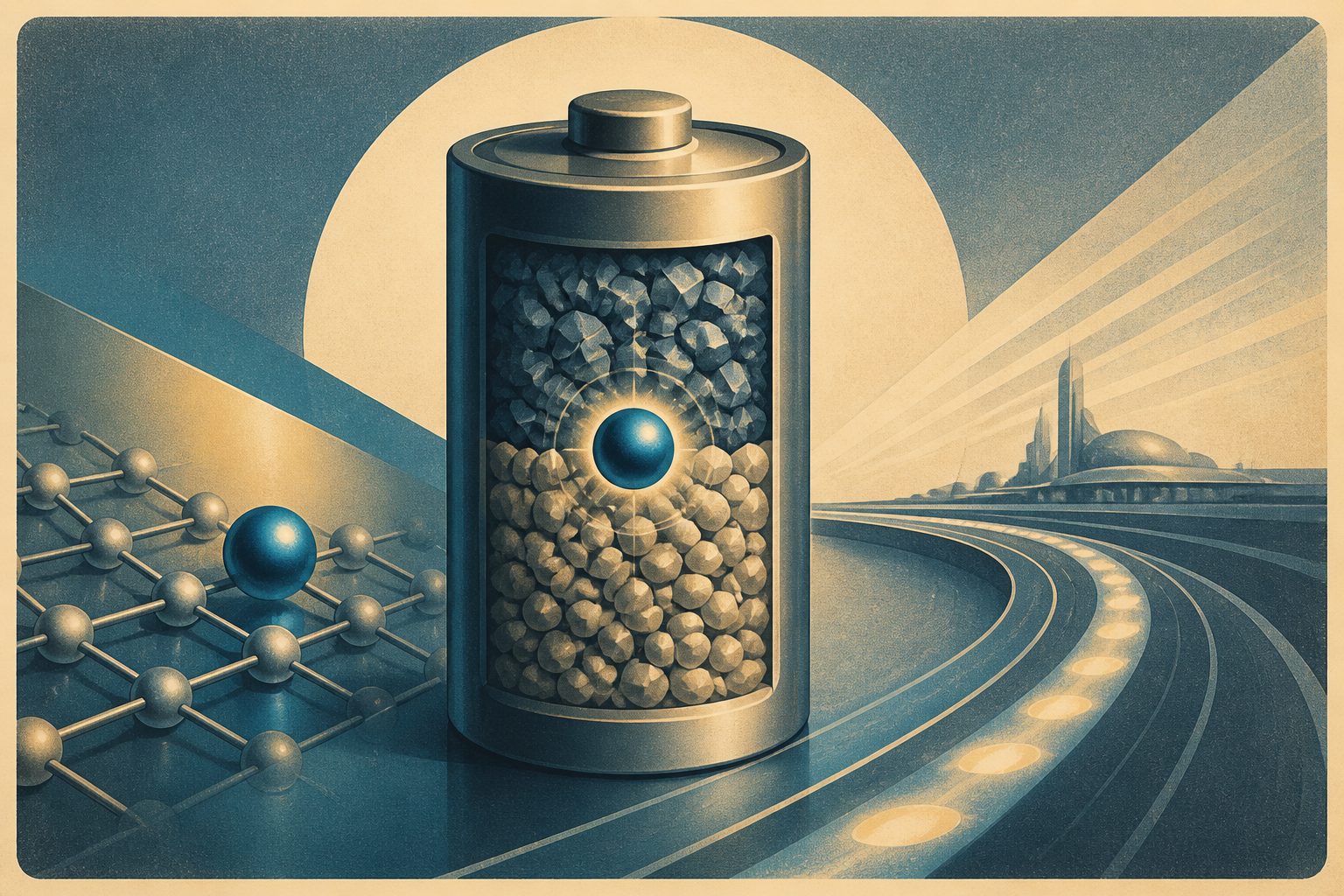
Researchers introduced isolated cobalt atoms into layered manganese dioxide, creating a cathode material for aqueous zinc–manganese batteries. They report that the cobalt changes the local structure and oxygen chemistry of the material, helping manganese compounds take part in reversible charge storage without added acid or a redox mediator.
The resulting battery reached a reported capacity of 658 mAh per gram and operated for more than 15,000 cycles. The researchers attribute this performance to a two-step process in which manganese stores and releases three electrons through two reversible reactions.
What the cobalt changed
The researchers embedded isolated cobalt atoms in layered manganese dioxide, producing a material they call Co–MnO2. They report that the cobalt atoms altered the symmetry of the manganese–oxygen units, reduced the covalent character of cobalt–oxygen bonds and increased the activity of oxygen in the crystal lattice.
According to the abstract, high-spin cobalt reduced structural distortions in the manganese dioxide and helped deposited manganese dioxide fully convert from adsorbed manganese ions. This was intended to limit inactive manganese deposits, sometimes described as “dead” manganese dioxide, and avoid manganese dendrites. The cathode supported reversible manganese dioxide/manganese(III) and manganese dioxide/manganese(II) reactions.
The researchers describe the battery chemistry as a “two-step, three-electron” mechanism. A zinc//Co–MnO2 battery reached 658 mAh g−1 and lasted for more than 15,000 cycles, according to the abstract.
// Source
Nano-Micro Letters · 2026 · DOI: 10.1007/s40820-026-02328-z
Authors: Yajun Zhao, Yajun Zhao, Yanan Lv, Yanan Lv, Shuoxiao Zhang, Kai Jiang, Meng Xu, Mudasir Muhammad, Yang Ren, Yang Ren, Yi Zhao, Xiaoming Sun
Institutions: National University of Singapore, City University of Hong Kong, Beijing University of Chemical Technology, Institute of High Energy Physics