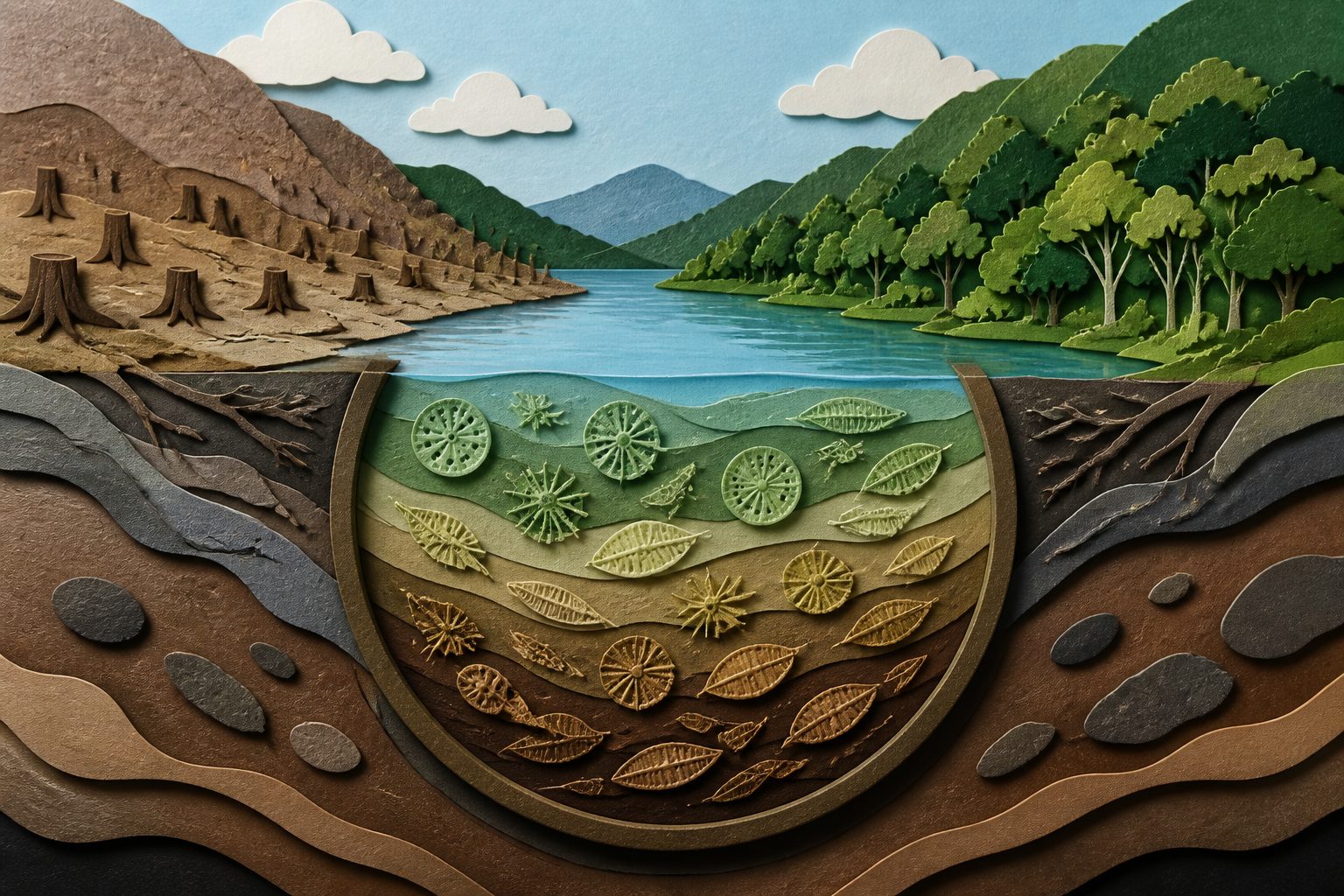
Diatoms in Lago Verde are shifting toward earlier conditions even though the lake remains highly nutrient-rich.
Researchers combined sediment records, lake measurements and satellite or aerial images to trace Lago Verde's changes over roughly 200 years. The sediment record indicates that erosion and deforestation intensified from about 1968 to 1988, when the lake's diatom community changed sharply and disturbance-tolerant species became dominant.
Since the 1990s, deforestation has slowed and some reforestation has occurred. Nitrogen concentrations have declined, and diatoms associated with disturbance have become less common while Aulacoseira species have increased. However, the lake remains turbid and eutrophic to hypereutrophic, and its current community includes new species rather than matching the original baseline completely.
How the lake changed
Lago Verde passed through three broad stages over the last 200 years. Earlier periods of lower disturbance brought gradual changes, but the 1970s and 1980s brought the largest documented shift: magnetic susceptibility indicated increased erosion, while diatom communities showed high species turnover and became dominated by disturbance-tolerant Achnanthidium minutissimum and Fragilaria capucina.
After deforestation slowed, forest cover partly recovered and nitrogen levels fell. Measurements from the lake and its sediments show that disturbance-tolerant diatoms declined while baseline planktonic Aulacoseira species increased, consistent with an ongoing recovery toward earlier conditions. The recovery is partial: the lake remains eutrophic to hypereutrophic and has not returned fully to its original ecological state.
Why the recovery matters
The study shows why short monitoring records can miss both the scale of a disturbance and the pace of recovery. Sediments preserved evidence of conditions before, during and after the major deforestation period, allowing the researchers to identify a rapid state shift and a later, incomplete recovery.
The findings also indicate that recovery depends on the duration and setting of disturbance. Comparing the modern record with an earlier period of human impact between AD 100 and 800 suggests that changing climate and prolonged pressure can constrain how closely a tropical lake returns to its former condition. Such long records can help inform conservation and restoration decisions in Neotropical lakes.
Evidence and limits
The researchers used magnetic susceptibility and diatoms preserved in sediments dated from about 1808 to 2025, along with diatoms and water-quality measurements from the lake. They also compared lake data from 2023 and 2024 with earlier measurements from 2000 and 2003, and reconstructed forest cover from images taken in 1976, 2000 and 2024.
This is a long-term ecological reconstruction rather than a controlled experiment. The timing of the major state shift is uncertain because core samples were spaced about four years apart, so the change may have occurred more quickly. The study documents partial recovery at this lake; it does not establish that other tropical lakes will respond in the same way.