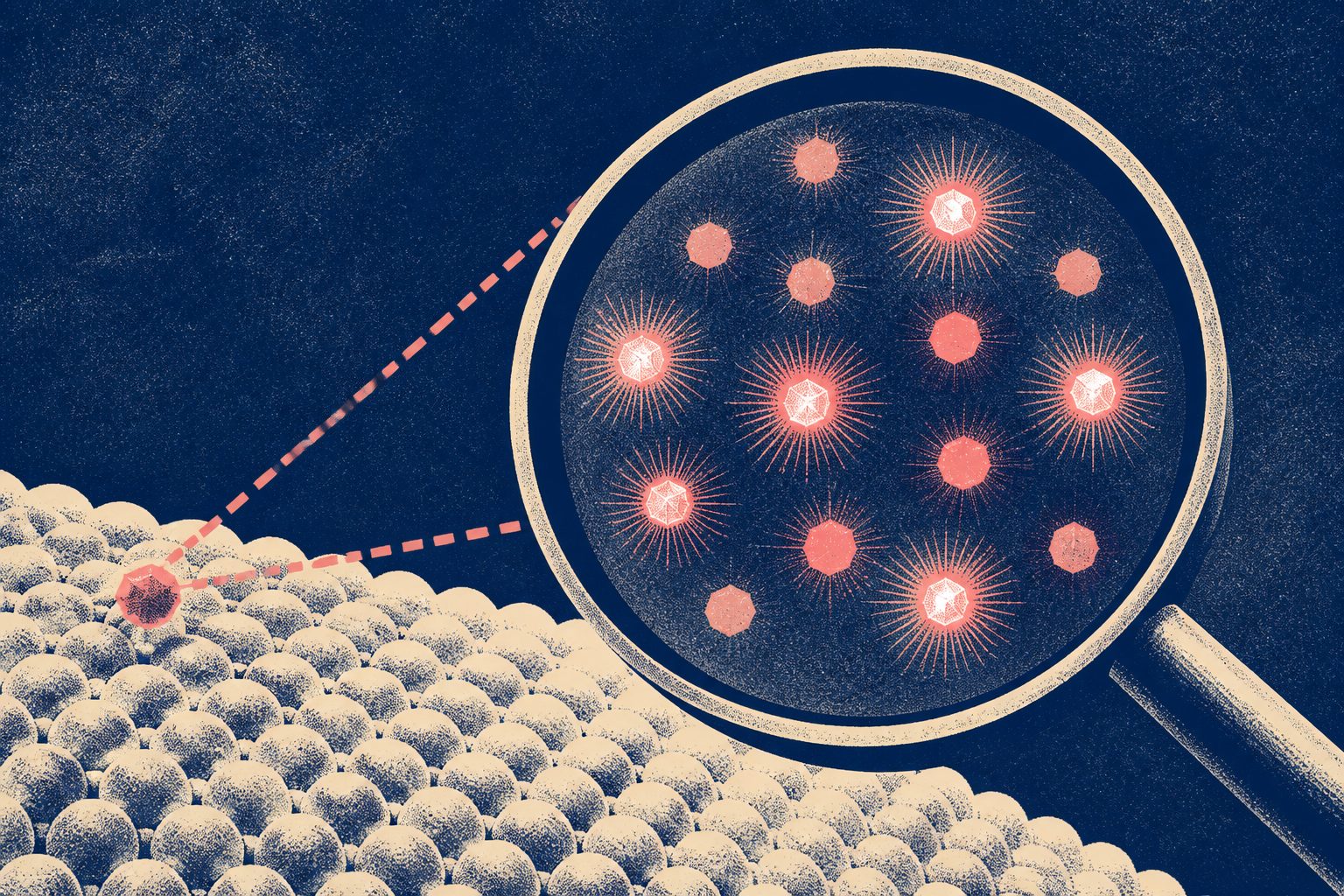
Lanthanide-doped particles switched between bright and dark states for hours, enabling low-power imaging in crowded samples.
Lanthanide-doped upconversion nanocrystals normally appear not to blink because many ions emit light independently inside each particle. In this study, the researchers found that the ions within a single nanocrystal could switch together between bright and dark states, producing an on–off intensity ratio of up to 25.
The blinking lasted for more than 15 hours and more than 10,000 cycles without discernible photodegradation. Changing the excitation power reversibly controlled the blinking. Using the particles' background-free emission, the researchers performed low-power localization microscopy in dense aggregates, resolving individual nanocrystals with a mean resolution of 12.6 nanometers and a mean localization precision of 1.2 nanometers.
How the particles blink
The researchers discovered collective blinking in the upconversion light emitted by thousands of lanthanide ions within a single nanocrystal. The particles reached an on–off intensity ratio of up to 25, continued blinking for over 15 hours and more than 10,000 cycles, and showed no discernible photodegradation during that period. The blinking could be reversed by adjusting the excitation power.
They propose that one quencher—likely produced by a cooperative process involving multiple ions—intercepts excitation energy in the network of ytterbium ions that helps drive the emission. This would darken the entire nanocrystal. The study also used the blinking to localize individual nanocrystals in dense aggregates with a mean resolution of 12.6 nanometers and a mean localization precision of 1.2 nanometers.
Why controlled blinking helps
Blinking is often treated as a problem because it makes light sources unstable, but controlled blinking can help a microscope distinguish and locate individual particles. These nanocrystals combine that behavior with upconversion emission, which is described as effectively free of background fluorescence, and resistance to photodegradation.
That combination enabled low-power localization microscopy of particles in dense aggregates. The authors say the approach could support work in nanoscience, bioimaging, and quantum technologies, although the abstract does not establish specific applications in those areas.
Evidence and caveats
This is a journal article reporting experimental observations of blinking, its control by excitation power, its persistence under prolonged illumination, and microscopy results. The proposed explanation involving a single quencher is a mechanism the researchers suggest; the abstract does not provide enough detail to determine how directly it was established or how broadly it applies beyond the nanocrystals studied.
The abstract also does not report the number of particles tested, the range of particle compositions and sizes, or the exact imaging conditions. The stated resolution and localization precision therefore describe the reported experiments rather than a demonstrated performance limit for all lanthanide-doped nanocrystals.