Rotating discs helped a solar still make desalinated water for under 11 cents a liter
In experiments, the rotating-disc design produced more water than standard and drum-based stills, with estimated costs as low as 8.2 cents per liter.
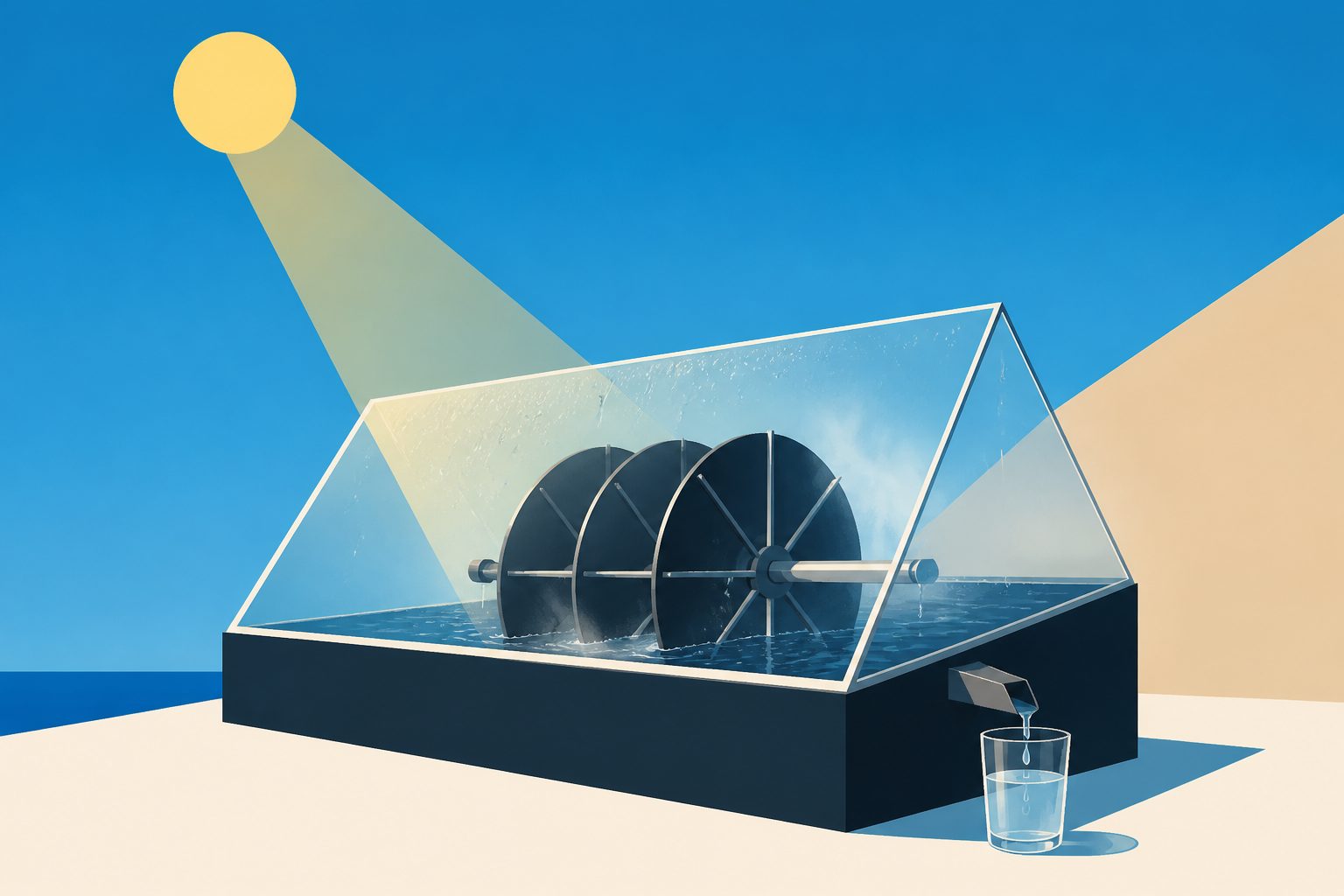
Editorial illustration — not from the study.
Researchers tested a solar still fitted with rotating aluminum discs that repeatedly move through the water. The discs expand the surfaces available for evaporation and condensation, and the system produced more water than both a standard passive still and a drum-based design.
The optimized unit had an estimated production cost of 8.2 to 10.3 cents per liter and a projected payback period of less than seven months. The study also found that solar radiation eliminated bacteria from the feedwater, although the abstract does not say whether the resulting water met drinking-water standards.
What the rotating discs changed
The system used a row of aluminum discs mounted on a rotating horizontal shaft. The discs increased the surfaces where water could evaporate and vapor could condense.
Compared with the drum-based still, the rotating-disc design increased productivity by 24%. The researchers reported an overall productivity increase of 310% compared with a standard passive solar still. Productivity was higher when the water was shallower: 3 centimeters performed better than 6 or 9 centimeters. It also increased at the lower tested disc speed of 0.25 revolutions per minute, compared with 0.5 and 0.75 revolutions per minute, and with discs spaced 3 centimeters apart rather than 6 centimeters apart.
Increasing the condensation area by 75.6% raised productivity by about 70%. Solar radiation completely eliminated bacteria from the feedwater. Regression analysis found strong relationships between productivity and the number of discs, their rotation speed and basin water depth, with R² values above 0.8.
The optimized unit had daily energy efficiency of 75% and exergy efficiency of 10.4%, compared with 25% and 3.5% for the conventional still. Exergy measures how much of the available energy can theoretically do useful work. Most of the system’s exergy destruction occurred in the basin water. Estimated production costs across the tested units ranged from $0.103 to $0.082 per liter, and estimated payback periods were under seven months.
Why the design matters
Solar stills use sunlight to separate water from salt, but conventional designs can produce water slowly. In this study, adding rotating discs increased output while keeping the estimated production cost below 11 cents per liter. The researchers’ life cycle assessment found that the rotating design’s higher productivity outweighed its greater embodied environmental impacts on a per-liter basis. Together with the short estimated payback period, these results support the authors’ conclusion that the design could make solar stills more suitable for developing communities than more complex, fossil-fuel-dependent desalination systems.
Evidence and caveats
The findings come from experimental tests comparing a rotating-disc solar still with conventional and drum-based stills, supported by statistical regression, economic analysis and a life cycle assessment. The abstract does not report the test location, duration, feedwater salinity, production volumes or the assumptions behind the cost and payback estimates. The results therefore show how the tested units performed under the study’s conditions, but do not establish how they would perform in every setting or whether the water meets drinking-water standards.
// Source
Energy Reports · 2026 · DOI: 10.1016/j.egyr.2026.109596
Researchers created closely alternating nickel and nickel molybdate domains less than a nanometer across. The catalyst reached 2 A per square centimetre at 1.62 volts and operated stably for more than 2,200 hours under the reported testing conditions.
A study finds that large language models can recognize patterns in material categories but consistently struggle to use coordinate information, even as the models and datasets grow. For properties shaped mainly by crystal structure, specialized models that represent geometry performed better.
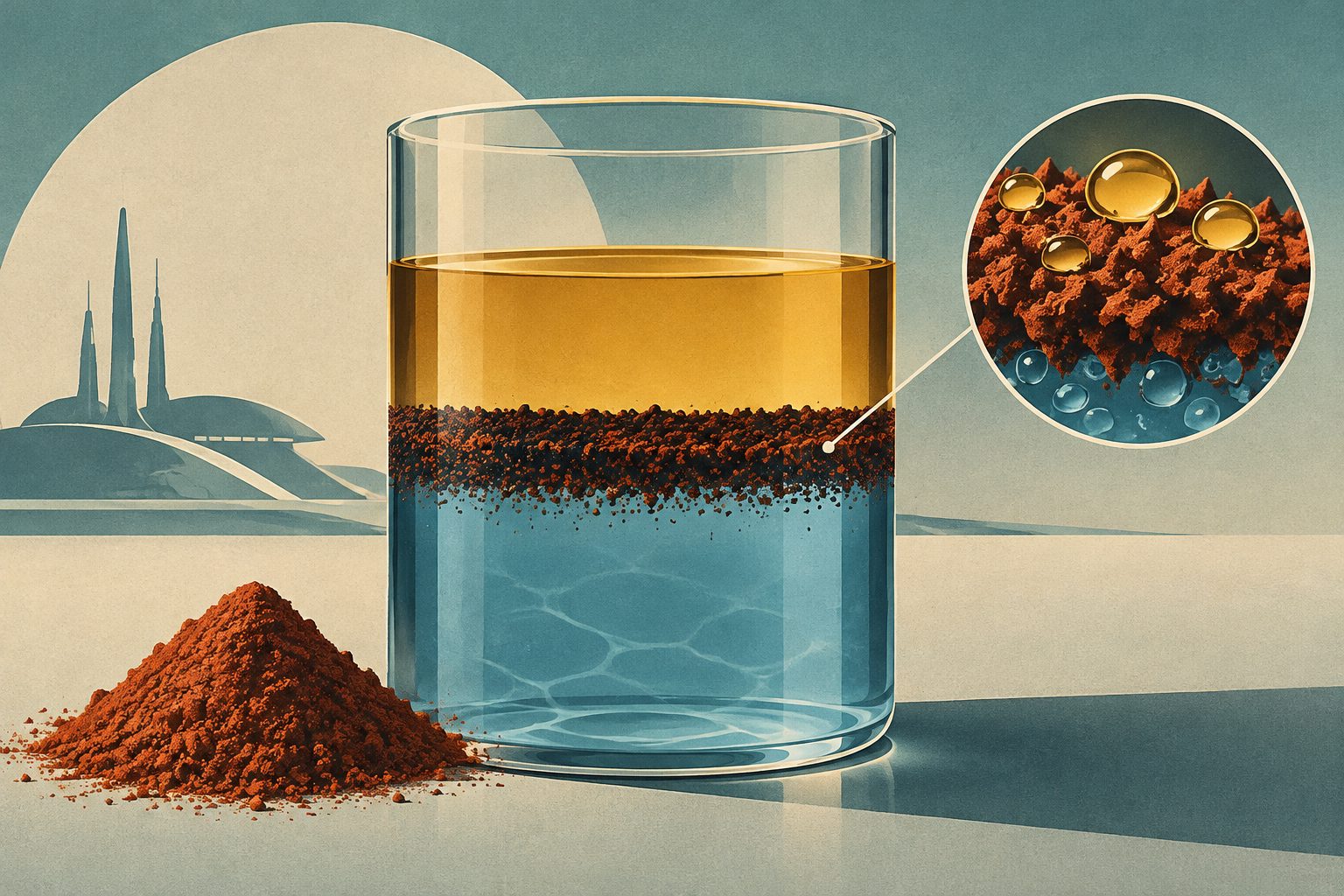
Researchers made water-repelling, oil-attracting copper oxide powders and a copper oxide-coated metal mesh without using organic surface modifiers. The mesh separated a chloroform–water mixture with about 98% efficiency, while the powder selectively adsorbed oil from water.