Review suggests cooling during root canal treatment may reduce short-term pain
Across 11 randomized trials, pain was lower at several follow-up times, but the certainty of the evidence was low.
Moderate evidenceReviewInterpret with caution
Medical disclaimer: This article summarizes research findings and is for informational purposes only. It is not medical advice.
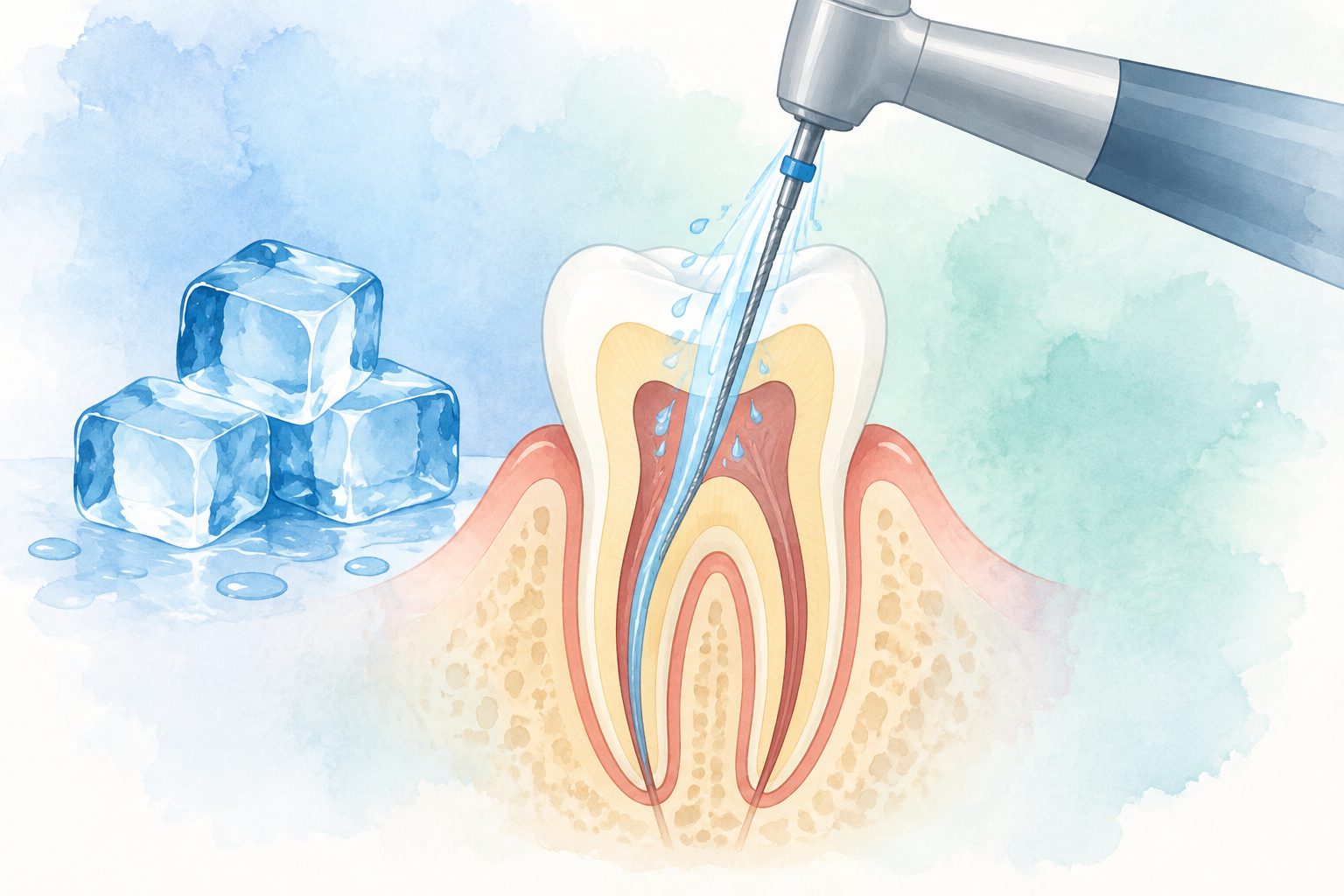
Editorial illustration — not from the study.
Researchers searched four medical databases through January 2026 for randomized trials comparing cooled irrigation during root canal treatment with room-temperature irrigation or standard care. They assessed pain using established pain-rating scales and combined results in random-effects analyses when studies reported comparable follow-up times.
The pooled results favored intracanal cryotherapy at 6, 24, 48, and 72 hours after treatment. The 12-hour comparison did not show a statistically significant difference, although the researchers noted that this comparison included fewer studies and involved more than one diagnostic category. Overall, the review concluded that cooling may provide a short-term reduction in pain, while the size and consistency of the effect remain uncertain.
What the review covered
The review asked whether intracanal cryotherapy reduces pain after nonsurgical root canal treatment in people with symptomatic apical periodontitis. It included 11 randomized controlled trials involving teeth diagnosed with either irreversible pulpitis with symptomatic apical periodontitis or necrotic pulp with symptomatic apical periodontitis. In the studies, a cooled irrigant at 15°C or below was used as a final irrigation step before the tooth was filled, and it was compared with room-temperature irrigation or standard care. Pain was measured at specified times using validated scales. Only a subset of the 11 trials contributed to each time-specific meta-analysis.
Key conclusions
The meta-analysis found statistically lower postoperative pain with intracanal cryotherapy at 6, 24, 48, and 72 hours compared with the control intervention. At 12 hours, the difference was not statistically significant. Subgroup analyses by pulpal diagnosis, tooth type, and whether treatment was completed in one or more visits did not identify statistically significant differences between subgroups. The review did not establish that cryotherapy has a uniform effect for all patients, and it did not provide a definitive estimate of how large or clinically important the pain reduction is.
Who this may apply to
The findings may be relevant to people with symptomatic apical periodontitis who undergo nonsurgical root canal treatment using procedures similar to those in the included trials. They may not apply to people with other dental diagnoses, different treatment methods, or different cryotherapy protocols. The review does not by itself establish the effect for every patient or setting, and it should not be read as evidence about long-term outcomes.
The significance
Pain after root canal treatment is a patient-relevant outcome, so a possible short-term reduction could matter for comfort after the procedure. This review brings together randomized human studies rather than relying on laboratory or animal findings. However, its low-certainty evidence means the results are better understood as an indication of a possible benefit than as a firm conclusion about the size or reliability of that benefit.
Limitations & evidence assessment
The main limitation was the quality and consistency of the underlying evidence: one trial was judged to have low risk of bias, one high risk, and nine had some concerns. The most common concern involved how researchers selected and reported results. The review also found substantial statistical heterogeneity across pooled analyses and considerable variation in clinical protocols. Publication bias was not assessed because fewer than 10 studies contributed to each meta-analysis, making standard methods such as funnel plots unreliable. Follow-up focused on short-term pain, and the available information does not establish longer-term outcomes or the total number of participants.
Why this evidence level: The review combined randomized controlled trials in people, which generally provides stronger evidence than observational research. However, the review rated the overall certainty as low because most included studies had risk-of-bias concerns, substantial differences between studies, and variable clinical methods.
Evidence levels are editorial estimates derived from study metadata — they are not clinical appraisals.
This systematic review examined randomized human trials of concurrent chemotherapy and radiation for locally advanced head and neck, cervical, esophageal, and non-small-cell lung cancers. Across the included trials, combined treatment was reported to provide better overall survival than radiation alone, but it also caused more severe short-term side effects. The review did not provide enough information in its abstract to show how many trials or patients were included.
Researchers pooled results from seven human studies comparing multiple-staged with single-stage removal and reconstruction of congenital melanocytic nevi, sometimes called congenital moles. Staged surgery was associated with fewer major wound complications and recurrences, as well as slightly shorter and narrower scars, but the studies did not find a clear difference in cosmetic or overall patient satisfaction.
A cluster-randomized human study in 210 adults with recently detected stage 1 hypertension in Uzbekistan compared salt-sensitivity testing followed by assigned medication choices with conventional management. After 12 weeks, more participants in the testing-guided group reached the study's blood pressure target, although the study was small, short, and conducted in only three primary care centers.