Review links lower vitamin D levels with obesity without diagnosed metabolic syndrome
The analysis found associations, not proof that vitamin D status causes or prevents obesity.
High evidenceReviewSome caution advised
Medical disclaimer: This article summarizes research findings and is for informational purposes only. It is not medical advice.
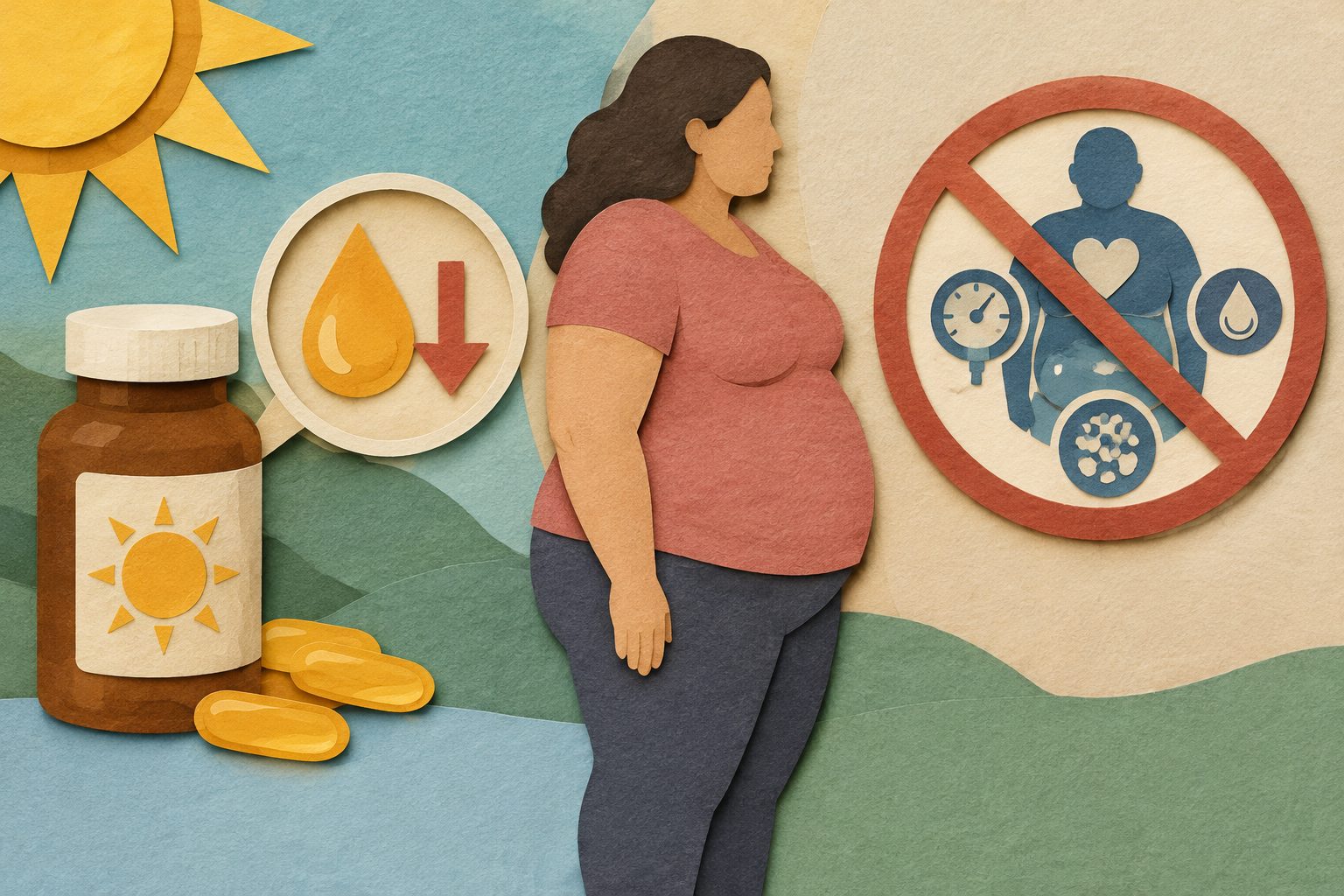
Editorial illustration — not from the study.
Researchers searched six databases for observational studies published through January 2025. They compared vitamin D measurements and the prevalence of vitamin D deficiency or insufficiency between people with obesity without diagnosed metabolic syndrome and control groups, including infants, children, adolescents, adults, and older participants.
Across the included studies, lower vitamin D status was associated with obesity. However, results varied according to the laboratory method used to measure vitamin D and the threshold used to define deficiency or insufficiency. The researchers reported substantial variation between studies, so the overall findings should be interpreted cautiously.
What the review covered
The researchers examined whether vitamin D status was associated with obesity without diagnosed metabolic syndrome, sometimes described as metabolically healthy obesity. They conducted a systematic search of PubMed, Embase, Web of Science, Wanfang, the China Science and Technology Periodical Database, and the Cochrane Database of Systematic Reviews for observational studies available through January 2025. The review included 74 human studies with approximately 86,833 control participants and 24,005 participants with obesity. The studies included 32 involving infants or children, 27 involving adolescents, 13 involving adults, and two involving older participants. People with certain liver, kidney, or endocrine diseases, or use of some relevant medicines, were excluded when reported by the individual studies.
What the review concluded
Across the pooled studies, serum or plasma 25-hydroxyvitamin D concentrations were lower in the obesity groups than in control groups, with a mean difference of -3.98 and a 95% confidence interval from -4.70 to -3.27. Vitamin D deficiency was more common among participants with obesity, with an odds ratio of 2.02 and a 95% confidence interval from 1.73 to 2.36. Vitamin D insufficiency was also associated with obesity, but the association was smaller, with an odds ratio of 1.17 and a 95% confidence interval from 1.04 to 1.32.
The results were not uniform across all subgroups. The association with lower vitamin D levels was not statistically significant in studies using LC-MS/MS or HPLC in the reported subgroup analyses. The association with vitamin D deficiency was not significant when deficiency was defined as a level below 10 or 12 ng/mL. Associations with insufficiency appeared only in some subgroups, including adolescents, people with mild obesity, and studies using certain laboratory methods. These findings describe statistical relationships in observational data and do not show whether low vitamin D contributes to obesity, obesity contributes to lower vitamin D levels, or other factors influence both.
Who this is relevant to
These findings may be most relevant to human populations resembling those represented in the included studies: people with obesity without diagnosed metabolic syndrome, including children, adolescents, adults, and some older participants. They may be less applicable to people with obesity-related liver, kidney, or endocrine disease, people taking the excluded medicines, or people with diagnosed metabolic syndrome, because such groups were excluded or not the focus. The results should not be interpreted as applying equally across all vitamin D tests or deficiency thresholds, and they do not by themselves establish effects of vitamin D intake or supplementation.
Why it matters
The review brings together a large body of human observational research about vitamin D status and obesity without diagnosed metabolic syndrome. It highlights that the relationship was generally consistent for lower measured vitamin D levels and deficiency, but less consistent for insufficiency and across laboratory methods or definitions. This may help explain why individual studies have reported conflicting results. The analysis does not establish that changing vitamin D status would change body weight, metabolic health, or the chance of developing obesity.
Limitations & evidence assessment
The evidence came entirely from observational studies, so confounding and reverse direction of association remain possible. The review reported substantial heterogeneity, with I² above 50%, and the findings varied according to participants' ages, obesity grades, vitamin D measurement methods, and definitions of deficiency or insufficiency. Only six included studies used LC-MS/MS, and only five studies were classified as involving moderate to severe obesity; most obesity studies involved mild obesity. Studies with incomplete published data were excluded, and the provided information does not fully describe the quality of every included study or how obesity and metabolic syndrome were assessed across all studies. The analysis also does not show that vitamin D intake or supplementation causes changes in obesity.
Why this evidence level: Meta-analysis pooling multiple studies sits at the top of common evidence hierarchies.
Evidence levels are editorial estimates derived from study metadata — they are not clinical appraisals.
Researchers combined genetic data from more than 1 million human participants to study factors associated with endometriosis. They identified 58 genomic regions, including 27 not previously reported, and used additional molecular analyses to implicate 314 genes. These findings point to possible biological pathways for further research, but they do not establish causes or demonstrate that any treatment will work.
Researchers systematically reviewed laboratory studies of how temperature affects the time it takes arboviruses to become transmissible inside mosquitoes. Across 53 studies covering 17 viruses, higher temperatures were generally linked with greater transmission efficiency and a shorter time to infectiousness for Zika and West Nile viruses, while results for several other viruses were unclear.
This systematic review and meta-analysis examined whether ultra-low-dose computed tomography (CT) can detect pulmonary, or lung, nodules while using less radiation than standard-dose CT. Across 42 studies involving 15,792 patients, pooled sensitivity for nodule detection was 91.9%, but results varied greatly between studies. The review also found that ultra-low-dose CT used an average effective dose of 0.22 millisieverts (mSv), while detection was less reliable for some small or hazy nodules and in patients with a high body mass index.