Review finds differences in back fascia among people with low back pain
The analysis found thicker, stiffer and more echo-producing thoracolumbar fascia, but the meaning of these differences remains uncertain.
High evidenceReviewSome caution advised
Medical disclaimer: This article summarizes research findings and is for informational purposes only. It is not medical advice.
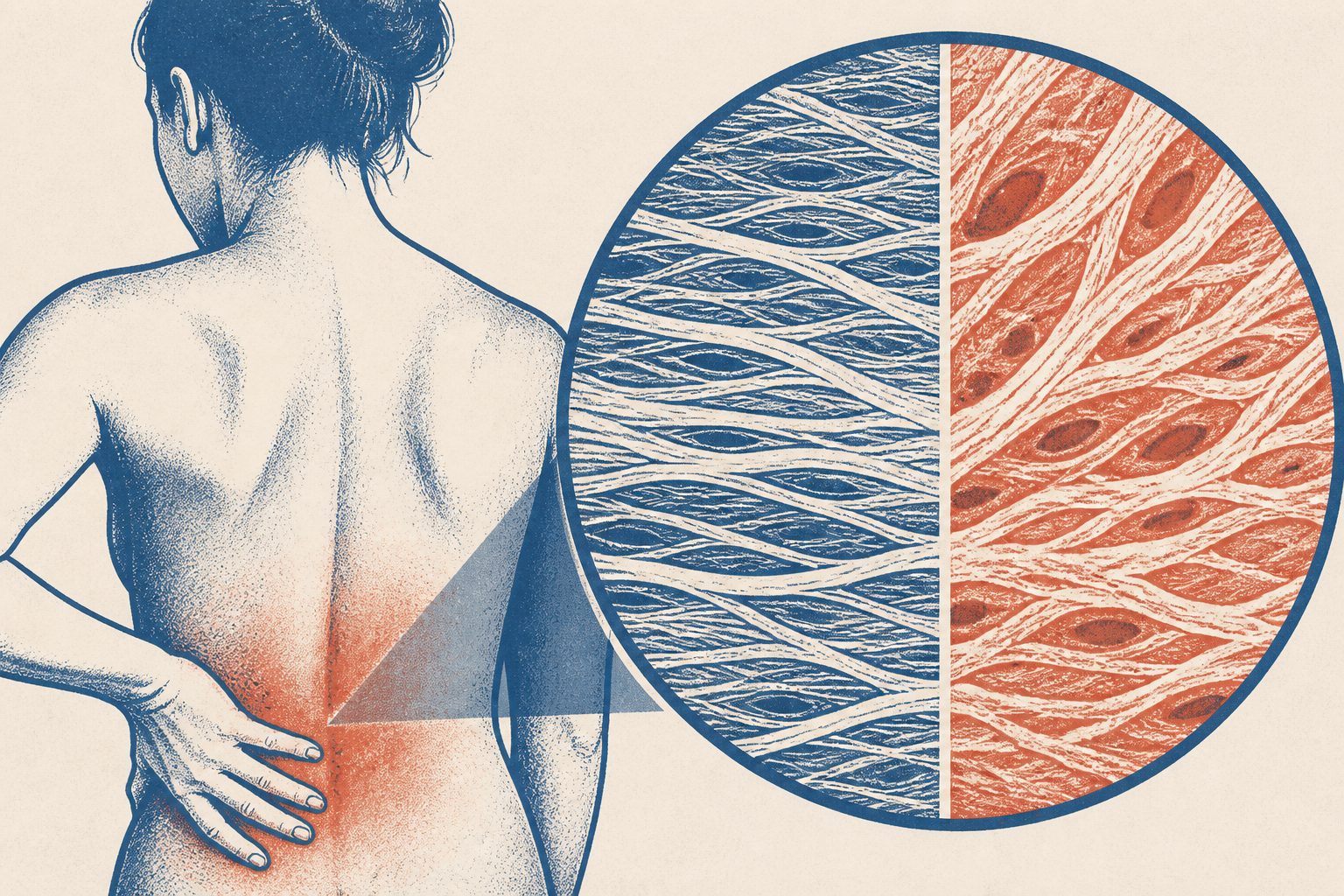
Editorial illustration — not from the study.
Researchers combined results from imaging studies using ultrasound or MRI to compare the thoracolumbar fascia in people with low back pain and asymptomatic controls. They also examined whether fascia characteristics were related to participants’ reported pain levels.
The low-back-pain groups had higher average measures of fascia thickness, stiffness and echogenicity than the control groups. Greater fascia thickness was also associated with higher reported pain ratings. Results for fascial-layer sliding were inconsistent, so its relationship with low back pain remains uncertain.
What the review examined
The researchers conducted a systematic literature search of PubMed, Web of Science, ScienceDirect, the Cochrane Library and Google Scholar. Two independent investigators selected imaging studies that measured the morphology or mechanical properties of the thoracolumbar fascia in people with low back pain and asymptomatic controls. Fourteen trials were included. The abstract does not report the total number of participants or enough detail to determine all participant characteristics and study designs.
What the review concluded
Compared with asymptomatic controls, participants with low back pain had greater thoracolumbar fascia thickness (standardized mean difference 0.64; 12 studies), stiffness (0.82; 3 studies) and echogenicity (0.43; 3 studies). Greater fascia thickness was associated with higher subjective pain ratings. The pooled result for fascial-layer sliding showed no clear overall difference, but both studies contributing to that comparison reported statistically significant differences in opposite directions. These are associations between imaging features and low back pain or pain ratings; they do not show that the fascia changes caused the pain.
Who this is relevant to
These findings may be relevant to human populations similar to those represented in the included imaging studies: people with low back pain and asymptomatic comparison participants. The abstract does not provide enough information to determine how well the results apply across different ages, causes or durations of low back pain, or other populations. The findings should not be interpreted as showing that thoracolumbar fascia measurements can diagnose the cause of pain or predict outcomes for every individual.
The significance
The findings suggest that the thoracolumbar fascia may differ in measurable ways between people with low back pain and people without symptoms. They may help guide future research into how back structures relate to pain. However, the review does not establish whether these differences contribute to pain, result from pain or related factors, or have useful predictive value for individual patients.
Limitations & evidence assessment
Only 14 trials were included, and several outcomes were based on just two or three studies. The conflicting results for fascial sliding indicate uncertainty, and the abstract does not provide the total sample size, participant details, methods used across studies or information about possible publication bias. Comparisons between people with and without pain, along with correlations between imaging findings and pain ratings, cannot establish cause and effect. The review reports moderate-to-high methodological quality overall, but this does not remove the limitations of the underlying studies or the limited evidence for some outcomes.
Why this evidence level: Meta-analysis pooling multiple studies sits at the top of common evidence hierarchies.
Evidence levels are editorial estimates derived from study metadata — they are not clinical appraisals.
// Source
Sports Medicine - Open · 2026 · DOI: 10.1186/s40798-026-01064-3
A 20-year comparison in California’s Central Valley found that reduced tillage with cover crops produced more stable soil aggregates, greater water retention and different forms of carbon protection than standard tillage without cover crops. The conservation system also retained room for additional carbon storage, although the study measured potential rather than future gains.
Human forebrain organoids classified artificial tactile Braille signals after a sensor converted the touch data into electrical stimulation. Accuracy averaged 61% with one organoid and rose to 83% when responses from three organoids were combined.
A study in mice found that a peptide targeting the memory-related protein CPEB3 reduced the persistence of traumatic memories and anhedonia, a loss of pleasure. The findings are an early genetic preclinical test of a possible approach for PTSD, not evidence of a treatment in people.