Review finds culture-confirmed sepsis in many suspected cases in sub-Saharan Africa
The analysis found varied bacterial causes, but estimates differed widely between studies and do not represent all newborns.
High evidenceReviewSome caution advised
Medical disclaimer: This article summarizes research findings and is for informational purposes only. It is not medical advice.
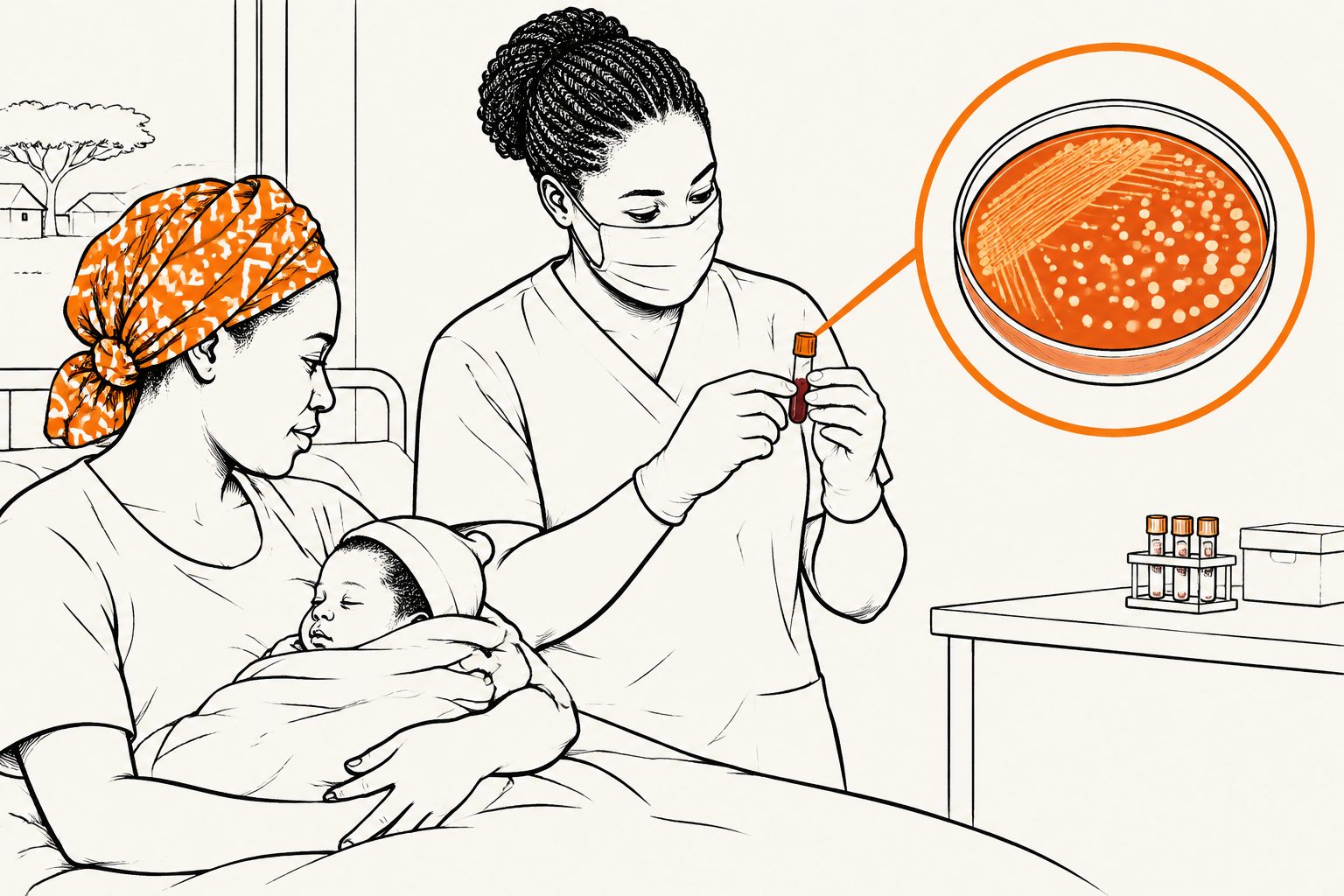
Editorial illustration — not from the study.
This systematic review and meta-analysis examined how often blood cultures confirmed bacterial sepsis in newborns aged 0 to 28 days in sub-Saharan Africa. Most included studies took place in neonatal intensive care settings, so the results mainly describe newborns already being evaluated for suspected sepsis rather than all newborns in the region.
Across the studies, the estimated prevalence was 35.2%, with a 95% confidence interval of 27.4% to 43.5%. The large differences between studies mean this pooled estimate should be interpreted cautiously. The analysis also described the bacteria found in blood cultures, but it did not test a treatment or establish that any particular factor caused sepsis.
The question reviewed
Researchers conducted a PRISMA 2020-guided systematic review and meta-analysis of observational studies published from January 2020 through December 2025. The studies included neonates aged 0 to 28 days in sub-Saharan Africa who were evaluated for suspected sepsis and had data on culture-confirmed bacterial sepsis and bacterial pathogens. Twenty-one studies from seven countries, involving 7,993 neonates, were included. Random-effects statistical models were used to combine prevalence and pathogen estimates, and the researchers assessed differences between studies and possible publication bias.
What the review concluded
The pooled estimate was that 35.2% of neonates evaluated for suspected sepsis had culture-confirmed bacterial sepsis, with a 95% confidence interval of 27.4% to 43.5%. Statistical heterogeneity was substantial and very high, with I² of 98.3%, indicating that the study estimates differed greatly. The estimated prevalence was similar in studies published during 2020–2022 and 2023–2025, with no statistically significant difference reported.
Among the culture-confirmed bacterial isolates, Staphylococcus aureus accounted for an estimated 23.0%, coagulase-negative staphylococci for 20.6%, Klebsiella pneumoniae for 15.2%, Escherichia coli for 9.3%, and Streptococcus species for 8.1%. These are pooled proportions of identified isolates, not estimates that each bacterium caused illness in all newborns in the region. The authors reported no statistical evidence of publication bias using Egger’s test, although such tests cannot rule out all forms of bias.
Where this may apply
These findings may be relevant to clinicians, public-health researchers, and health systems working with newborns evaluated for suspected bacterial sepsis in settings similar to those represented in the seven included countries, particularly neonatal intensive care units. They do not directly describe all newborns in sub-Saharan Africa, newborns outside the region, or cases that were not culture-confirmed. The results also should not be interpreted as showing that the listed bacteria cause the same proportion of infections in every hospital or country.
Why it matters
The findings indicate that culture-confirmed bacterial sepsis was common among newborns already selected for evaluation of suspected sepsis in the included studies. The range of bacteria identified suggests that microbiological surveillance and diagnostic capacity are relevant to understanding neonatal infections in the studied settings. However, the analysis does not show how common sepsis is among all newborns in sub-Saharan Africa, and it does not establish which prevention or treatment approaches are effective.
Limitations & evidence assessment
The studies were observational, so the review can describe prevalence and bacterial patterns but cannot establish causes or treatment effects. Most studies were conducted in neonatal intensive care, and only seven countries were represented, so the results may not apply evenly across all sub-Saharan African settings or to newborns who were not evaluated for suspected sepsis. The very high heterogeneity means the pooled 35.2% estimate combines substantially different study results and should not be treated as a single precise regional rate. The abstract does not provide enough information to assess differences in blood-culture methods, prior antibiotic exposure, study quality, or how consistently sepsis was diagnosed. The reported pathogen proportions are limited to bacteria recovered from blood cultures and may not capture every infection.
Why this evidence level: Meta-analysis pooling multiple studies sits at the top of common evidence hierarchies.
Evidence levels are editorial estimates derived from study metadata — they are not clinical appraisals.
// Source
Critical Care Sepsis and Severe Infection · 2026 · DOI: 10.1186/s44541-026-00021-7
Researchers combined genetic data from more than 1 million human participants to study factors associated with endometriosis. They identified 58 genomic regions, including 27 not previously reported, and used additional molecular analyses to implicate 314 genes. These findings point to possible biological pathways for further research, but they do not establish causes or demonstrate that any treatment will work.
Researchers systematically reviewed laboratory studies of how temperature affects the time it takes arboviruses to become transmissible inside mosquitoes. Across 53 studies covering 17 viruses, higher temperatures were generally linked with greater transmission efficiency and a shorter time to infectiousness for Zika and West Nile viruses, while results for several other viruses were unclear.
This systematic review and meta-analysis examined whether ultra-low-dose computed tomography (CT) can detect pulmonary, or lung, nodules while using less radiation than standard-dose CT. Across 42 studies involving 15,792 patients, pooled sensitivity for nodule detection was 91.9%, but results varied greatly between studies. The review also found that ultra-low-dose CT used an average effective dose of 0.22 millisieverts (mSv), while detection was less reliable for some small or hazy nodules and in patients with a high body mass index.