Review examines ketamine’s possible mechanisms for treating ALS
The article discusses sigma-1 receptor signaling, mitochondrial function, and neuroplasticity as potential links.
Moderate evidenceReviewInterpret with caution
Medical disclaimer: This article summarizes research findings and is for informational purposes only. It is not medical advice.
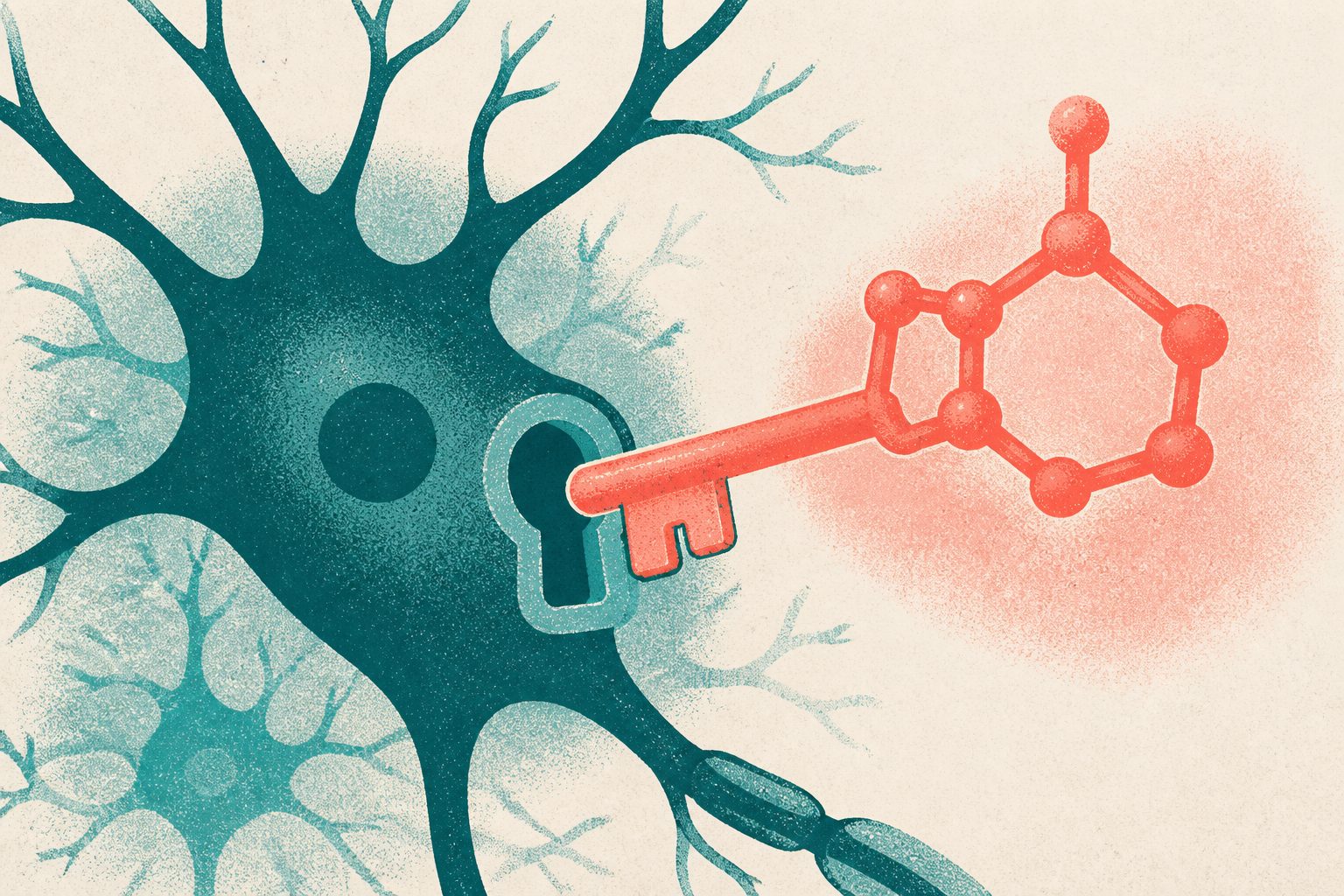
Editorial illustration — not from the study.
The review starts from the fact that ALS involves progressive loss of motor neurons and that current FDA-approved therapies offer only modest benefits. It then summarizes research suggesting multiple biological processes may contribute to ALS progression, including mitochondrial dysfunction, endoplasmic reticulum stress, protein aggregation, and sigma-1 receptor dysregulation.
Within that context, the authors describe several ways ketamine—an anesthetic with emerging uses in depression—might theoretically affect those pathways. They also suggest that ketamine’s actions could converge on neuroplasticity and other ALS-relevant features, and they discuss a potential direction for future clinical investigation involving a low-dose sublingual approach (as proposed by the authors).
What the review examined
Researchers reviewed prior knowledge about ALS biology and ketamine’s pharmacology to examine whether ketamine could plausibly address ALS-related mechanisms. The review is narrative in style and centers on sigma-1 receptor modulation, mitochondrial function, protein clearance, and neuroplasticity, drawing on reported mechanistic findings rather than describing a specific new human study population or sample size.
What the evidence shows
The review does not report original experimental results or clinical outcomes. Instead, it summarizes a mechanistic rationale and prior reports indicating ketamine may: act beyond NMDA receptor antagonism, potentially influence sigma-1 receptor signaling, affect mitochondrial function, support processes related to protein clearance, and promote neuroplasticity involving BDNF–mTOR pathways, alongside anti-inflammatory effects and effects on sigma-1 receptor trafficking (as described by the authors). It concludes with a proposal that ketamine could be investigated clinically for ALS, including the idea of low-dose sublingual ketamine as a candidate strategy.
Who this may apply to
This review may be most relevant to people interested in ALS research directions, such as how sigma-1 receptor signaling, mitochondria, and neuroplasticity could be targeted. It does not establish what would happen in ALS patients if ketamine were used, and it does not provide human outcome data in the abstract. Therefore, it should not be taken as evidence that ketamine is effective for ALS or as guidance for patient care.
The significance
Because ALS has limited disease-modifying options, exploring new hypotheses for therapeutic targets is an ongoing research priority. However, this is a review centered on mechanisms and prior reports, so it cannot confirm that ketamine improves ALS outcomes in patients; the evidence presented is conceptual and not equivalent to demonstrated clinical benefit.
Limitations & evidence assessment
Key limitations include the nature of a narrative review: it does not provide a systematic, comprehensive search and does not itself test ketamine in a defined patient cohort. The abstract provides limited detail on the specific studies included, their quality, and how consistently they support each proposed mechanism. The proposed clinical direction (including low-dose sublingual ketamine) is presented as a candidate for investigation rather than as evidence of effectiveness. Because the work focuses on mechanisms, it also cannot establish safety or efficacy in people with ALS from the information provided.
Why this evidence level: Narrative review: synthesizes existing work but without systematic methodology.
Evidence levels are editorial estimates derived from study metadata — they are not clinical appraisals.
// Source
Journal of Neurology Research · 2026 · DOI: 10.14740/jnr1115
A 20-year comparison in California’s Central Valley found that reduced tillage with cover crops produced more stable soil aggregates, greater water retention and different forms of carbon protection than standard tillage without cover crops. The conservation system also retained room for additional carbon storage, although the study measured potential rather than future gains.
Human forebrain organoids classified artificial tactile Braille signals after a sensor converted the touch data into electrical stimulation. Accuracy averaged 61% with one organoid and rose to 83% when responses from three organoids were combined.
A study in mice found that a peptide targeting the memory-related protein CPEB3 reduced the persistence of traumatic memories and anhedonia, a loss of pleasure. The findings are an early genetic preclinical test of a possible approach for PTSD, not evidence of a treatment in people.