Review examines heart changes reported in drug-related sudden deaths
An analysis of 18 autopsy-based reports found that heart enlargement and scarring were commonly described, but the evidence was limited.
Low evidenceReviewInterpret with caution
Medical disclaimer: This article summarizes research findings and is for informational purposes only. It is not medical advice.
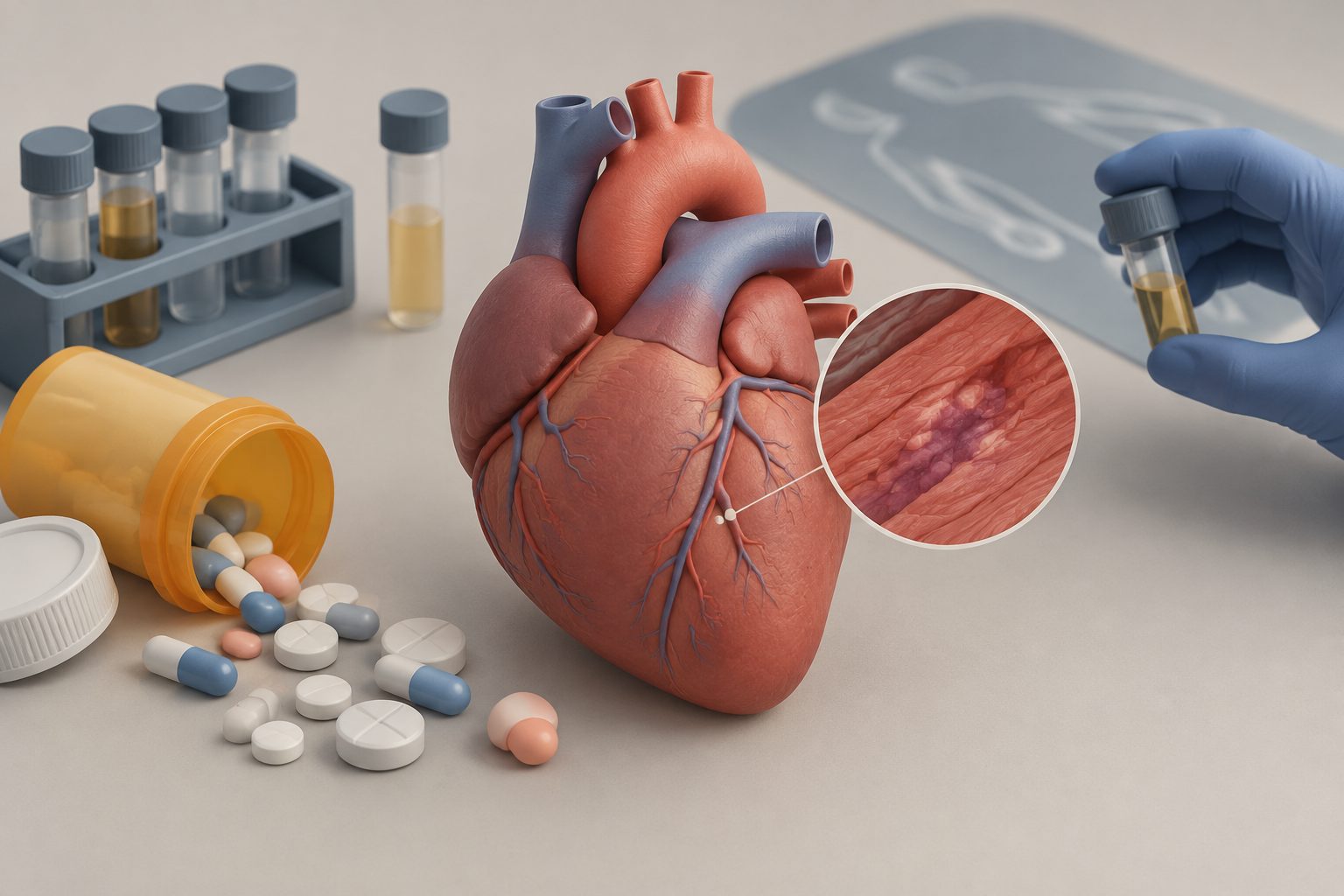
Editorial illustration — not from the study.
Researchers searched medical databases for English-language case reports and case series describing autopsy findings in sudden cardiac deaths associated with recreational drugs. The review covered reports involving alcohol, cocaine, methamphetamine, newer opioids, nicotine, cannabis, and anabolic steroids.
Heart enlargement was the most frequently reported finding, followed by myocardial fibrosis, meaning scarring of the heart muscle. Heart attacks were reported in chronic cocaine and amphetamine users, while coronary artery disease was reported in cases involving cocaine and marijuana. Dilated cardiomyopathy, in which the heart becomes enlarged and weakened, was reported in studies involving alcohol, methamphetamine, and newer opioids.
What the review covered
The researchers conducted a systematic review of published English-language case reports, case series, and retrospective case series. Searches were performed from March to April 2025 and updated in September 2026 in PubMed, Web of Science, and Scopus. Eligible reports had to describe relevant heart findings at autopsy in cases classified as recreational drug-related sudden cardiac death. Eighteen studies met the eligibility criteria. The abstract does not provide the total number of individual decedents represented by those studies.
What the evidence shows
Across the included reports, heart enlargement was the most frequently reported pathological finding, followed by myocardial fibrosis, or heart-muscle scarring. Myocardial infarction, commonly called a heart attack, appeared in reports involving chronic cocaine and amphetamine use; the review states that effects appeared more prolonged among amphetamine users, but it does not provide enough detail to quantify this comparison. Coronary artery disease was documented in reports involving cocaine and marijuana, and dilated cardiomyopathy was identified in reports involving alcohol, methamphetamine, and newer opioids. These are reported associations in selected autopsy cases, not proof that any specific substance caused a death or that the findings are typical of all users.
Where this may apply
These findings may be relevant to forensic professionals evaluating autopsy cases similar to those described in the review, particularly cases involving suspected recreational drug exposure and sudden cardiac death. They should not be assumed to apply to all people who use these substances, to people with other causes of sudden death, or to living patients without comparable clinical and toxicological information. The review does not provide individualized risk estimates or treatment guidance.
Why it matters
The review suggests that heart pathology may provide supportive information when forensic specialists assess suspected drug-related sudden deaths. It also emphasizes that interpretation depends on combining autopsy findings with medical records, police information, tissue examination, and toxicology. The findings are most relevant to forensic investigations and do not establish the risk for an individual person or provide a clinical estimate of how often these heart changes occur.
Limitations & evidence assessment
The review included only 18 studies, and the eligible evidence consisted of case reports and case series. Such reports may overrepresent unusual or severe cases, had no comparison group, and cannot establish causation or estimate population risk. The abstract provides limited information about the number and characteristics of the individual people represented, how the cases were selected, and whether the findings were assessed consistently across studies. The reports also involved several different substances and may not be directly comparable.
Why this evidence level: This systematic review included 18 reports, but the underlying evidence consisted of case reports and case series rather than controlled studies. The findings describe patterns seen at autopsy and cannot establish that a particular drug caused a cardiac death or show how often these findings occur in the wider population.
Evidence levels are editorial estimates derived from study metadata — they are not clinical appraisals.
// Source
Egyptian Journal of Forensic Sciences · 2026 · DOI: 10.1186/s41935-026-00588-9
Researchers combined genetic data from more than 1 million human participants to study factors associated with endometriosis. They identified 58 genomic regions, including 27 not previously reported, and used additional molecular analyses to implicate 314 genes. These findings point to possible biological pathways for further research, but they do not establish causes or demonstrate that any treatment will work.
Researchers systematically reviewed laboratory studies of how temperature affects the time it takes arboviruses to become transmissible inside mosquitoes. Across 53 studies covering 17 viruses, higher temperatures were generally linked with greater transmission efficiency and a shorter time to infectiousness for Zika and West Nile viruses, while results for several other viruses were unclear.
This systematic review and meta-analysis examined whether ultra-low-dose computed tomography (CT) can detect pulmonary, or lung, nodules while using less radiation than standard-dose CT. Across 42 studies involving 15,792 patients, pooled sensitivity for nodule detection was 91.9%, but results varied greatly between studies. The review also found that ultra-low-dose CT used an average effective dose of 0.22 millisieverts (mSv), while detection was less reliable for some small or hazy nodules and in patients with a high body mass index.