Review examines childhood obesity strategies and barriers in Nigeria
The analysis highlights activity, diet and school- and family-level factors, but finds that implementation is often difficult.
Moderate evidenceReviewSome caution advised
Medical disclaimer: This article summarizes research findings and is for informational purposes only. It is not medical advice.
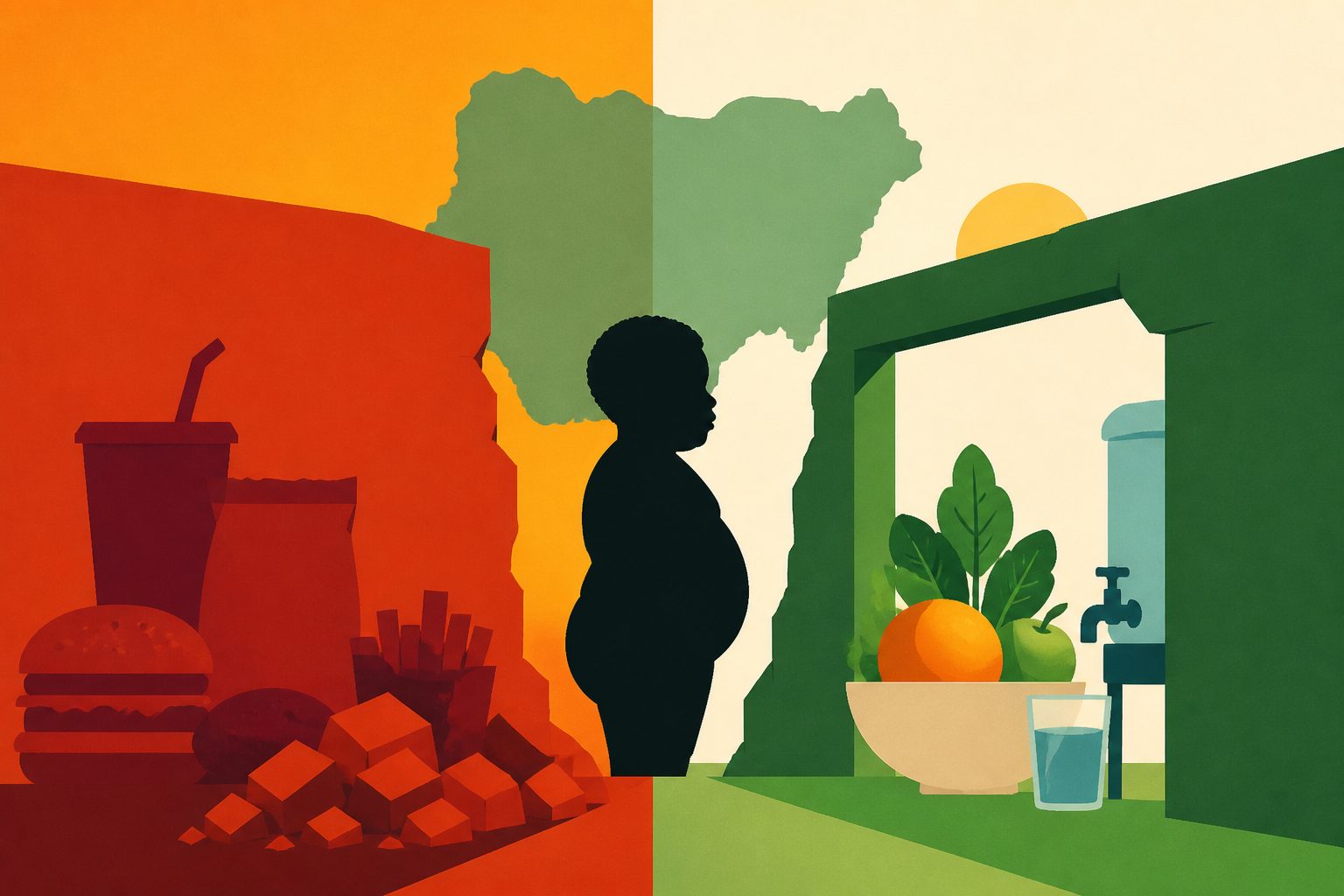
Editorial illustration — not from the study.
Researchers searched seven academic databases and other sources for English-language studies published from 2014 through 2024. After screening 1,595 records, they included eight studies and combined their findings thematically.
The review identified physical activity, dietary restriction, limiting screen time, drugs and herbal remedies among the reported approaches. Physical activity and dietary changes appeared more helpful when adherence was high, but the review did not establish that any single strategy works for all children or families in Nigeria.
What the review examined
The researchers asked which strategies have been used to control childhood obesity in Nigeria and what social, cultural and economic factors affect their implementation. They conducted a systematic review of studies involving Nigerian settings, searching CINAHL, PubMed, Cochrane, Medline, ScienceDirect, Scopus, PsycNET, Google Scholar, ResearchGate and reference lists. The search covered English-language publications from 2014 to 2024. Of 1,595 records screened, eight studies met the inclusion criteria. The included research used quantitative, qualitative and mixed-methods designs, and the researchers assessed study quality with a checklist before conducting a thematic synthesis.
What the review concluded
Five types of strategies were identified: physical activity, dietary restriction, screen-time restriction, drugs and herbal remedies. Physical activity and dietary changes were reported most often and appeared beneficial in settings where adherence was high, although the review does not show that these effects were consistent or causal across all included studies.
Implementation was reported to be affected by parental compliance, school environments, sedentary patterns in private schools, limited recreational space, insecurity, urbanisation, high-calorie diets, parents' work demands, socioeconomic conditions and cultural beliefs that view larger body size positively. The review concluded that approaches focused only on individual behavior are unlikely to be sufficient without support from families, schools and broader policies.
Where this may apply
The findings may be most relevant to children, families, schools and policymakers in Nigeria and to settings with similar social, economic, cultural and environmental conditions. They should not be assumed to apply equally to every Nigerian community or to children in other countries. The review reports findings from previously conducted human studies, not a new trial, and it does not establish that any listed strategy is effective or appropriate for an individual child.
Why it matters
The review draws attention to conditions surrounding children and families, rather than treating childhood obesity as an issue of individual choices alone. It suggests that efforts in Nigeria may need to account for school settings, access to safe recreational space, food environments, family time and cultural beliefs. Because the review synthesised a small and varied set of studies, it provides context for policy and research discussions rather than a definitive comparison of interventions.
Limitations & evidence assessment
Only eight studies were included, despite screening 1,595 records, so the available evidence base was small. The studies used different quantitative, qualitative and mixed-methods approaches, which limits direct comparison, and the abstract does not provide detailed results for each study or enough information to independently judge their quality. The review searched only for English-language publications, so relevant research in other languages may have been missed. Its thematic synthesis can identify reported patterns and barriers but cannot by itself establish that a particular strategy causes changes in children's weight or health. The abstract also does not report whether the included studies had control groups, how long participants were followed, or how outcomes were measured.
Why this evidence level: This is a systematic review, which can provide a broad view of existing research. However, it included only eight studies, used different study methods, and the abstract provides limited detail about the quality and results of the individual studies.
Evidence levels are editorial estimates derived from study metadata — they are not clinical appraisals.
This systematic review examined randomized human trials of concurrent chemotherapy and radiation for locally advanced head and neck, cervical, esophageal, and non-small-cell lung cancers. Across the included trials, combined treatment was reported to provide better overall survival than radiation alone, but it also caused more severe short-term side effects. The review did not provide enough information in its abstract to show how many trials or patients were included.
Researchers pooled results from seven human studies comparing multiple-staged with single-stage removal and reconstruction of congenital melanocytic nevi, sometimes called congenital moles. Staged surgery was associated with fewer major wound complications and recurrences, as well as slightly shorter and narrower scars, but the studies did not find a clear difference in cosmetic or overall patient satisfaction.
A cluster-randomized human study in 210 adults with recently detected stage 1 hypertension in Uzbekistan compared salt-sensitivity testing followed by assigned medication choices with conventional management. After 12 weeks, more participants in the testing-guided group reached the study's blood pressure target, although the study was small, short, and conducted in only three primary care centers.