Researchers used fish-viscera waste to grow purple sulfur bacteria in biofloc tanks, producing single-cell protein with antioxidant activity that supported Daphnia magna growth.
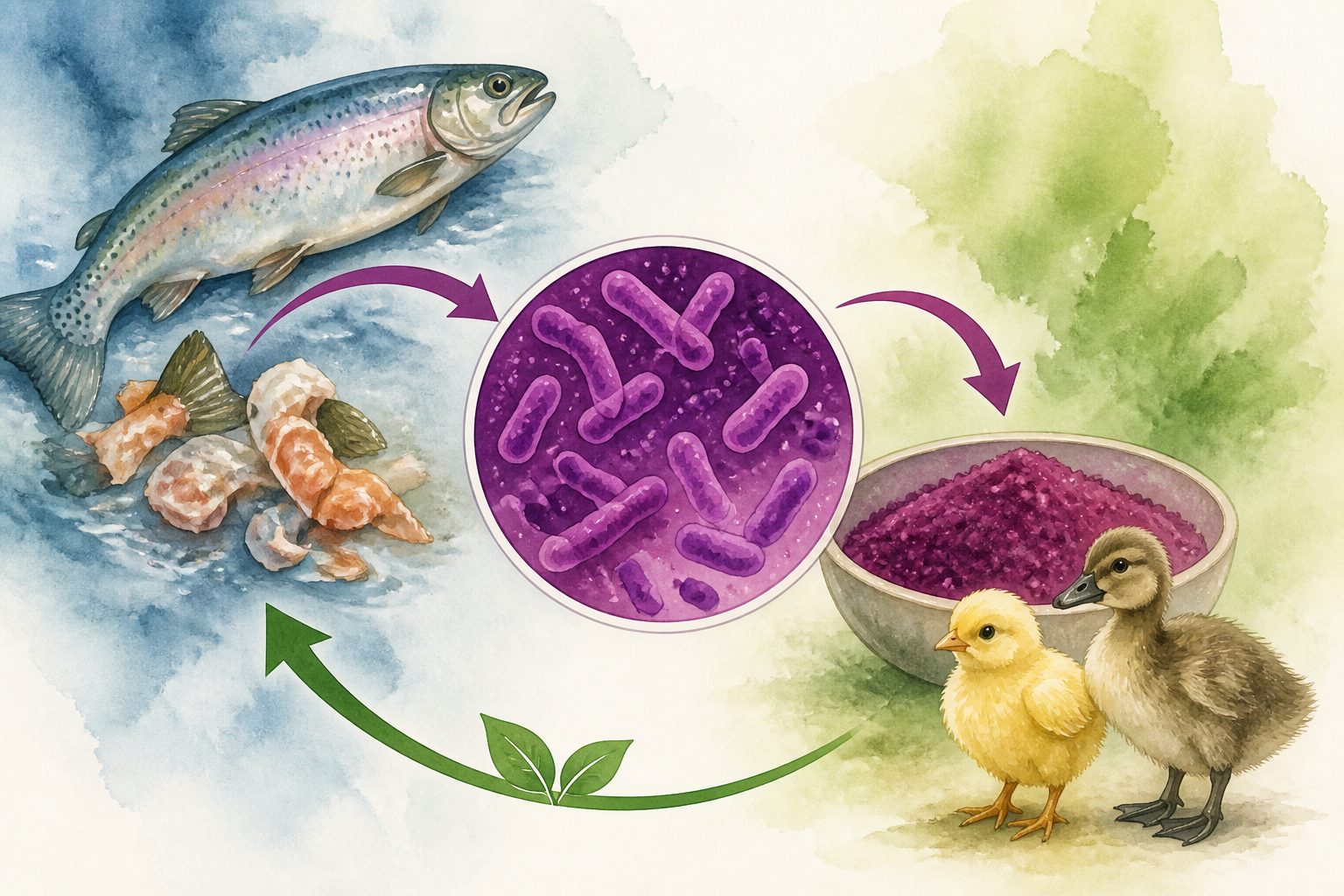
The researchers started with trout viscera, enzymatically broke it down into a nitrogen-rich fish protein hydrolysate, and used it to feed purple sulfur bacteria in biofloc systems. They tested different carbon-to-nitrogen ratios and different harvest times, then analyzed the resulting single-cell protein for nutrition, antioxidant activity, and safety.
They also ran a preliminary feeding trial using Daphnia magna, comparing the single-cell protein to commercial fishmeal and yeast-based single-cell protein. The study reported that the best-performing conditions produced single-cell protein with strong antioxidant measures, a safety profile meeting regulatory thresholds, and water-quality improvements that reduced effluent discharge compared with a flow-through setup.
Protein quality, safety, and feeding results
- Trout viscera waste was processed into fish protein hydrolysate (FPH) using Alcalase® (pH 8.0, 55 °C, 3 h, enzyme-to-substrate ratio 1:100 w/w), which was then used as a nitrogen source for purple sulfur bacteria biofloc technology.
- Changing the carbon-to-nitrogen ratio (10:1, 20:1, 30:1) and harvest time (3 to 12 h) significantly affected the quality of the harvested single-cell protein (two-way ANOVA; P < 0.001).
- FPH after hydrolysis contained 78.85 ± 1.20% protein (dry weight) with a degree of hydrolysis of 17.65 ± 0.85%, and showed antioxidant activity (FRAP: 153.20 ± 4.10 µmol Trolox equivalents g⁻¹; DPPH scavenging: 79.55 ± 2.30% at 20 mg mL⁻¹).
- The best SCP condition reported was 30:1 carbon-to-nitrogen with a 12-hour harvest, producing SCP with 42.55 ± 1.35% crude protein, 15.85 ± 0.95% total lipids, and an n-3/n-6 ratio of 1.18.
- Antioxidant activity of the best SCP condition included H₂O₂ scavenging of 78.90 ± 2.15% and FRAP of 168.50 ± 5.20 µmol TE g⁻¹, with low lipid oxidation (TBARS: 0.22 ± 0.03 mg malondialdehyde kg⁻¹).
- The microbial community was high, with total heterotrophs at 8.95 ± 0.35 × 10⁹ CFU g⁻¹ and PSB at 6.45 ± 0.25 × 10⁹ CFU g⁻¹.
- Safety screening reported heavy metal levels within regulatory thresholds (Pb 0.12 mg kg⁻¹; Cd 0.05 mg kg⁻¹; Hg 0.02 mg kg⁻¹), histamine at 18.5 mg kg⁻¹, and no *Salmonella* or pathogenic *Vibrio* species.
- Water quality in the biofloc systems was stabilized (total ammonia nitrogen: 0.01 ± 0.00 mg L⁻¹; total suspended solids: 645 ± 35 mg L⁻¹), and effluent discharge was reduced by 70% versus conventional flow-through controls (*P* < 0.05).
- In a Daphnia magna bioassay, 40% dietary inclusion of the PSB-FPH SCP supported growth performance and survivability comparable to high-grade fishmeal and outperformed yeast-based SCP (P < 0.01).
- An economic analysis projected a 25% reduction in protein ingredient costs at commercial scale.
- The authors state the approach could replace 30–50% of conventional fishmeal in larviculture diets based on their results and optimization.
Turning waste into usable aquaculture protein
Aquaculture waste is produced at large scale, and fishmeal is under pressure as fish stocks decline. This study links a wastewater-style feedstock (trout processing by-products) with a protein product made by purple sulfur bacteria, and it reports antioxidant activity, safety screening, a Daphnia feeding result, and reduced effluent discharge in the tested systems.
Lab evidence, with animal and scale limits
This is a laboratory and experimental study reported in a peer-reviewed journal (Scientific Reports). The evidence includes chemical and nutritional analyses of the protein product, measurements of water quality during cultivation, microbial counts, safety tests (heavy metals, histamine, and pathogen screening), and a small feeding bioassay using Daphnia magna.
Limitations include that the feeding trial was with Daphnia magna (not fish larvae), and the study does not provide details in the abstract about the number of animals, duration, or how directly fishmeal replacement was tested in larviculture feeding. The work also includes economic modeling, but the abstract describes it as a projected ingredient-cost analysis rather than a full field-scale cost trial.